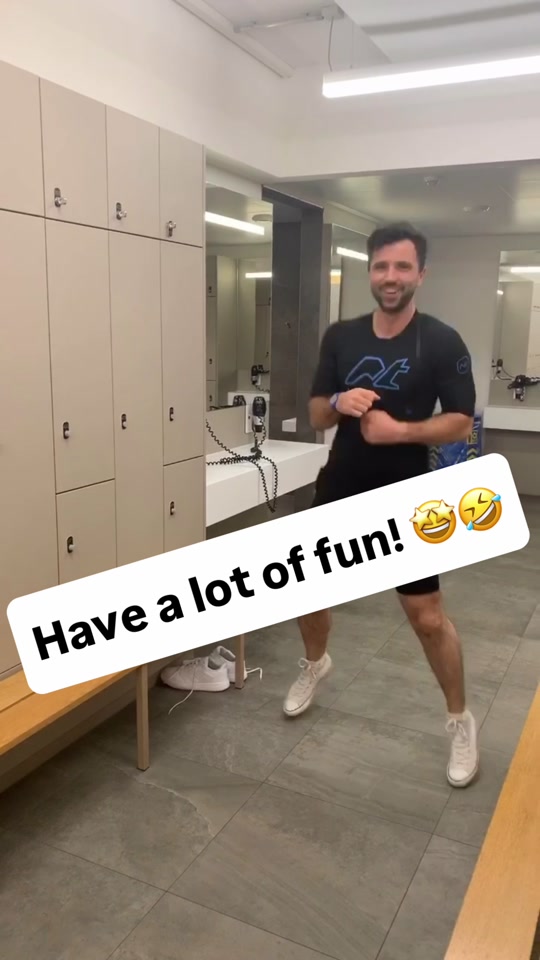
In the video, I am dancing in a changing room. Lockers, a bench, a mirror. Seven seconds, and a simple line across the screen: have a lot of fun.
The caption asks for the number-one personality trait for a good life. My answer is deliberately loud. It is a personal vote for playfulness, not a ranking of human beings.
I want room for enjoyment inside an ordinary day. Before the perfect holiday. Before everything is finished. Before I become so respectable that a little dancing feels like a threat to my dignity.
Adult playfulness can be very ordinary
Here is what I mean by playfulness: being willing to find a little enjoyment, curiosity or humour in what is already in front of you. It does not require being the loudest person in the room.
You can be quiet and playful. You can enjoy a drawing, a game, an absurd question, a song. You can laugh with someone without turning them into the target of the joke.
That is close to what I meant in being childlike without giving up responsibility. There is room to take your commitments seriously and still enjoy being alive. The two can fit inside the same person.

What the research actually supports
A randomised online study of 533 participants tested three one-week playfulness exercises against a placebo activity. The researchers reported increased playfulness and short-term benefits for well-being. That supports a modest idea: playfulness can be practised. It does not establish the best personality trait for life, or promise lasting happiness for every person. The outcomes came from participants’ self-reports. ¹
I like the smaller question this leaves us with: could I give enjoyment a little more space today?
Ten minutes is a place to start, not another target
Suppose you choose ten minutes a day for something you enjoy. Over seven days, that is 10 × 7 = 70 minutes, or one hour and ten minutes. Twenty minutes a day becomes 140 minutes, or two hours and twenty minutes.
Those are examples of a schedule, not instructions from the study. There is no happiness score attached to either bar. You do not owe anyone twenty minutes of cheerful behaviour.

Pick something small enough to fit the day you actually have. Put on a song. Invite someone to a game. Give your curiosity a little time without asking it to produce anything useful.
At the end of the week, ask one plain question: did I enjoy any of that enough to do it again? If the answer is no, change the activity. This is not a test you have failed.
My walking reset gives a different kind of small beginning. The useful connection is permission to begin before life is perfectly arranged.
And if today is heavy, let it be heavy. Enjoyment should not become another performance demanded of you.
The video is only seven seconds. I do not need it to prove a grand theory. I want it to leave one little door open in the day.
The song is already playing.
Sources and calculation notes
-
¹ Proyer, Gander, Brauer and Chick, original study abstract, published online in 2020; journal issue 2021. Self-report evidence, not a ranking of life outcomes.
-
Time examples are editorial arithmetic: 10 × 7 = 70; 20 × 7 = 140 minutes. No effect size or treatment schedule is inferred. Source data.
-
The opening uses the visible scene, caption and on-screen message. Background music is not quoted or treated as the creator’s speech.
-
Original video and thumbnail: Eduard Luta on TikTok. Published 2026-09-25. Research checked 25 September 2026.