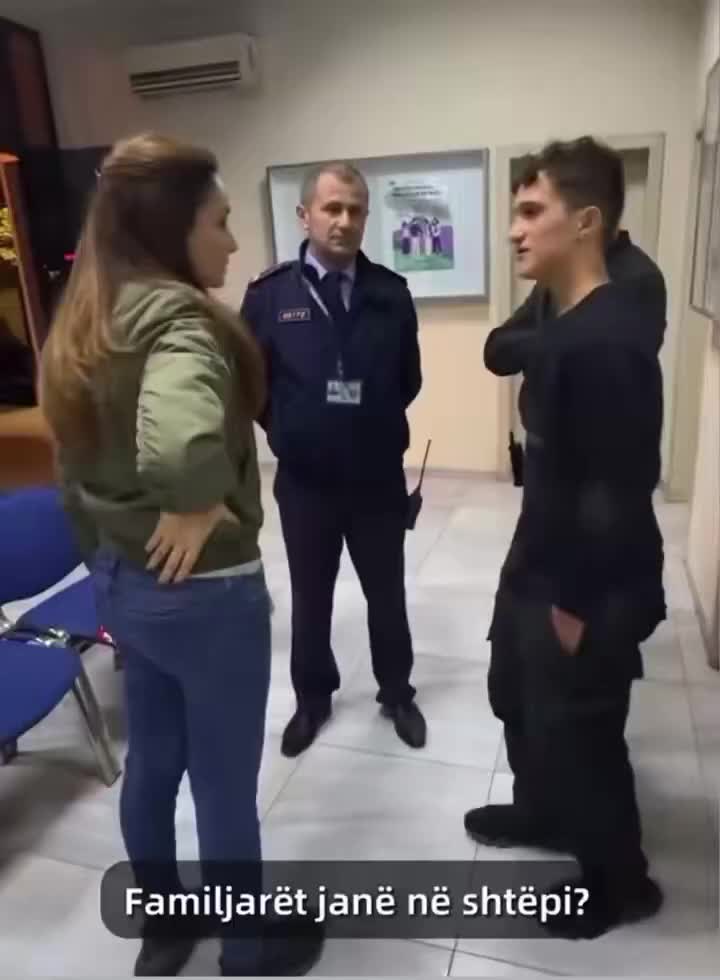
“Nuk jam djalë i keq.” I am not a bad person.
That is the line I keep coming back to in the video I shared. A young man is speaking to a woman indoors, with officers nearby. He describes being without economic assistance or work and struggling to keep the household going. Later, he says he grew up with hardship. Near the end comes another sentence: he does not want to hurt anyone.[1]
Before we turn a person in a protest video into a political label, can we hear what he is actually saying?
The caption I wrote was about work, dignity and the chance to build a life. Those words deserve something more useful than a sympathetic comment followed by the next video.
What this video lets us hear
The young man’s statements are his account. This excerpt does not give us his benefit application, employment history or household records. It does not establish why assistance is absent, whether an application was refused, or whether he meets a programme’s conditions. The original filming date and precise setting have not been independently verified; 18 October 2026 is the date of my TikTok post.
That distinction matters because we can listen without pretending to have completed an investigation. We can also recognise a difficult situation without deciding, from a short recording, everything that happened before the camera started.
What is visible is a conversation. What the subtitles give us is a person explaining hardship and asking to be understood. His dignity does not depend on our ability to verify every detail of his life in the comments. Any specific allegation or eligibility decision still needs evidence.
In the article about Tirana’s kiosks, I argued for taking both people’s losses and public decisions seriously. The same discipline belongs here: concern for a person and care with the facts can exist together.
Work is more than a vacancy
When someone speaks about keeping a home going, “find a job” is not a complete response. A practical conversation would ask what work the person can do, what opportunities are reachable, and what gets in the way. Travel costs, working hours or care responsibilities are questions to explore, not facts I can assign to this young man.
The International Labour Organization’s idea of decent work combines earning opportunities with rights, protection and a voice in working life.[2] It gives us a broader way to assess an offer than the existence of a vacancy alone.
In Albania, Article 49 of the Constitution protects the freedom to earn a living through lawful work a person chooses or accepts, including freedom over profession and vocational qualification.[3] It is not evidence that a particular vacancy is available to the person in this clip.
For a reader looking for a practical starting point, AKPA’s official employment portal lists vacancies, jobseeker registration and vocational-training services.[4] A service listing is a place to begin an enquiry; it is not a promise of placement. Ask which opportunities match your circumstances and what the next step requires.

Assistance and employment answer different needs
Someone may need help with today’s household expenses while also looking for work. Sending that person from one conversation to the other without addressing either is not a useful answer.
Article 52(2) of Albania’s Constitution addresses assistance, under conditions set by law, for people who become unemployed for reasons outside their control and lack other means of support.[5] Those conditions cannot be settled by watching this video.
The State Social Service describes economic assistance as support for eligible people and families in need. Its guidance directs applications to the local unit of residence and explains assessment and appeal routes. A refusal for insufficient points can be challenged, and a new application can be made in later months.[6] Check the current instructions and the actual decision for your circumstances.
For this young man, we do not have those records. We cannot turn “I have no assistance” into “this office unlawfully denied him assistance.” That would add a conclusion he has not supplied the evidence for.
What we can ask of an institution is a comprehensible answer: which request has been received, what information is needed, what was decided and where a person can seek review. An answer someone cannot use leaves the practical problem where it started.

Hear the grievance and keep the boundary against harm
The exchange includes a warning against violence. The young man says he does not want to hurt another person. Both parts belong in the story. Poverty should not be used to excuse harm, and a discussion of harm should not erase the person speaking about hardship.
Article 47 of Albania’s Constitution protects peaceful, unarmed assembly and participation in it, with procedures prescribed by law for public spaces.[7] This is the relevant general principle. The clip does not establish a legal verdict on the conduct of any participant.
I do not want to reduce him to an illustration for whichever side someone already supports. As with a viral clip that gets used to represent an entire community, one excerpt cannot carry all the conclusions we might load onto it.
The useful question after watching is small enough to act on: what would help this person take the next step? A clear employment contact. An explanation of an assistance decision. Someone who listens without making him perform his suffering again for an audience.
“I am not a bad person.”
A person should not have to begin there to be heard.
Sources and notes
- [1] Original video, posted 18 October 2026. Original uploaded file and embedded Albanian subtitles reviewed. Personal circumstances are attributed testimony; incident date, identities, eligibility and institutional wrongdoing are not independently established.
- [2] ILO: decent work.
- [3] Constitution of Albania, Article 49, School of Magistrates’ electronic commentary portal.
- [4] AKPA employment portal. Service information, not a verified vacancy match or successful application.
- [5] Constitution, Article 52.
- [6] State Social Service: economic assistance.
- [7] Constitution, Article 47. Sources checked 19 October 2026. Visuals are qualitative guides, not statistics or findings about this person. Evidence and limits.