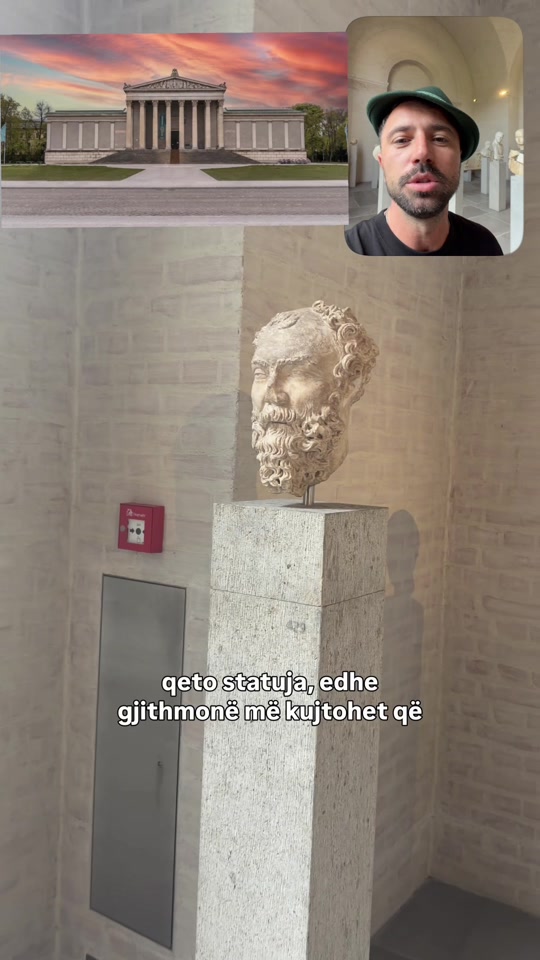
I am in Munich, at the Glyptothek, looking at statues. Faces in stone. People who lived long before us, still taking up space in a room we can walk into today.
In the video, I start asking what they achieved. Who changed something? Who wanted to be remembered? Who had a statue made for them, and who arranged it themselves?
Then I ask whether their children would have wanted statues made to remember them.
That thought brings the question into my own life: what would the people closest to us say about the person behind the achievements? That is the question I want to develop here.
What the museum can tell us
The Glyptothek holds Greek and Roman sculpture dating from the sixth century BCE to the fifth century CE. Its collection includes portraits of thinkers and rulers, as well as works made for religious, public and funerary settings. The museum itself was built in 1816–1830 to Leo von Klenze’s design.[1]
That context matters. A surviving sculpture is an object with a history; it cannot, by itself, tell us whether the person represented was a good father, an honest friend or a generous neighbour. I am using the encounter to ask a question about my own life, rather than judging an unidentified face in the gallery.
Success gives us more than one question
The caption asks who we become on the way to success. In the spoken video, that means ordinary responsibilities: being a good father, son and friend, keeping your word, and knowing when to say no.
These are difficult things to put on a pedestal. There is no grand ceremony every time somebody keeps a promise when it becomes inconvenient.
We can name a business result, an amount earned or an audience reached. Then we can ask about the conduct that produced it. Did we tell the truth? Who absorbed the pressure? Did the people beside us have a voice?

Ambition has a place here. Building something useful can create value for other people. The challenge is to keep examining what the work asks of us and what we are asking of others.
That is also the concern in my article about family values in everyday actions. A value becomes much more demanding when it has to describe something we actually do.
The part about ego
In the clip, I talk about noticing when ego is speaking and when the heart is speaking. I use those words to ask what is driving a decision.
Imagine choosing between two ways to handle a mistake at work. One makes you look blameless by leaving someone else with the problem. The other requires admitting your part and helping put it right. The useful question is what the choice protects: an image, a relationship, a responsibility?
And saying yes to everybody is no answer either. The video also mentions knowing when to say no. Keeping your word sometimes begins with refusing a promise you cannot keep.
Values need practice
There is an old philosophical connection here. In Book II of the Nicomachean Ethics, Aristotle connects character with repeated action, and distinguishes merely performing an act from choosing it deliberately.[2] It gives us a way to think about the connection between a value and a choice.
The practical question I take from it is simple: what does this value ask of me in the decision already in front of me?
Take reliability. There is a difference between calling yourself reliable and telling someone early that you cannot deliver what you promised. One concrete action might be to explain the problem, agree on a realistic next step and follow through. That example gives the value something we can return to and examine.

Choose one decision. Name the value at stake, choose an action, consider who will be affected, then return to what happened. If the action fell short, repair what you can. The point of these prompts is to bring the reflection back to something we can act on.
Why I mention Be The One
At the end of the video I connect this reflection to Be The One, the app I am building, and invite people to the beta community. The aim I describe is to help us reflect on our decisions and the person we are becoming.
The Be The One join page offers early-access registration and describes reflection features.[3] That is an invitation to a product in development. It does not establish that an app improves character or relationships. A tool can make room for a question; we still have to live the answer.
Back in the gallery, the question is no longer just how somebody’s name survived.
What will the people who live beside me remember of how I treated them?
Sources and notes
-
[1] Glyptothek: collection and building history, official museum source. The exterior inset in the original thumbnail shows the neighbouring State Collections of Antiquities. The sculpture’s sitter is not identified here.
-
[2] Aristotle, Nicomachean Ethics, Book II, sections 1 and 4, W. D. Ross translation. Paraphrased; the decision exercise is an editorial extension.
-
[3] Be The One: early access, checked 5 October 2026. Product description, not independent evidence of effectiveness.
-
Both diagrams are qualitative. No numerical comparison or calculation is claimed. Source and visual notes.
-
Original video and thumbnail: Eduard Luta on TikTok. Published 4 October 2026. Sources checked 5 October 2026.