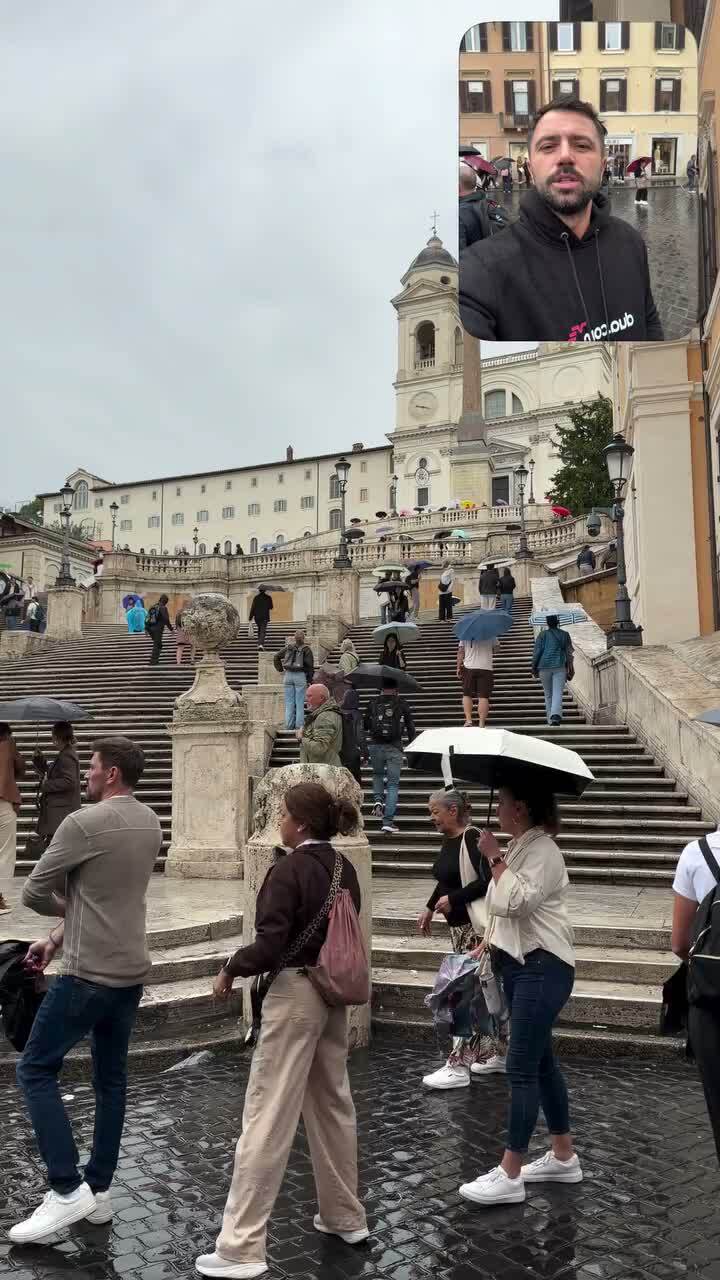
The stone is wet. Umbrellas move through the square, and the steps rise towards the church. I am at the Spanish Steps in Rome, talking about the question I have started carrying into places like this: what is the history here, and where do Albanians appear in it?[1]
Then a name brings the place closer: Albani.
In the video, I connect Pope Clement XI with the early plans for the staircase. An inserted card makes that early role explicit. The pleasure of finding the connection is real. Understanding exactly what it means makes the visit more interesting still.
What Clement XI actually contributed
Rome’s monument authority records a 1717 design competition called by Clement XI. It connects the project’s earlier development with French donor Stefano Gueffier’s 1660 bequest.[2] The architect named by the city’s tourism authority is Francesco De Sanctis.[3]
That separates three roles: promoting a project, designing it and helping finance its development. The Albani connection does not make the pope its architect or the family its sole builder or funder.
The Vatican identifies Clement XI as Giovanni Francesco Albani, born in Urbino, with his pontificate ending on 19 March 1721. John Paul II also recalled his Albanian origins in a 1993 audience.[4] His heritage and his role in the project belong in the history; neither needs to be enlarged into ownership of everyone else’s work.

In my narration, I give the familiar 1723–1725 dates. The official city account is more precise about the stages: construction 1723–1726, with a 1725 Jubilee inauguration under Benedict XIII.[3] An opening date and the completion of work can be different dates. The article keeps that distinction visible.
Clement XI’s papacy had already ended before construction began. Rome’s monument authority places the start under Innocent XIII and completion under Benedict XIII.[2] The connection is to an earlier planning initiative carried forward under later popes.
Why Spanish, with a French bequest and an Albani pope?
The name can make the history sound simpler than it is. Italy’s official tourism portal explains that Piazza di Spagna takes its name from the Spanish Embassy to the Holy See.[5] The name of the square is not a list of everyone who made the staircase possible.
For me, that is the interesting part. One place can carry several histories without one cancelling the others. I can recognise an Albanian connection and still name the Roman architect, the French bequest and the later papal stages accurately.

A national connection can be a doorway into the subject. It should make me more curious about the other people involved, rather than less interested in them.
Let the connection deepen the visit
Towards the end of the video, I say how much more enjoyable it becomes to learn Italian culture while finding a connection with our own. That is the feeling I wanted to share: the place stops being only a famous picture and begins to hold a story I want to understand.
A similar question runs through my visit to Palazzo Scanderbeg near the Trevi Fountain. A familiar name opened questions about a visit, a building and what actually survives. At Skanderbeg’s monument in Piazza Albania, a different location led into a different historical moment.
Here, I would keep three questions with the view: who proposed the project, who designed it, and which date refers to which stage? They are simple questions, but they stop the whole history being squeezed into one surname.
Nothing in this visit proves that a whole people created a monument. It gives me one specific connection worth following properly. That is enough to make the square feel different.
The umbrellas pass. The steps remain. I have another reason to look up.
Sources and notes
-
[1] Original video, shared 21 October 2026. Complete 85.051837-second owner-source audio, caption and timeline reviewed; original filming date not established.
-
[2] Rome’s monument authority: architect, bequest, competition and construction stages.
-
[3] Turismo Roma: 1723–1726 works and 1725 Jubilee inauguration.
-
[4] Vatican: Clement XI’s identity and pontificate; John Paul II, 28 April 1993, §2, recalling Albanian origins.
-
[5] Italia.it: Piazza di Spagna, for the square’s name. Sources checked 22 October 2026. Both diagrams summarise roles and dates, not national ownership.