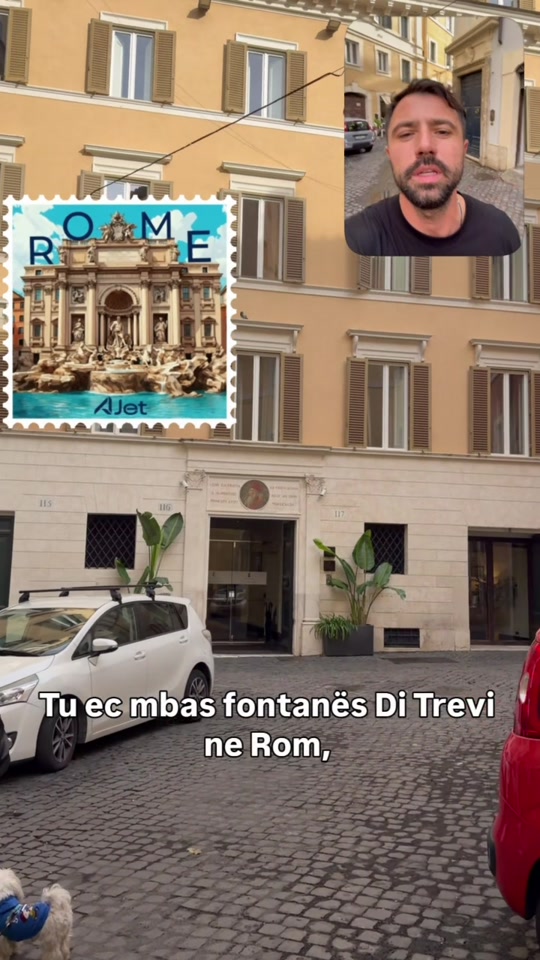
Walking behind the Trevi Fountain in Rome, I find myself in front of a building carrying a name I know immediately: Palazzo Scanderbeg.
The facade is ochre. There are shutters, an entrance and a small portrait above the doorway. In the video, I explain that I went inside to ask whether there were other surviving pieces connected with Skanderbeg. The answer I report points me back to that portrait.
A famous name can be everywhere in our minds and still surprise us on a wall.
Palazzo Scanderbeg and the Roman visit of 1466
The palace’s own history identifies it as Skanderbeg’s Roman residence in 1466. It also records an 1843 refurbishment, recalled by the inscription above the entrance.[1] That gives us a connection with his visit, while reminding us that the building we see has a history of alteration.
The wider setting matters. In the winter of 1466–1467, Skanderbeg sought support from Pope Paul II for the struggle against the Ottoman Empire. Jeton Omari’s University of Padua study reproduces contemporary diplomatic testimony about his presence in Rome in December and the continuing discussions in January.[2]
I talk about that search for help in the video. We often meet Skanderbeg as the figure who stands firmly on a horse, already certain of what comes next. A diplomatic visit introduces another side: having to persuade, negotiate and ask others to act.
That is a different way of looking at a hero. Strength does not remove the need for support.

What the portrait can tell us
The portrait makes the connection visible. It gives you a reason to stop, look up and ask why this name is here.
But a portrait over a door does not, by itself, tell us who painted it, whether it survives unchanged from the fifteenth century, or exactly which rooms a visitor occupied. The sources used here do not establish those details.
There is enough to explore without filling the gaps. The palace’s association with Skanderbeg, the record of his Roman visit and the later restoration belong to different kinds of evidence. Reading them together is more useful than treating everything on the facade as if it came from one moment.
My question inside was simple: what remains that connects us with him? It is a question worth carrying to other historic places too. Sometimes the answer is an object. Sometimes it is a name, a document or a building that has changed while keeping the association alive.
A palace, a square and a lane
The name extends beyond the doorway. Rome’s municipal topographic dictionary of 1927–1929 lists both Piazza Scanderbeg and Vicolo Scanderbeg in the Trevi district.[3] These are established place names, not just the name of today’s accommodation.
For finding the building, Rome’s official tourism registry gives Piazza Scanderbeg 117 and lists it as a guest house.[4] The exterior is the place to begin this visit; the listing does not present the interiors as a public museum.

The equestrian statue is elsewhere: Skanderbeg’s monument in Piazza Albania, by Viale Aventino. Keeping those two stops separate makes their histories easier to follow. The palace leads towards a fifteenth-century visit; the statue has a much later political and commemorative story.
A name I want us to follow further
Towards the end of the video, I return to a frustration: we do not tell enough of our history from our own perspective. Discovering these traces makes me want to understand more of the contribution, the relationships and the stories behind them.
That desire needs curiosity as much as pride. A building bearing Skanderbeg’s name is a starting point for investigation. It is not a reason to claim every story attached to it is already settled.
I felt a related connection when seeing his helmet in Vienna. Here in Rome, the encounter is smaller: a doorway and a portrait, close to a landmark everyone comes to see.
Look up. There may be a familiar name waiting above the door.
Sources and notes
-
[1] Palazzo Scanderbeg’s institutional history: residence associated with 1466 and refurbishment in 1843. This is the property’s historical account, not a medieval ownership deed.
-
[2] Jeton Omari, Scanderbeg tra storia e storiografia, University of Padua, 2013/2014, pp. 170–171: diplomatic testimony about the winter visit. It does not establish exact nights at this palace.
-
[3] Rome’s municipal topographic dictionary, 1927–1929, printed p. 313, PDF p. 157, records the square and lane.
-
[4] Turismo Roma: Palazzo Scanderbeg accommodation listing, for present use and address. Sources checked 15–16 October 2026. No room rate, museum-access promise or exact portrait age is asserted. Source and visual notes.
-
Original video and thumbnail: Eduard Luta on TikTok. Published 10 October 2026. Sources checked 16 October 2026.