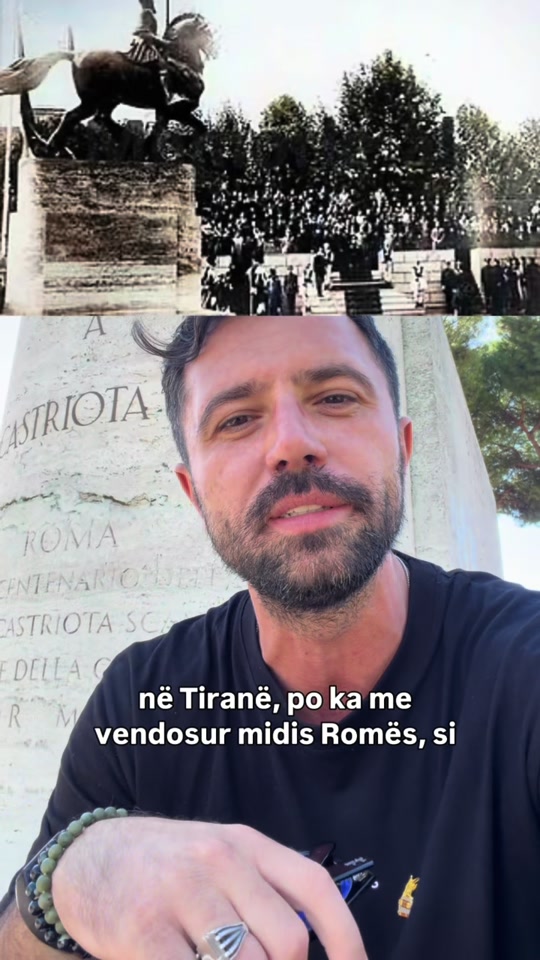
I am beside the Skanderbeg monument in Piazza Albania, Rome. A day earlier, I had visited the palace associated with him near the Trevi Fountain. Now here he is again, on horseback above me.
At the end of the video, I say that these two visits make me feel more proud, more Albanian, while I am in Italy.
But this monument has a difficult story. Its connection with Tirana is real; so is its installation under fascism. Understanding both gives the visit more meaning than a photograph alone.
The project began with Tirana in mind
The bronze is the work of Romano Romanelli. A commission under King Zog was intended for Tirana, and the surviving paperwork takes us beyond the short version of that story.
Albanian government documents reproduced by historian Shaban Sinani record negotiations in August 1938 and approval of a contract with changes that November. The planned location was the ministers’ square in Tirana.[1] Romanelli’s scholarly biography also connects the Tirana project with the monument later installed in Rome.[2]
That is different from saying a statue already standing in Tirana was taken away. The evidence establishes an intended destination. It does not establish the removal of an installed Tirana bronze.
Italy invaded Albania in 1939. Rome’s heritage authority connects the renaming of Piazza Albania with the annexation and records Mussolini’s inauguration of the monument in October 1940.[3][4] The language of unity surrounding that setting must be read against occupation. It was a political use of Albanian history, not simply a neutral tribute between neighbours.

What I see in the horse and rider
In the video, I focus on the contrast between the horse’s movement and the rider’s steadiness. I read control and determination into the figure.
That is my response to the sculpture. It is not proof of Romanelli’s precise intention, or an explanation of how every battle was won. Rome’s catalogue describes a horse moving at a walk, with Skanderbeg raising his sword.[3] The sense of force I felt does not depend on calling it a gallop.
A monument can make you feel something before you know its history. Then the history asks you to look again.
Rome and Tirana both return to 1468
The inscription on the Roman base belongs to another moment. The city added its commemorative text in 1968, marking 500 years since Skanderbeg’s death in 1468.[3] The inscription and the 1940 installation are therefore separated by 28 calendar years.
Tirana also commemorated that anniversary. Its municipality records the replacement of the Stalin statue with the Skanderbeg monument in 1968, a work by Odhise Paskali, Janaq Paço and Shaban Hadëri.[5] This is a different sculpture, not the Roman bronze returning home.
That comparison matters. The same historical figure can appear in different cities, under different governments, with different messages attached to him. A name on a pedestal is only the beginning of the explanation.

Two places to visit, two stories to keep separate
The equestrian monument is in Piazza Albania, by Viale Aventino. Palazzo Scanderbeg near Trevi is a separate stop. One leads into the memory of a fifteenth-century diplomatic visit; the other into twentieth-century commissions and commemoration.
Together they gave me the feeling I describe in the video: our history extends beyond the places where we usually expect to meet it. That also connects with seeing Skanderbeg’s helmet in Vienna.
I want other Albanians to come, look and discover more. There is enough here to feel pride without smoothing out the uncomfortable parts.
The more carefully we look, the more there is to discover.
Sources and notes
-
[1] Shaban Sinani’s archival investigation reproduces Albanian government documents dated 9 August, 17 August and 7 November 1938. Reproductions were inspected; the original archive files were not.
-
[2] Treccani: Romano Romanelli, Alessandra Imbellone, 2018, corroborates the Tirana–Rome project history.
-
[3] Rome’s heritage authority, for the sculpture, political setting and 1968 commemoration. Location and sculptor also appear in Roma Capitale’s conservation record.
-
[4] The city gives 27 October 1940; the Italian Foreign Ministry’s photographic catalogue, PDF p. 64, gives 28 October. The article uses October 1940.
-
[5] Tirana municipality: square and monument. Calculations: 1968 − 1468 = 500 years; 1968 − 1940 = 28 calendar years. Sources checked 15–16 October 2026. Source and visual notes.
-
Original video and thumbnail: Eduard Luta on TikTok. Published 11 October 2026. Sources checked 16 October 2026.