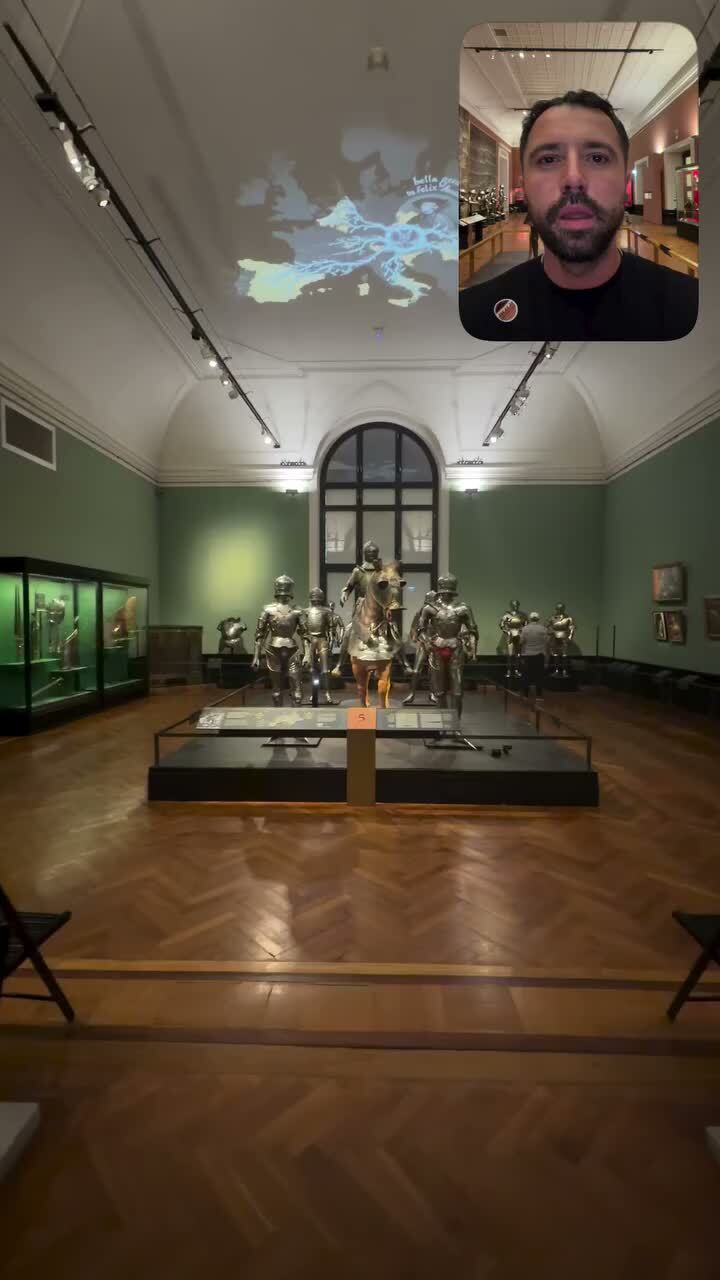
A horse and its rider stand among the suits of armour. I am looking around a museum room in Vienna, imagining what it would feel like if that metal were moving towards me. Then the camera turns to a long, curved weapon in a green display case. My mind goes straight to Skanderbeg.[1]
That is the movement in this video: from looking at armour to trying to imagine the person inside it. I react to the sword’s size and call it Skanderbeg’s. The museum record adds a distinction worth keeping: a weapon can have a historical association with his name without being established as something he used.
The sword and the museum label
The Kunsthistorisches Museum’s catalogue has a particularly relevant entry: a Kriegsmesser, a large single-edged weapon, inventory A 145. It lists a length of 150 centimetres, a weight of 3.20 kilograms, and a date of about 1490–1500. Its ownership field says “previously attributed to” Skanderbeg.[2]
The curved blade and long grip in my footage resemble that type. The small filmed label is not clear enough to read reliably, so I am not treating visual resemblance as a confirmed inventory identification.
The catalogue measurement does explain the scale I am reacting to: 150 cm ÷ 100 = 1.5 metres. That is the listed length of A 145, not a measurement I took through the glass. It says nothing by itself about the strength of a particular historical person.

A date changes the question
The museum gives Skanderbeg’s death as 1468.[3] Its approximate dating of A 145 therefore falls 22–32 years later: 1490 − 1468 = 22; 1500 − 1468 = 32. These are comparisons with the endpoints of an approximate catalogue range, not exact manufacturing dates or an authentication test.[2,3]
That is a good reason to preserve the catalogue’s qualification. I can be fascinated by the weapon without turning an old attribution into proven personal ownership.
There are other objects in Vienna connected with the name. The museum discusses a different sword, A 550, and a helmet, A 127, with a goat-head crest.[3,4] They should not be collapsed into one object because a caption says “Skanderbeg’s sword”. The goat-head helmet is not visible in this clip.

The museum traces the helmet’s recorded presence to an Ambras inventory in 1593.[4] That is a documentary reference in a collection. It does not let me reconstruct every earlier hand the object passed through.
Keep the imagination, then read carefully
The physical question in my narration is simple: how would I move, fight or even hold a weapon while wearing all that metal? I am reacting from the other side of the glass. I do not put on the armour, weigh it or test the sword.
I like that moment because history stops looking flat. There is a body inside the equipment. Someone had to see, breathe, move and make decisions in it. My imagined scene is a way into that question; it is not a reconstruction of a particular battle.
I explored the feeling of belonging in my earlier visit to Skanderbeg’s helmet. This clip takes me through the wider armour display. The Vienna walk carries another part of the same question: why does a place far from home sometimes make your own history feel closer?
For this room, I would keep the sequence simple. Look at the shape. Notice what it makes you imagine. Then read the inventory number, date and attribution before deciding what you know.
The imagination gets me to stop. The label gives me a reason to stay.
Sources and notes
-
[1] Original video, shared 22 October 2026. Complete 61.971202-second owner source, full Albanian audio/transcription aid, caption and visual timeline reviewed. Original filming date unestablished; small labels unreadable.
-
[2] KHM: Kriegsmesser, A 145: approximate date, 150 cm length, 3.20 kg and former attribution. Not confirmed as the filmed object.
-
[3] KHM: the Skanderbeg objects: death year and distinction between A 145 and A 550.
-
[4] KHM: helmet, A 127: crest and 1593 inventory. Sources checked 24 October 2026. Calculations: 150 ÷ 100 = 1.5 m; approximate date endpoints minus 1468 = 22 and 32 years. No armour-weight, horse-speed or combat-performance estimate.