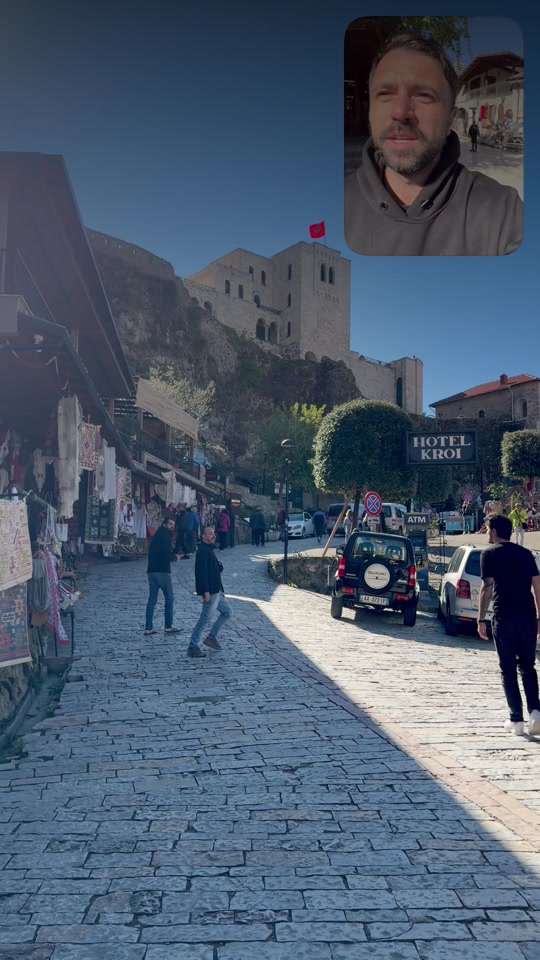
Walking towards Kruja’s castle, I share something that caught my attention: Skanderbeg’s defence of the place extended beyond its walls.
In the video, I describe a force inside the fortress and another outside, attacking Ottoman supplies and vulnerable points. It changes the picture. You look up at a castle and naturally imagine the people defending it from behind the stone. The surrounding roads and countryside also belong to the story.
This was the end of a journey that began in Vienna, with the helmet and sword associated with Skanderbeg. Reaching Kruja connected those objects with a place. Looking into the defence adds another connection: between the fortress and everything an army needed to sustain a siege.
A specific case: the siege of 1450
Kruja faced more than one Ottoman siege. To give the idea in my video a clear historical setting, this article focuses on 1450, when Sultan Murad II’s army besieged the fortress.
An account based on the Albanian Academy of Sciences’ encyclopedic dictionary describes a garrison under Vrana Konti inside Kruja, while Skanderbeg operated with forces outside. Those forces put pressure on the besiegers, including their supply routes.[1]
This is the distinction that interested me. Holding the fortress and operating outside it were complementary tasks. The garrison denied the besieging army its objective. Forces in the surrounding area made maintaining the siege harder.
The walls mattered. So did the connection between the walls and the country around them.
The cards below show these roles as a reading aid. They are not a reconstructed battlefield map, and the boxes do not represent troop numbers.

Follow the flour, not just the fighting
One useful detail comes from historian Luan Malltezi’s study of Venetian Albania and Skanderbeg. Discussing the 1450 siege, he records Venetian merchants supplying the Ottoman camp with flour and bread, and Skanderbeg attacking supply convoys. His account draws on documentary collections and also describes Venetian instructions to the authorities in Durrës to help the Albanians.[2]
That is a more complicated picture than two completely sealed-off sides. Merchants, coastal authorities, military forces and people moving goods could have different roles and interests.
It also makes the idea of supplies concrete. An army surrounding a fortress still needs to eat. Supplies have to reach it. A road carrying food can therefore matter to the outcome even when it lies outside the scene we usually picture as the battle.
This does not reduce the whole siege to one trick. A castle’s resistance, the outside forces and the political setting have to be considered together. The source evidence supports the importance of supply disruption; it does not give this article a reliable percentage showing how much each factor contributed.
Read the landscape with a wider question
The next time I look at a fortress, I want to ask more than how high its walls are. Where did people and supplies move? What could the defenders do from inside? What depended on forces elsewhere?
These questions are a way to read a historical account. They do not mean that a visitor can identify a fifteenth-century supply route simply by looking at today’s road. A route needs its own evidence. The bazaar and approach shown in the video are part of my present-day visit, not proof of where a particular convoy travelled.

From admiration to understanding
The Vienna stop gave us objects associated with Skanderbeg. The Kunsthistorisches Museum uses attribution and collection records to explain those objects.[3] Kruja prompts a different question: how was this place defended?
That question gives admiration somewhere to go. A celebrated name becomes connected with decisions, people and the practical problem of sustaining resistance. Vrana Konti and the garrison also belong in that picture; the story is larger than one person standing on a wall.
In my reflections on Vienna and Albanian identity, the journey is also about recognising a connection far from home. Here the pleasure is in learning a detail that changes how I see the place in front of me.
I arrived looking at a castle. I left thinking about what was happening beyond it.
Sources and notes
-
[1] The Beginning of the First Siege of Krujë, Albanian Heritage, reproducing information from the Albanian Academy of Sciences, Albanian Encyclopedic Dictionary, vol. 3 (2009), p. 2274. Used for the division between Vrana Konti’s garrison and Skanderbeg’s forces outside.
-
[2] Luan Malltezi, “Venetian” Albania and Scanderbeg, Studia Albanica, 2018/2, printed p. 87, notes 65–66. Documentary discussion of supplies and convoy attacks in 1450.
-
[3] Kunsthistorisches Museum: Skanderbeg, for the arms and their attribution. Sources checked 15 October 2026.
-
The diagrams explain roles and questions; they contain no reconstructed routes, troop estimates or casualty figures. The historical discussion is specifically about 1450 and is not applied to every siege of Kruja. Source and visual notes.
-
Original video and thumbnail: Eduard Luta on TikTok. Published 14 October 2026. Sources checked 16 October 2026.