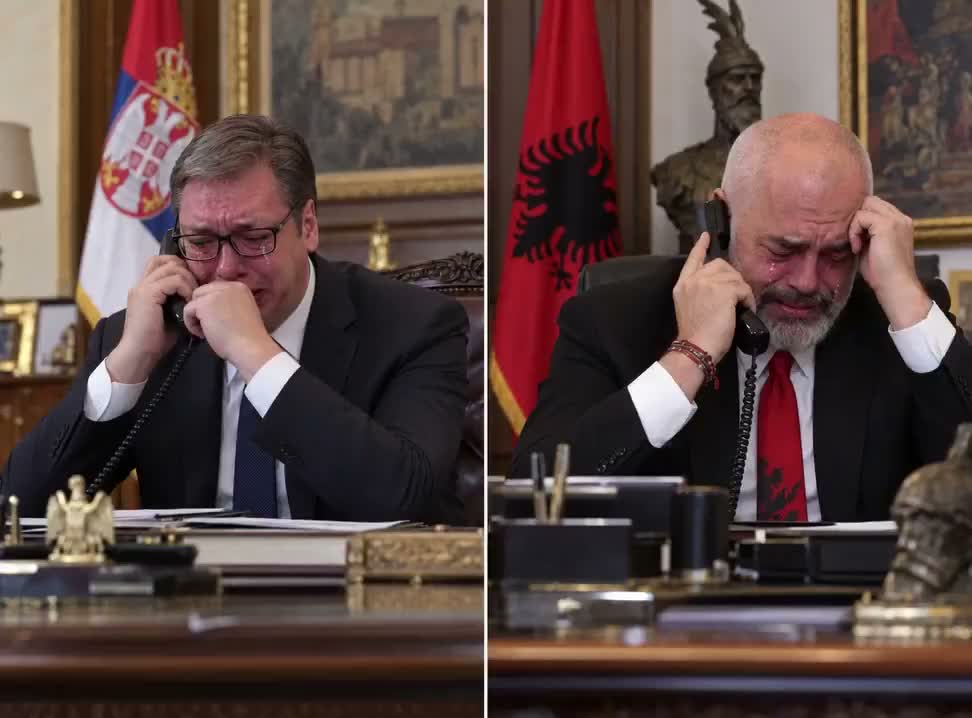
Two phones. Two desks. Rama and Vučić imagined in tears.
This is political satire: an imagined scene, not a recording that establishes a real call between them. The split screen turns the familiar image of powerful men in official-looking rooms into something deliberately ridiculous.[1]
My caption gives the joke its direction: do not underestimate the will of the people. The scene imagines power looking fragile. The message asks citizens to stop seeing themselves as powerless.
What the image can carry
The edit portrays Aleksandar Vučić and Edi Rama holding telephone receivers, their faces contorted as if crying. It stays with that scene. There is no crowd, protest or election result in these fifteen seconds.
That matters when the video leaves its original caption. A satirical image can carry a political judgment without becoming evidence that its subjects actually behaved that way. I want the label to stay beside it: political satire.
The caption’s claim that a united people cannot be silenced expresses conviction. It is not a measured prediction that every movement will win. Real people can face pressure, disagree with each other or fail to obtain the change they seek.
I still want to challenge the resignation beneath the opposite belief: that citizens can never matter and powerful people can never be questioned.
Give the people’s voice somewhere to go
The Universal Declaration of Human Rights links expression, peaceful assembly and political participation in Articles 19–21. Article 21 connects public authority to people’s will expressed through genuine elections.[2]
That gives my caption a more useful direction than simply waiting for the people in the picture to look afraid. Speak. Organise peacefully. Ask questions that deserve answers. Take participation seriously, including the right of another citizen to disagree.

For me, unity should not mean that everybody repeats one person’s opinion. It should mean that people can stand together for a principle without surrendering their own judgment. A citizen’s dignity cannot depend on whether they flatter the person at the desk.
That is the thread connecting this joke to the follow-up question in public life and the difference between wealth and freedom in Rama’s earlier words.
The imaginary call lasts fifteen seconds. The serious question is what citizens can say, ask and do after the joke ends.
Let the powerful be the subject of the joke. Let people keep their voice.
Sources and notes
-
[1] Original post, shared 26 October 2026; source reviewed 27 October. The original caption explicitly labels it political satire. The complete 15.042-second owner source, its visual timeline and full-audio transcription aid were reviewed. No reliable dialogue transcript, real-call authentication, genuine-emotion claim or production-method attribution is supplied.
-
[2] United Nations, Universal Declaration of Human Rights, Articles 19–21. Checked 27 October 2026. The diagram separates the imagined scene, the caption’s political message and civic principles; it contains no statistics or claim about a particular event.