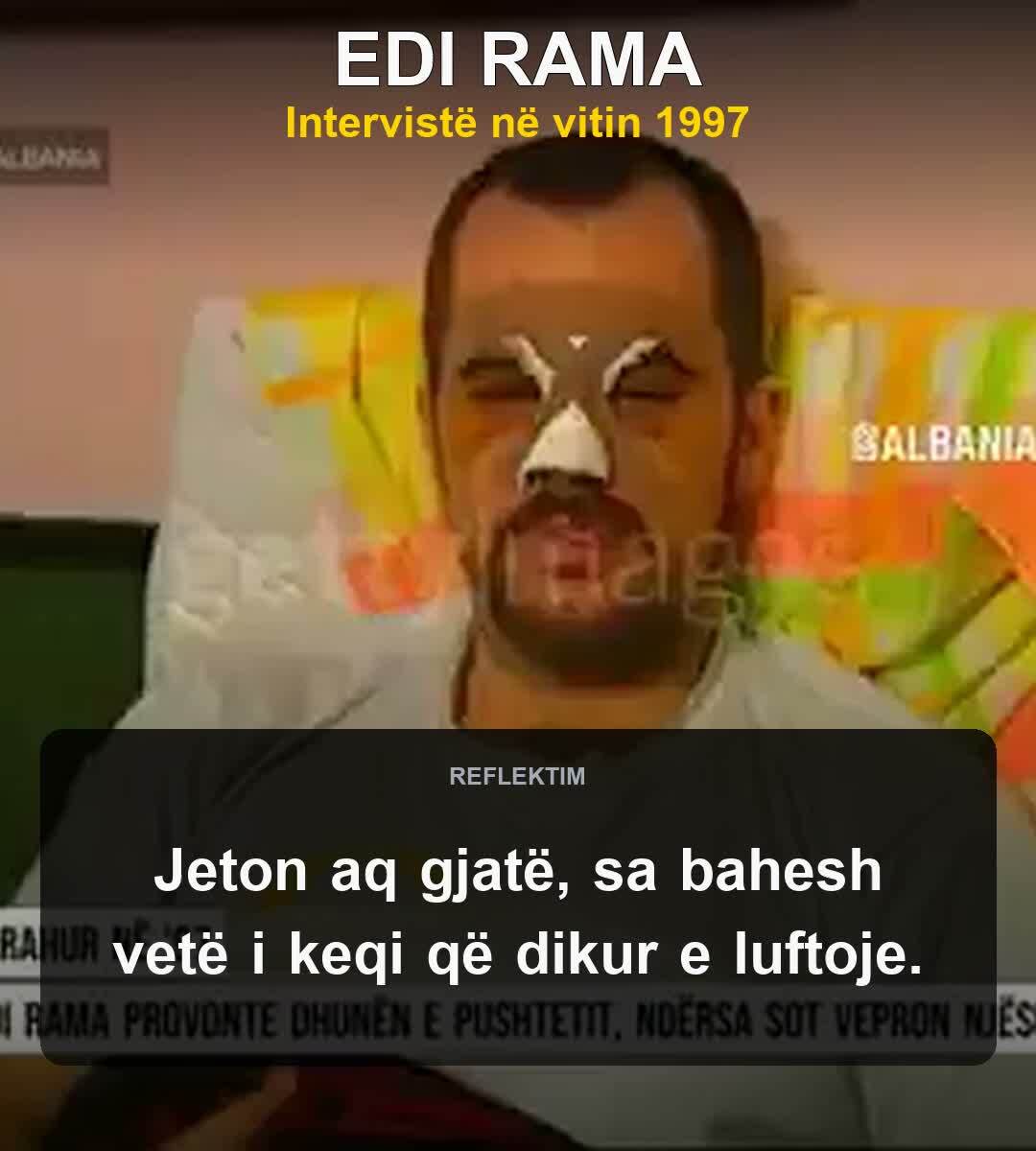
A bandaged face. A bed. A reporter’s narration. Then Edi Rama speaks about the illusion that “you can be rich without being free”.[1]
That is the sentence I wanted to bring into the present. The edit labels the interview 1997. My caption sets Rama against his earlier words and asks what happens when a critic gains power. That comparison is my political judgment. The useful test is the principle he states: wealth cannot replace freedom.
What the recording actually says
The English-language report introduces Rama as an artist and anti-government activist. Its narrator describes an attack and says Rama believes the masked attackers received orders from the ruling party. Rama then accuses those in power of manipulating elections and betraying their democratic beginnings.
Those are statements in this excerpt. The recording does not identify the attackers, establish the chain of command or supply the complete original broadcast. I am not treating the narrator’s account of Rama’s belief as proof of who gave an order.
The bandages make the scene hard to look away from. They do not make every accusation self-proving.
Put the dates beside the image
Human Rights Watch’s 1998 Albania chapter records that independent writer Edi Rama was seriously injured on 22 January 1997. It describes the assailants as unknown.[2] That supports a documented historical attack; it does not authenticate this excerpt’s exact filming day or original broadcaster.

ODIHR’s July 1996 report flagged violations of 32 of 79 election-law articles within its pre-election and election-day review.[3] These counts concern legal provisions, not ballots. They establish no current-election fraud rate.
The standard should survive the change of position
My caption makes a harsh comparison between the earlier critic and the later politician. I want the question underneath that comparison to remain precise.
Can a citizen criticise the people who govern? Can journalists persist with an uncomfortable question? Can people contest power through credible elections? A promise of greater wealth does not settle those questions.
The same test should follow a person from opposition into power. I should not applaud a principle when it is useful against someone else, then abandon it when it becomes inconvenient for someone I support.

That is also why the follow-up question matters in public life. An answer about prosperity can still leave an unanswered question about accountability. And police power must answer to the public, including citizens who disagree with the government.
This archive does not replace the evidence needed to assess any specific present-day allegation. It gives me a standard to ask about in the present. If I want to argue that someone has betrayed it, I owe the reader the relevant current facts as well.
For this video, I would keep his sentence in view and apply it consistently.
The words do not expire when the positions change.
Sources and notes
-
[1] Original post, shared 24 October 2026. Complete 31.000998-second owner source and visual timeline reviewed. Spoken report/interview: English; added captions: Albanian. The edit supplies the 1997 label; exact original broadcast and filming day remain unverified.
-
[2] Human Rights Watch, World Report 1998: Albania, Human Rights Developments. Attack date and unknown assailants; the report’s suspicion of secret-police involvement is not an established perpetrator finding.
-
[3] ODIHR’s 1996 election observation report, 26 May/2 June elections; 2 July 1996 report, p. 2. Checked 25 October 2026. Diagrams organise evidence, without measuring current freedom or proving a present allegation.