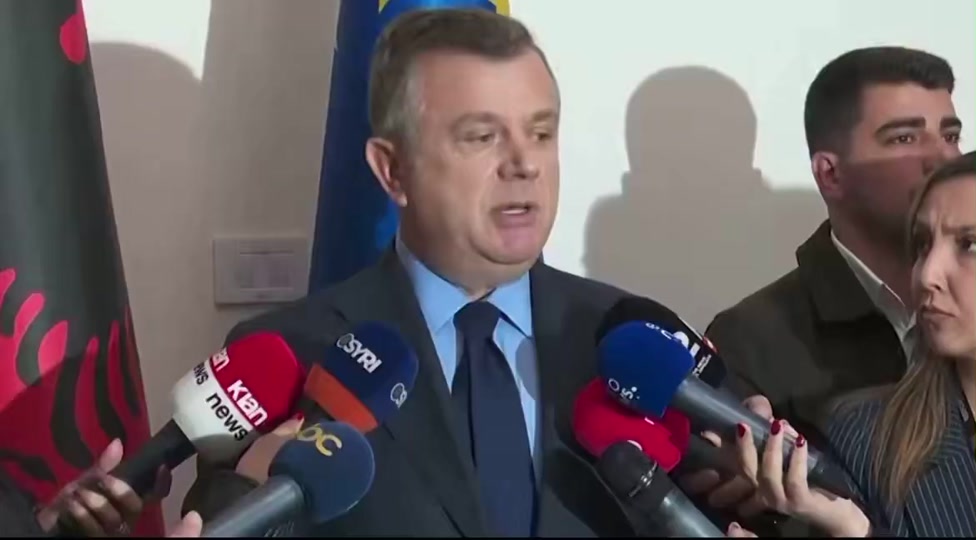
The room is crowded with microphones. Taulant Balla is speaking about violence against police. Ambrozia Meta brings the discussion back to allegations of police violence against minors.[1]
That persistence is what I praised when I shared the clip. My caption used the word burrneshë—an expression of admiration for her courage. It was praise for asking the question, not a claim that the video independently proves every allegation spoken in the exchange.
Keep the specific question in the room
Meta asks whether the alleged conduct has been condemned. Balla responds by referring to injured officers and an attack on a building. She presses again, challenging the account and later contrasting the protection of the Parliament leadership building with that of the Socialist Party building.
Those are claims made in a press exchange. The clip includes an edited inset comparing the two buildings, but it is not a complete incident investigation. I cannot establish a young person’s age, the circumstances of an injury or the full deployment of officers from this excerpt.
What I can examine is the structure of the conversation. A question about one alleged action is not answered simply because another serious action is mentioned.

Police injuries can deserve an answer. So can allegations about the force used against protesters. Discussing one does not make the other question disappear.
Journalism has a public audience
I was not in that room. I shared the excerpt because a journalist asking on camera can keep an issue available to people who cannot ask the official themselves.
UNESCO describes independent journalism as a public good that supplies factual information and serves a watchdog role.[2] That is a useful reference for the function of the question. It is not an endorsement of a particular reporter, outlet or allegation.
Admiration should still leave room for scrutiny. A reporter’s claim needs evidence too. The standard I want is that the answer and the follow-up both make the disputed conduct clearer, rather than allowing the exchange to become a contest of personalities.
A direct answer leaves something to check
If an official disputes an allegation, which part is disputed? What record supports the response? If an investigation is mentioned, who is responsible for it and what can eventually be made public?
These questions are my editorial test for a useful response. They are not facts established about any inquiry in this clip.

It is close to the point in police pay and conscience: an institution’s public duty cannot be settled by a speech alone. And in the Ahmetaj–Report excerpt, an accusation needed the replies and records around it.
The original recording date of this exchange has not been independently established here. My sharing date is 20 October 2026; I would not use it to label the footage as a new event or merge it with a different confrontation involving the same journalist.
I wanted to recognise the refusal to let the question be carried out of the room before it had been addressed.
A microphone records a response. A follow-up asks whether it was an answer.
Sources and notes
-
[1] Original excerpt, shared 20 October 2026. Exact 56.029751-second uploaded source, complete audio and eight-frame timeline reviewed. Speaker identification follows the supplied source and matching visible exchange. The allegations, injury descriptions, building-security comparisons and original event date are not independently established. This is the indoor Balla press exchange, not a separate protest/Guard incident.
-
[2] UNESCO: Journalism as a public good. General context for journalism’s public-information and watchdog role. Checked 21 October 2026. Visuals are editorial readings and questions; no audience statistic, legal ruling or reporter performance score is implied.