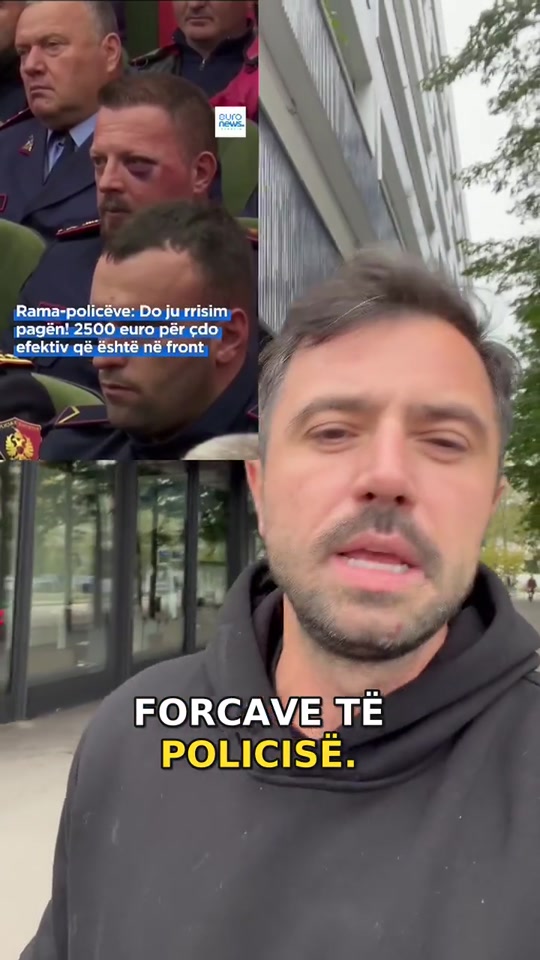
I had just watched Edi Rama speaking to the police. In the video, I say I did not know whether to laugh, cry, feel relieved or get angry.
The question behind that reaction was simple: what happens when a government answers a crisis of trust with more money for the people enforcing its decisions?
My caption put it bluntly: you can raise a salary, but you cannot buy a conscience. An officer does not stop being part of society when the shift begins. That is the argument I wanted to make.
First, get the €2,500 figure right
The official transcript of Rama’s 19 October 2026 speech distinguishes an immediate €2,500 amount for officers on that front from a separate salary increase promised for 1 January. It does not establish a €2,500 monthly salary or prove payment. [1]
That distinction matters. A bonus, a recurring wage and an announcement are different things. Mixing them together makes it harder to question the actual decision.
My objection was about what money can achieve in a confrontation between the state and its citizens. Better pay does not, by itself, answer a complaint about injustice. It also does not tell us what any individual officer thinks.
An officer serves the public
In the clip, I argue that officers can share the frustrations of the people protesting: they live with the same institutions and may face their own difficulties. I also predict that more pressure will make more people question what is happening.
Those are my political judgments. The video contains no survey of officers’ views, and it cannot establish that all officers share the same opinion or will act in the same way.
Albania’s police law requires a depoliticised institution, protection of rights, impartiality and accountability. [2]

A payment cannot settle whether an officer’s actions were lawful. Neither can a political speech. A particular incident still needs its own evidence and assessment.
This connects with the question in my article on the person behind a protest: can we still see the human being once someone has been reduced to a role?
Give a complaint somewhere concrete to go
A public accusation is stronger when it identifies the action being challenged. Which incident? Where and when? What does the full recording show, including the moments before it? These are useful questions before treating a short clip as the whole account.
Albania’s Police Oversight Agency, AMP, accepts complaints about suspected breaches by officers within its remit. Its published channels include a free telephone line and email. [3]

A complaint is a request for scrutiny. It is not a finding against an officer, and a published contact channel is not a promise of a particular outcome.
I want the demand for public accountability to remain clear after the anger of the moment. The state belongs to the people it serves. The uniform carries a responsibility to those people.
A conscience does not appear on a payslip.
Sources and notes
-
[1] Official Prime Minister’s transcript, 19 October 2026. Announcement and salary increase are distinguished; payment is not verified here.
-
[2] Law 82/2024 on the State Police, Articles 4, 6, 7 and 32. Brief reference; no case ruling.
-
[3] AMP: types of complaints and contact channels. Phone 0800 90 90 and email ankesa@amp.gov.al checked on 20 October 2026. AMP describes its handling of complaints according to their content and importance; no outcome is assumed.
-
Source: Eduard’s TikTok post of 19 October 2026, its caption and the complete recovered video. Full-audio transcription was checked against original frames and visible Albanian captions. Claims about political motives, officers’ feelings and future reactions remain opinion; other political comparisons in the clip are not adopted as verified findings. Sources checked 20 October 2026.
-
Original video and thumbnail: Eduard Luta on TikTok. Published 19 October 2026. Sources checked 20 October 2026.