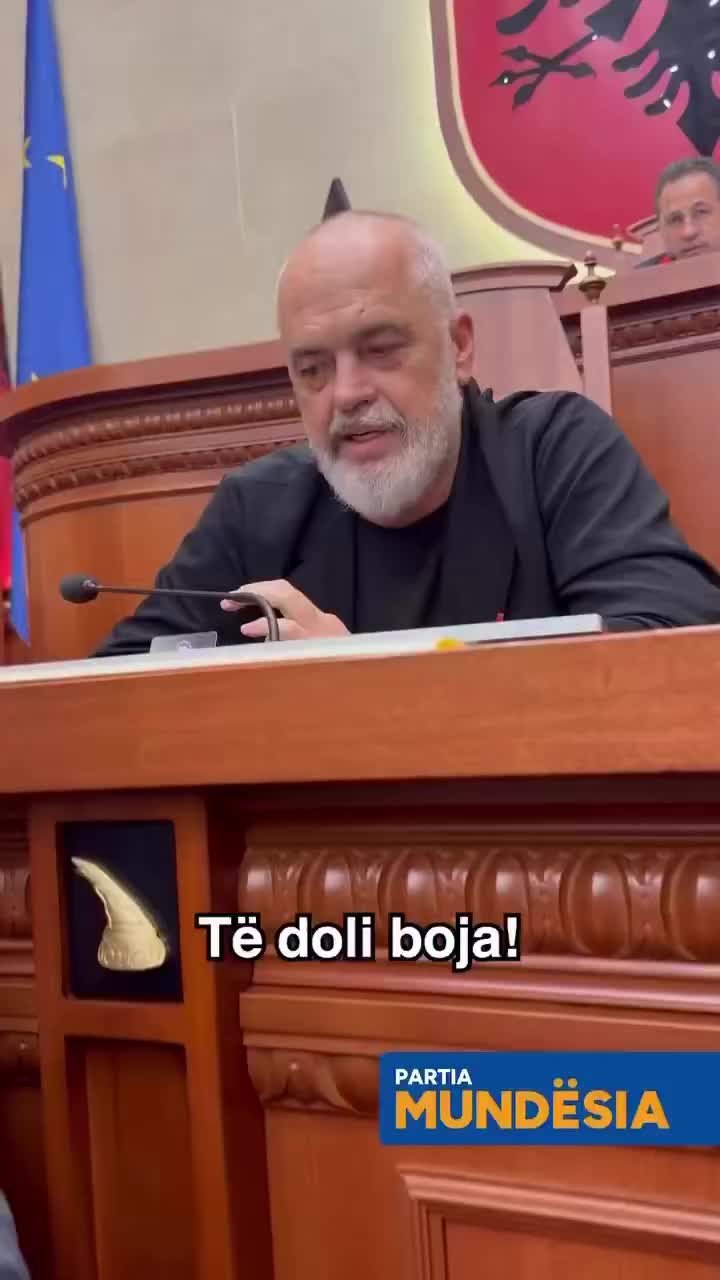
I said it in the caption: I do not know Agron Shehaj personally. I shared the clip because the directness of the confrontation gave me motivation. Someone was standing in front of power and demanding an answer.
The video shows a heated parliamentary exchange with Edi Rama. Shehaj accuses him of benefiting at citizens’ expense, challenges his account of responsibility and says he will have to answer before justice. Rama pushes back, asking what he has stolen. These are accusations and responses inside a political confrontation. [1]
The camera is mainly on Rama while Shehaj’s voice is heard. That matters when a still image travels without the audio: the man prominent in the thumbnail is the person being confronted.
The part that mattered to me
My frustration in the caption was with a familiar pattern: politicians blame one another, while responsibility seems to keep moving out of reach. I wanted to share the courage to interrupt that pattern and ask for an account.
Shehaj’s own biography identifies him as a member of parliament and leader of Partia Mundësia. [2] He is a political participant. Praising the force of this moment does not establish that every accusation he makes is true.
I want the demand for answers to survive after the clip has stopped being shared. What decision is being challenged? Who authorised it? Which record supports the allegation? What does the person accused say in response?
Those questions give anger somewhere useful to go.

What would an answer contain?
A serious answer should let people inspect something: a decision, a contract, a payment record, an explanation that can be checked. If the documents contradict the allegation, that belongs in the account too. If they raise further questions, those questions deserve a response.
This is the same concern behind my writing about Sazan, public interest and documents. A public argument becomes more useful when people can see what is being decided and on what basis.
The excerpt does not supply a complete evidence file or a court decision. Albania’s Constitution protects the presumption of innocence until guilt is established by a final court judgment. [3] Demanding political accountability and claiming to have proved a crime carry different responsibilities.
The demand has places to go
Information, peaceful assembly and parliamentary scrutiny all have a place in the Constitution. [3] They matter because accountability needs ways to keep a question alive beyond one heated exchange.

The visual describes constitutional provisions. The video alone does not establish that a formal parliamentary question or interpellation was initiated in this exchange, or whether a particular obligation was met.
I shared the clip as part of a call to raise our voices and demand better. That also means staying with the detail after the first burst of emotion: reading the records, hearing the response and noticing when the question has still not been answered.
A public office should come with the expectation that you will explain what you have done with it.
Sources and notes
-
[1] Panorama, report of the matching exchange: secondary corroboration of the speakers and confrontation; the article does not independently prove its allegations. No original session date is asserted here.
-
[2] Agron Shehaj, official biography: first-party identification of his parliamentary and party roles, not independent evidence for the accusations.
-
[3] Constitution of Albania, official IDP-hosted text, Articles 23, 30, 47 and 80. The visual is a brief summary; the provisions and applicable procedures govern their use. No finding of criminal guilt is asserted.
-
Original source: Eduard’s TikTok post of 18 October 2026, its caption and matching parliamentary video, visibly credited to Agron Shehaj/Partia Mundësia. This is the repost date. The full audio was checked through transcription alongside the original frames; unclear wording is not quoted. The first visual is an editorial evidence checklist, not a case assessment. Sources checked 19 October 2026.
-
Original video and thumbnail: Eduard Luta on TikTok. Published 18 October 2026. Sources checked 19 October 2026.