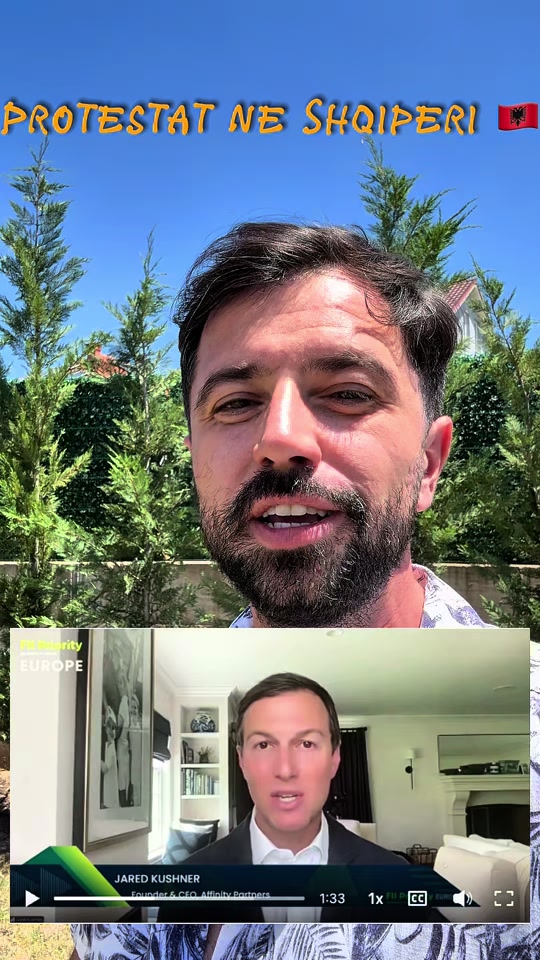
In my 14 June video about the protests in Albania, I am trying to understand how a relationship began. I recount an interview in which Jared Kushner describes a holiday, a boat and meeting Edi Rama. The concern is about access: when powerful people meet informally, how does a country know the decisions that follow serve its citizens?
The video expresses strong suspicions about motives. Those suspicions are not findings of corruption. Neither a family name nor a private introduction establishes wrongdoing. The part that can be tested is the path from an introduction to a public decision.
The meeting and the decision are different evidence
The inset in the original cover is labelled FII Priority Europe, with Kushner identified as Affinity Partners’ founder and CEO. The organiser’s 2025 programme places his session in Tirana on 17 May. That helps identify the event context; it does not independently verify every detail of my retelling.
There is also a direct account from Rama. In a Reuters interview on 8 June 2026, he said he met Kushner and Ivanka Trump when their group stopped in Durrës to refuel and have dinner. He defended the investment as beneficial to Albania. This is the prime minister’s account and position, not an independent assessment of the deal.
A meeting can explain access. To assess the use of public assets, we still need the documents that specify what was agreed.
What the official Sazan record says
AIDA’s published Decision No. 11 of 30 December 2025 refers to strategic status granted on 30 December 2024 to the Sazan resort proposal by Atlantic Incubation Partners LLC. It extends negotiation arrangements and assigns the Ministry of Defence the cost of clearing explosive hazards. Strategic status is not evidence that every final term has been completed.
Separately, AIDA’s response register records a 5 February 2026 reply describing the negotiating group and the ongoing process. These dated records provide a documentary trail; they should not be presented as a complete account of the project’s status today.

What an investment headline leaves out
A large investment number can combine private building costs, spending spread across years and assumptions about future demand. It does not, on its own, tell us what the public receives.
A serious assessment would set the contributed land and other public assets beside the state’s costs, obligations and enforceable return. Jobs need a definition: temporary construction work and permanent operating jobs are not the same claim. Environmental promises need measurable conditions and a responsible authority. Public access needs explicit terms rather than an attractive rendering.
The clearing-cost provision is a concrete reason to ask about the budget. The document identifies a public responsibility but does not, by itself, supply a final total that can be used here. Inventing that figure would make the article less useful.
Sazan and other proposed coastal developments also need to be distinguished. A condition or allegation concerning one site cannot simply be transferred to every project associated with the same investors.
A stronger way to ask for accountability
I want the debate to reach questions that can receive documented answers: what property is involved, how it was valued, which approvals apply, who pays each cost, and what happens if promised benefits do not arrive.
That does not require assuming that investment is automatically good or automatically corrupt. It requires a standard that applies regardless of who knows whom. Residents should be able to inspect the relevant terms and challenge them on their substance.
The video began with the origin of a relationship. The public-interest question continues beyond that first meeting: what, precisely, does Albania commit—and what does it receive in return?
Sources and calculation notes
-
Event context: FII Priority Europe 2025 programme, 17 May session. The organiser labels this programme a draft.
-
Rama’s account: Reuters interview transcript, 8 June 2026.
-
Documentary context: AIDA decision, especially points 5–6; AIDA response register, reply dated 5 February 2026. No final land valuation, contract value, corruption finding or net public return is inferred.
-
Original video and thumbnail: Eduard Luta on TikTok. Published 2026-06-14. Research checked 28 September 2026.