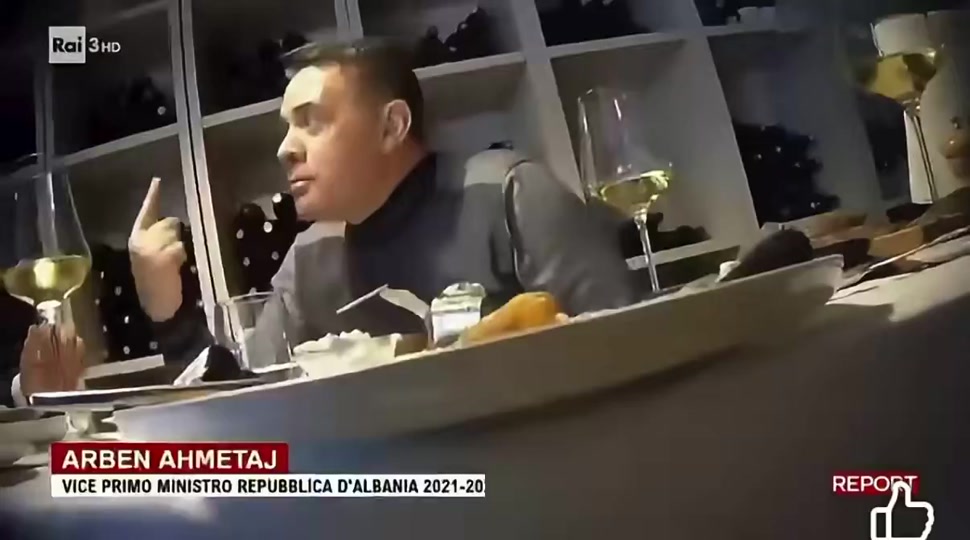
A restaurant table. Plates, glasses, a conversation that sounds much heavier than the setting around it.
The man identified on screen as former Albanian deputy prime minister Arben Ahmetaj is speaking to Giorgio Mottola. He describes what he alleges are connections between political power, criminal money and public decisions. When I shared this excerpt, I connected it to the anger behind protests in Albania. That is my political reading of the video. It is not a substitute for checking its claims.[1]
This is an excerpt from Rai3’s Report investigation broadcast on 2 June 2024. My TikTok post is dated 19 October 2026. A new post does not make the footage a new event. RaiPlay identifies the investigation as La campagna d’Albania, by Mottola.[2]
What Ahmetaj alleges in the excerpt
Ahmetaj says he raised concerns about cannabis cultivation in government meetings. He then alleges that criminal groups obtain public contracts through people acting on their behalf, and that construction is used to launder proceeds. He names Ergys Agasi as an alleged intermediary with Edi Rama and claims to have seen figures he describes as crime bosses at the government building.[1]
These are serious allegations. They are Ahmetaj’s account, not findings established by this article. The excerpt contains no contract file, bank records or judgment with which a reader could independently test them. His account of what another person said also remains his account.
Notice Mottola’s follow-up: he pushes for the place, the people and what Ahmetaj says he personally saw. That move matters. A broad accusation becomes more testable when it has specifics that can be checked.

The replies the short clip leaves out
The full programme continues beyond the extract. Its transcript records Rama rejecting the allegations. The Albanian Prime Minister’s Office also published his interview on 2 June 2024: he questioned the source’s credibility and insisted that accusations require proof.[3][4]
Rai’s studio summary separately records Agasi denying links with criminal groups. That response belongs beside the allegation. Rai also qualified the procedural position at the time of the broadcast; that dated caveat must not be passed off as a description of the situation today.[3]
A denial does not resolve a dispute. Nor does a confident accusation. Both belong in the record; neither should be silently turned into a verdict. This article explains this particular excerpt and its original context. It does not determine anyone’s guilt or offer a current case-status report.
The question behind a company name
One part of the conversation deserves more than a shocked reaction: the allegation that contracts can pass through people standing in for someone else.
There is a practical question here. Who actually owns or controls the company receiving public money? The Financial Action Task Force’s 2023 guidance calls for authorities to have accurate, current information on true owners and to combine information from different sources.[5]
That is general guidance, not evidence against the people in this video. But it explains why a company name on a document is only a starting point. An inquiry needs to connect the company, the decision and the money. Simply seeing a building go up tells us none of that by itself.
What I want to see after the outrage
For any specific contract raised in a controversy, I would want a clear account of three things: the selection, the people who ultimately benefit, and the work actually paid for. The visual below turns that into concrete questions. It is a guide to scrutiny, not a claim that we possess those records in this case.

The UN’s procurement model offers a relevant benchmark: transparent procedures, competition, objective decisions and a way for suppliers to challenge decisions. It is a model for legislation, not a ruling about an Albanian contract.[6]
The useful next question is therefore not simply whether a speaker sounds believable. It is whether the specific allegation survives contact with records, responses and independent examination.
My caption said the protests would not stop. That was a statement of conviction, not a verified forecast. The demand beneath it is accountability: people should be able to ask how decisions were made, who benefited and what public money delivered.
I explored the same need for documents in Sazan, investment and public trust. And in listening to a young protester, the starting point was the person whose frustration is too easily dismissed.
The conversation at the table matters. What happens to its claims afterwards matters just as much.
Anger should sharpen the questions. Evidence should decide the answers.
Sources and notes
-
[1] Original shared excerpt, posted 19 October 2026. Uploaded video checked against its audio, Albanian subtitles and Rai transcript. The caption’s hidden-camera description and the precise filming date were not independently established.
-
[2] RaiPlay: La campagna d’Albania, broadcast 2 June 2024.
-
[3] Rai’s full transcript, PDF pages 12–16. Includes the source conversation and omitted responses. No present-day legal status is inferred.
-
[4] Rama’s interview, official government transcript, 2 June 2024.
-
[5] FATF beneficial-ownership guidance, 10 March 2023. General context only.
-
[6] UNCITRAL public-procurement model, 2011. General context only. Figures are an editorial chronology and question guide; no corruption rate or financial loss is calculated. Sources checked 20 October 2026.