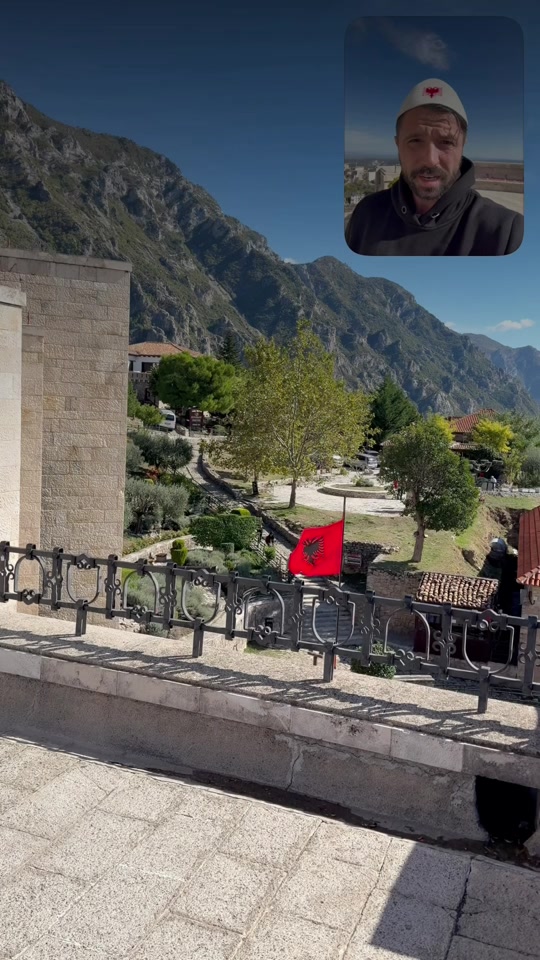
We began this Albanian journey through Europe in Vienna, where the arms associated with Skanderbeg are kept. In this video, we reach Kruja: the castle, the museum and the place where that history feels close again.
There is pleasure in the visit. I say so in the clip. Learning more about Gjergj Kastrioti Skanderbeg and seeing the history explained gives me something to take home.
There is also frustration. On the approach, I question the condition of the place and why more care is not being taken with the visitor’s experience. Both reactions belong in the same story. I can be moved by what Kruja represents and still want the arrival to feel better looked after.
From an object in Vienna to a place in Kruja
The two stops offer different ways into the same history. In Vienna, you can follow an object and the evidence attached to it. In Kruja, you encounter the setting and the story presented around it.
The Kunsthistorisches Museum’s catalogue dates the helmet attributed to Skanderbeg probably to the second half of the fifteenth century. It documents the object in the 1593 inventory of Ferdinand II’s collection at Ambras, then records its transfer to Vienna in 1806.[1] These dates describe the object’s documented collection history. They are not the dates of Skanderbeg’s battles.
That distinction makes a museum label more interesting. An object has a physical history and a history of attribution: what it is made from, where it has been recorded, and why it is associated with a person. Looking closely gives our attachment more substance.
I wrote about that earlier stop in Skanderbeg’s helmet in Vienna. Kruja brings another part of the journey into view.

The museum is a way of telling the history
The National Gjergj Kastrioti Skanderbeg Museum stands inside Kruja’s fortress walls. The Albanian Consulate General in Munich’s museum guide dates its inauguration to 1 November 1982 and describes a collection that includes both original objects and reproductions.[2][3]
That matters when we look around. The museum is a modern institution interpreting an older history. Its construction date and the age of the fortress are different things. A reproduction can help explain an event, while an original object can carry evidence from its own time. Clear labels help visitors understand which kind of encounter they are having.
In the video, I enjoy finding elements of this history explained. That is one reason to make the visit: to leave with more than a photograph of a famous name. A good explanation gives you a detail to remember, a connection you had missed or a question worth following further.
The visit begins before the entrance
My criticism in the clip concerns what I encountered on the way in. It is a reaction to this visit, not a survey of every day in Kruja or a measured assessment of its management.
But the question behind it is practical. If a place matters so much to us, what does that care look like when someone arrives?
Think about the whole sequence: finding the entrance, walking through the approach, understanding where to go and then reading the story inside. The visitor experiences those parts together. The museum cannot be separated completely from the space that introduces it.
This is why I return to maintenance when talking about public places. A place is experienced through the small things that someone keeps attending to. Clear directions, a cared-for approach and understandable explanations are useful priorities to examine. The cards below are prompts for that discussion, not findings from an inspection.

Pride can ask for better care
I do not leave the video without saying how beautiful the place is and how much pleasure the history gives me. The criticism comes with that attachment.
The trip began with Skanderbeg’s arms in Vienna and reached his story in Kruja. That connection is powerful. So is the simple thought that a place carrying so much meaning deserves attention in its everyday details.
When we invite people to encounter our history, the welcome begins on the way in.
Sources and notes
-
[1] Kunsthistorisches Museum: helmet attributed to Skanderbeg, A 127. Catalogue dating and collection history; attribution is preserved as attribution.
-
[2] Albania National Tourism Agency: Skanderbeg Museum, for the museum’s setting inside the fortress.
-
[3] Albanian Consulate General in Munich: museum guide, for the 1 November 1982 inauguration and original objects alongside reproductions. Sources checked 15–16 October 2026; no current opening hours or prices are asserted.
-
The comments on arrival and upkeep are my observations in the original video. The visitor prompts are editorial suggestions, not a condition survey. An unverified annual visitor figure spoken in the clip is not used here. Source and visual notes.
-
Original video and thumbnail: Eduard Luta on TikTok. Published 14 October 2026. Sources checked 16 October 2026.