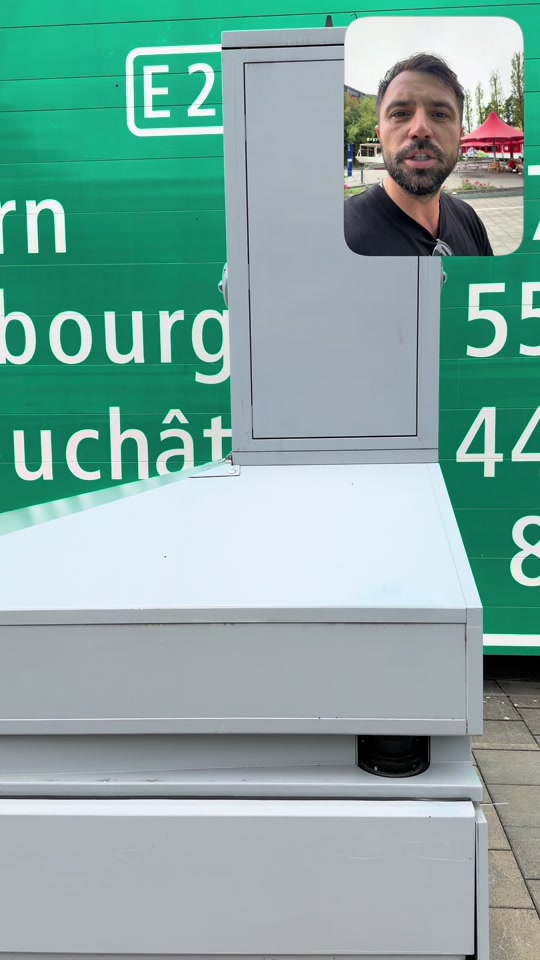
In the video, I point at a speed camera and ask a frustrated question. Our politicians travel through Switzerland, Germany and France. They see practical systems around them. Why is it so difficult to bring useful ideas home?
I connect the idea to safer roads and better police salaries, mentioning a target of at least €2,000 a month. That is an ambition in the clip. It is not a funded proposal. To make the argument useful, we need to separate the safety evidence from the money.
Start with the lives, not the fines
Kosovo Police’s 2025 annual report records 111 road deaths, compared with 97 in 2024: an increase of 14 people, or 14.4%. It also records 785,107 traffic tickets in 2025 and 9,037 police officers. Official annual report.

Those totals do not tell us which crashes a camera could have prevented. They also do not isolate the role of speed. They tell us that road safety needs serious attention, without pretending that one piece of equipment explains every death.
What the camera evidence supports
A Cochrane review found a consistent direction of benefit across the studies it examined: speed cameras were associated with fewer crashes and injuries. But study quality and differences between settings prevented a reliable single overall effect estimate. The review is from 2010; it is evidence to consider, not a ready-made forecast for Kosovo. Cochrane review.
The World Health Organization treats safe speeds as one part of a wider road-safety system, alongside road design, vehicles, road users and post-crash care. WHO road-traffic injury overview.
My proposal would therefore begin with dangerous locations, clear speed limits, reliable equipment, fair procedures and published evaluation. Measure speeds, serious injuries and deaths. Account for traffic volumes and wider trends. Do not declare success simply because the number of tickets increased.
Does the salary claim add up?
Paying 9,037 officers €2,000 per month implies 9,037 × 2,000 × 12 = €216,888,000 in annual salary payments. That is a total at the proposed salary level, not the extra cost of reaching it. We would need current pay, grades, allowances and employer costs to calculate the actual increase. This article does not establish them.
We can still test a clearly labelled hypothetical raise. An extra €500 per month for every one of those officers would cost €54,222,000 per year, before additional employer costs.

Now assume, only for illustration, that every ticket brings in €50 and is fully collected. Covering that €500 raise would require 1,084,440 collected tickets a year before any enforcement or administration costs. The €50 is an assumption, not Kosovo’s average collected fine or a statement of the legal tariff.
For scale, applying the same assumed €50 to all 785,107 tickets reported in 2025 gives €39,255,350 gross. That is €14,966,650 below the hypothetical raise. Existing tickets are not new camera revenue, and gross amounts are not net money available for salaries.
The arithmetic does not prove cameras cannot contribute revenue. It shows why the clip’s salary ambition cannot be treated as self-financing without a proper budget.
A safety policy should survive its own success
If drivers slow down and violations fall, a successful system may collect less money. Permanent salaries should not depend on continuing to catch a certain number of people breaking the rules.

I would want two public accounts: one showing what happened to road safety, another showing the full financial costs and receipts. Camera placement should follow the safety problem, not the easiest place to collect money. People need clear rules and a way to challenge mistakes.
This is the same discipline I wanted in the grocery-price comparison: take a strong reaction, check the inputs, and let the calculation change the claim where it needs to.
The useful idea in the video survives that scrutiny. Learn from working systems. Test them properly. Count the lives protected before celebrating the fines collected.
Sources and calculation notes
-
Inputs: Kosovo Police 2025 annual report, printed pages 6, 12–13. Officer count excludes civilian staff. Death counts describe people, not the number of fatal crashes.
-
Evidence: Cochrane, Wilson et al., 2010; WHO safe-system context. No foreign percentage reduction is applied to Kosovo’s deaths.
-
Scenarios:
9037 × 2000 × 12;9037 × 500 × 12;54222000 / 50;785107 × 50. Assumed pay changes and fine receipts are illustrative. No deduction for equipment, collection, appeals or employer costs; no claim that fine revenue is legally earmarked for pay. -
Original video and thumbnail: Eduard Luta on TikTok. Published 2026-09-20. Research checked 23 September 2026.