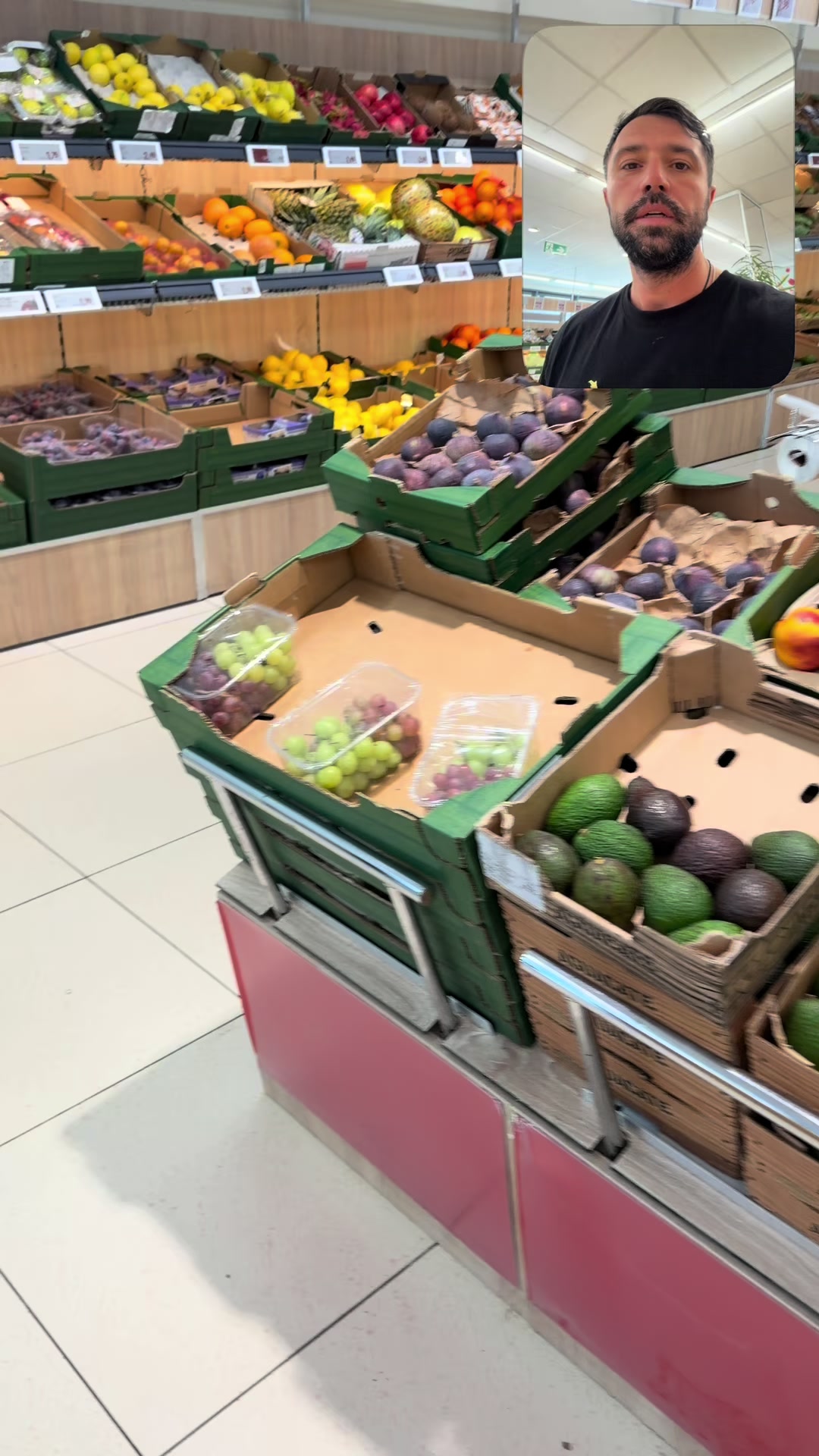
The question in my video is simple: how can everyday shopping feel so much easier in Germany when people back home in Kosovo earn so much less?
I am talking about the ordinary things you put in a basket. The choices available on the shelf. The difference between seeing a price and wondering whether you can afford it.
The caption says it bluntly: lower salaries, expensive essentials, and too many expensive brands. But a reaction in a supermarket deserves more than another reaction underneath it. It deserves some arithmetic.
Here is what the research shows: a small four-staple benchmark costs 24.7% more using Kosovo’s official observed prices than ALDI Nord’s listed prices. Relative to the published average net wages, it takes 5.42 times as much of a monthly salary.
This is a comparison of Kosovo’s August 2026 sampled prices with German discounter listings checked on 23 September 2026. It is a useful benchmark, with different brands, collection methods, and dates—not a measurement of every shop in either country.
First, put the salaries beside each other
For 2025, the Kosovo Agency of Statistics reports an average monthly net wage of €636. Germany’s Federal Statistical Office reports €2,761 in monthly net wages and salaries per employee, in its national-accounts table revised on 25 August 2026. Both figures are after the relevant employee deductions; neither is a median or a household budget. Kosovo wage report, Destatis wage data.

Divide €2,761 by €636 and you get 4.34. That difference matters before we compare a single product.
At exactly the same shelf price, a purchase already takes 4.34 times the share of the Kosovo average wage. For a price to consume the same share of these two wages, it would have to be about 77% lower in Kosovo.
That is why “but it is cheaper here” can miss what someone is trying to tell you.
Four things we can actually put numbers on
To examine the concern beyond the video, I used four straightforward categories: a litre of milk and a kilogram each of rice, wheat flour, and sugar. Every item in the basket has one of those quantities. It is a small comparison basket, not a weekly diet or a complete cost-of-living index.
The Kosovo observations come from the statistical agency’s August 2026 consumer-price report, Table 3. The German side uses ALDI Nord’s ordinary listed products: MILSANI whole UHT milk, BON-RI parboiled rice, BACK FAMILY Type 405 flour, and DIADEM refined sugar. Kosovo price table, ALDI milk, rice, flour, sugar.

| Item | Kosovo | ALDI Nord | Difference |
|---|---|---|---|
| Milk · 1 L | €1.25 | €0.95 | +31.6% |
| Rice · 1 kg | €1.74 | €1.39 | +25.2% |
| Flour · 1 kg | €0.81 | €0.59 | +37.3% |
| Sugar · 1 kg | €1.09 | €0.99 | +10.1% |
| Total | €4.89 | €3.92 | +24.7% |
The total is 97 cents higher on the Kosovo side. None of these four comparisons shows a threefold shelf-price difference. That matters: the wider claim in the caption should not become a statistic just because it sounds right.
There is another limit worth making explicit. The Kosovo table does not specify milk fat content, rice variety, or the same named brands. The German prices demonstrate a particular budget option. They do not establish Germany’s national average price for an identical product.
What they do give us is a transparent set of inputs. Now we can ask the more interesting question.
How much of a salary does that basket take?
The calculation is simple: basket price ÷ average monthly net wage × 100.
In Kosovo, €4.89 divided by €636 is 0.769%. In Germany, €3.92 divided by €2,761 is 0.142%. Dividing those unrounded shares gives 5.42.

Put differently: a €4.89 purchase against Kosovo’s average wage takes the same salary share as a €21.23 purchase against Germany’s average wage. The selected German basket costs €3.92. The €21.23 figure is an income-equivalent calculation, not a German shelf price.
That is the part a price tag cannot show you.
The caption’s three-times-higher-prices and three-times-lower-wages scenario would mathematically imply nine times the salary burden. That is a conditional calculation. For the particular evidence assembled here, the result is 5.42 times. It is already a substantial difference without stretching it.
Inflation does not tell the whole affordability story
Kosovo’s August 2026 release reports consumer prices 7.3% higher than a year earlier, with food and non-alcoholic beverages 2.6% higher. These are year-on-year changes within Kosovo, not price comparisons with Germany. KAS August 2026 report.

The distinction is important. Inflation tells us how quickly prices are changing. Affordability asks whether earnings can comfortably cover the prices that are already there. A lower inflation rate can coexist with a difficult weekly shop.
The choice on the shelf matters too
My caption also asks why expensive brands take up so much of the conversation. An affordable everyday option matters because you cannot choose a cheaper alternative that is not available to you.
The ALDI examples show what a budget range can look like. This research does not measure the availability of equivalent budget brands across Kosovo, and it does not establish why an individual importer or retailer charges a particular price. Competition, sourcing, scale, and product mix are questions to investigate—not explanations proved by four prices.
The standard I want is straightforward: everyday essentials, clear unit prices, and an affordable choice people can actually buy. A family should not have to turn every supermarket visit into a financial calculation.
What I wanted to say
This comparison cannot tell us that every household in Germany is comfortable, or that every product in Kosovo costs more. Rent, household size, remittances, other income, and personal circumstances all change the picture. National means also hide the people earning well below them.
But it does put numbers beside the frustration. The shelf-price difference in this small benchmark is about a quarter. The salary difference turns it into more than five times the share of earnings.
A price is only cheap if the person paying it can afford it.
Sources and calculation notes
- Video: original TikTok, Eduard Luta. The poster above is its original thumbnail. The four-staple research is an added comparison, not a transcription of every product shown in the clip.
- Earnings: KAS, Wage Level in Kosovo 2025, published May 2026; Destatis national accounts, revised 25 August 2026. Employee averages under different national methods; not a harmonised comparison of occupations or working hours. KAS changed its private/public-enterprise data source in 2025.
- Kosovo prices: August 2026 HICP report, published 10 September; Table 3, printed page 10. Country sample averages for the named categories.
- German prices: ALDI Nord’s milk range, rice, and flour/sugar range, checked 23 September 2026. Listed own-label prices, not national averages or guaranteed future prices.
- Arithmetic: shelf premium =
(4.89 / 3.92 − 1) × 100; relative wage burden =(4.89 / 636) / (3.92 / 2761); income-equivalent German price =4.89 × 2761 / 636. All calculations use the original values, with rounding only for display. Both countries’ quoted prices are in euros; no currency conversion is used. Mixing August/September price observations with annual 2025 wages makes this an indicative benchmark rather than a same-date household survey.