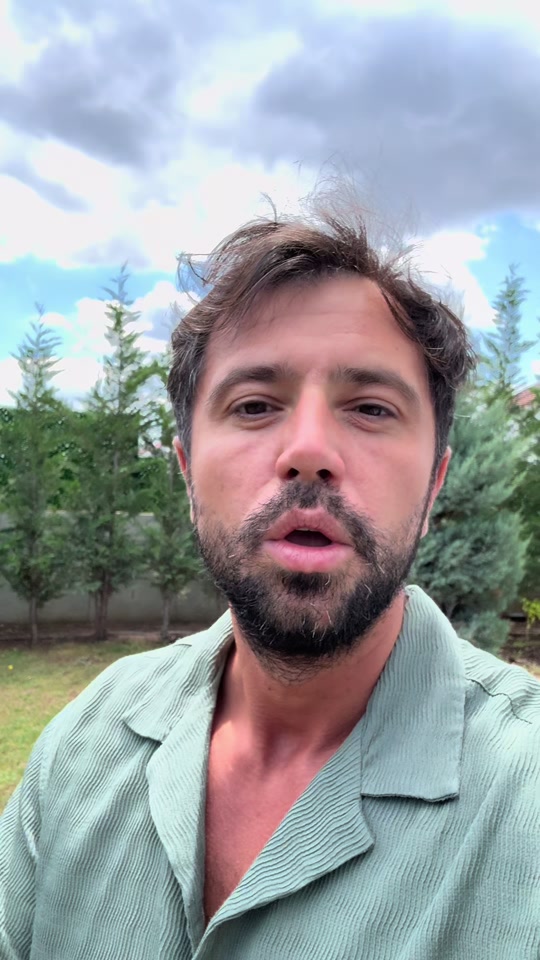
I am outside thinking about an expression I have used all my life: i zgjuar. We say it about someone who is clever. We also hear in it the language of waking up. In the video, that connection catches me with the force of something obvious that I had never properly noticed.
The lexical connection is real. The Albanian dictionary entry for zgjuar includes being awake and, figuratively, being quick-minded or clever.[1] My next step—connecting it with spiritual awareness and leaving autopilot—is an interpretation of that language.
A dictionary meaning and a personal metaphor
| Layer | What it means here |
|---|---|
| Literal sense | Awake, no longer asleep |
| Figurative sense | Clever or mentally quick |
| My reflection | Paying attention to habits and assumptions |
The first two belong to the word’s recorded meanings. The third is what the word prompted me to think about. A dictionary does not establish that successful people are spiritually awakened, or that a particular belief makes someone more intelligent.

In the clip I use images of a matrix, a dream and a body or mind as tools for living. They express my spiritual perspective. They are not evidence that the world is literally a simulation, or a reason to dismiss somebody who sees things differently as “asleep.”
What we can say about Albanian’s history
I also call Albanian one of the oldest languages. That broad ranking is not established by the video. A separate branch on a language-family tree does not tell us that a living language is older than all the others.
The University of Texas Linguistics Research Center describes Albanian as a distinct Indo-European branch. Its historical overview identifies the 1462 baptismal formula as the earliest unambiguous surviving attestation and Gjon Buzuku’s 1555 Meshari as the first larger text.[2] Those are dates of surviving written evidence, not the birth dates of spoken Albanian.
I can love the language without needing an unsupported first-place claim. The word in front of me is already interesting.
Make “waking up” an action
The useful challenge I take from the word is to notice where I act automatically. Am I repeating a judgment I have never examined? Am I calling something impossible before trying to understand it? Can I listen to a correction without treating it as an attack?
Those questions leave room for learning. They also keep the metaphor pointed at my own habits, where it can do some work, rather than turning it into a label for everyone else. My piece about thinking independently follows the same distinction.
A beautiful word does not finish the thinking for me. It can remind me to begin.
Sources and calculation notes
-
[1] FJALË: zgjuar, adjective senses 1–2. The everyday meanings are documented; the spiritual connection is my interpretation. No reconstructed etymology is asserted.
-
[2] Brian Joseph, Angelo Costanzo and Jonathan Slocum, University of Texas Linguistics Research Center: Introduction to Albanian, history and earliest attestations. Written documentation and a language’s ancestry are different questions.
-
Original video and thumbnail: Eduard Luta on TikTok. Published 2026-07-25. Research checked 27 September 2026.