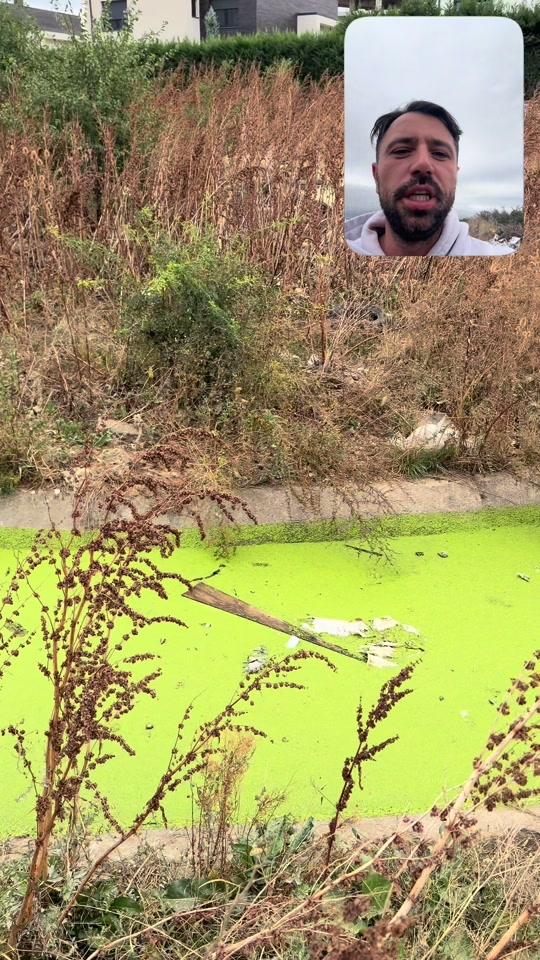
I pointed the camera at the green water in Çagllavicë, near Prishtina, and joked that I had found matcha. This is a nine-second joke about the colour of the water. There is no tea review hiding behind it.
But after the joke, a reasonable question remains: what are we actually looking at?
The honest answer starts with a limit. The video shows a green surface. It does not contain a water analysis, an identification of the organisms, or a verified explanation of where the colour came from.
A colour is a clue, not a laboratory result
The US Environmental Protection Agency lists discoloured water and surface accumulations among possible visible signs of cyanobacterial blooms. It also explains that visible blooms and toxin presence do not reliably track each other; confirming toxin levels requires laboratory testing.[1]
That guidance helps interpret the limits of an image. It does not identify this particular water as a cyanobacterial bloom. I cannot establish toxicity, sewage contamination or the source of a discharge from this clip.

This is where social media can make us careless. The observation is real, so the explanation we attach to it begins to feel real too. Soon somebody is repeating a diagnosis nobody actually made.
I would rather turn the image into a precise question: has this location been inspected, and are there any test results or official findings available?
Make the observation useful
A useful report would include the exact location, the date, the visible condition and a photograph taken from a safe position. Describe a green surface as a green surface. If there is a visible pipe, photograph its position without declaring what it carries. Ask the responsible local authority for an inspection or the existing findings.

A simple example of wording would be: “I observed green water at this location on this date. The attached photograph shows the condition. Has it been assessed, and which service can investigate?” This is a template for a future report, not a claim that I have already submitted one or received an answer.
If a place looks affected by a bloom, avoid contact with the water and keep pets away while checking local advice.[2] There is no reason to collect a sample yourself to make a social-media point.
The next step matters more than the caption
In my reflection on Switzerland, I talk about the ordinary maintenance behind places that feel cared for. This is the same question at a smaller scale: who notices a problem, who owns the response, and how does anybody know it was dealt with?
The joke got the colour across immediately. A useful follow-up would get us an answer.
Sources and calculation notes
-
[1] US EPA: visible signs and the need for testing. General guidance; no site-specific diagnosis is available in the video.
-
[2] US EPA: what you can do about harmful algal blooms.
-
Location follows the original narration. The diagrams organise observations and questions; they do not report measurements or an inspection.
-
Original video and thumbnail: Eduard Luta on TikTok. Published 2026-09-12. Research checked 23 September 2026.