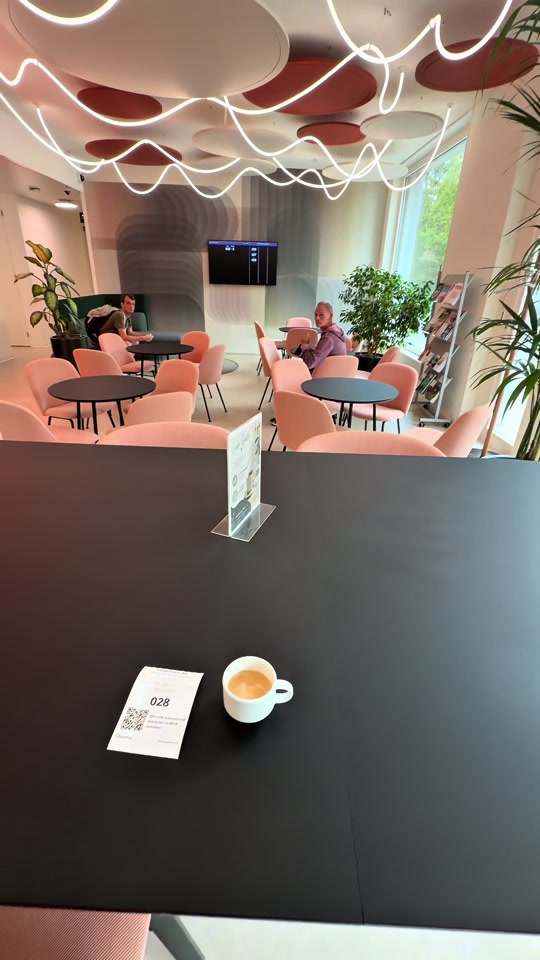
The Swiss scene in this video comes with a simple thought: imagine the peace of wanting things to be in order. A cared-for space changes what you expect from the next one.
I look at Switzerland and think about what we could build in Kosovo. That is an aspiration, not proof that one country has no problems or that another cannot change. A café is also not a national survey.
What I want to bring home is a more useful question than “why are they better?” Who keeps the standard alive after the opening day?
One example we can actually measure
SBB reported train punctuality of 94.1% in 2025, compared with 93.2% in 2024. Its definition counts a train as punctual when the delay is under three minutes. This concerns railway operations, not the café in the clip. SBB annual punctuality announcement and measurement explanation.

The improvement is 0.9 percentage points, not 0.9% of the earlier value. As a simple illustration, applying those rates to 1,000 measured arrivals gives 932 versus 941 punctual arrivals: nine more. The corresponding late share falls from 6.8% to 5.9%, a relative reduction of about 13.2%. These are scaled examples; they are not actual counts of Swiss trains.
A small movement near a high baseline still requires work. But it does not prove which maintenance action caused the change, and it does not supply a fair comparison with Kosovo’s railway without comparable data.
The part that can travel
I would start with one shared place: a courtyard, a café entrance, a bus stop. Define what “in order” means there. Clear access? Working lights? An emptied bin? Then name who checks it and how a fault gets fixed.

A photograph records a moment. Maintenance is the series of moments after it. An attractive new bench with no repair plan may tell a different story six months later.
For a small local pilot, keep a dated record of defects reported, defects resolved and days to resolution. Those would be useful measurements. “People here do not care” is not a measurement, and it hides the people already doing the work.
Admiration should lead to a specific demand
The standard I want is not imported furniture. It is continuity: things remain usable, responsibilities remain clear, and a reported problem reaches someone who can act.
That connects with my road-safety video: borrowing an idea means checking how it works. And in Hamburg, practical infrastructure matters because it lets people get on with the reason they travelled.
A place feels cared for when care becomes repeatable.
Sources and calculation notes
-
SBB figures refer to 2024 and 2025, published 27 January 2026. Under-three-minute definition: SBB punctuality.
-
94.1 − 93.2 = 0.9percentage points;1000 × 0.941 − 1000 × 0.932 = 9;(6.8 − 5.9) / 6.8 × 100 = 13.24%. No Kosovo rail comparison is inferred. Inputs. -
Maintenance diagram is a proposed local checklist. The clip and caption establish the Swiss observation; no café name or price is asserted.
-
Original video and thumbnail: Eduard Luta on TikTok. Published 2026-09-18. Research checked 23 September 2026.