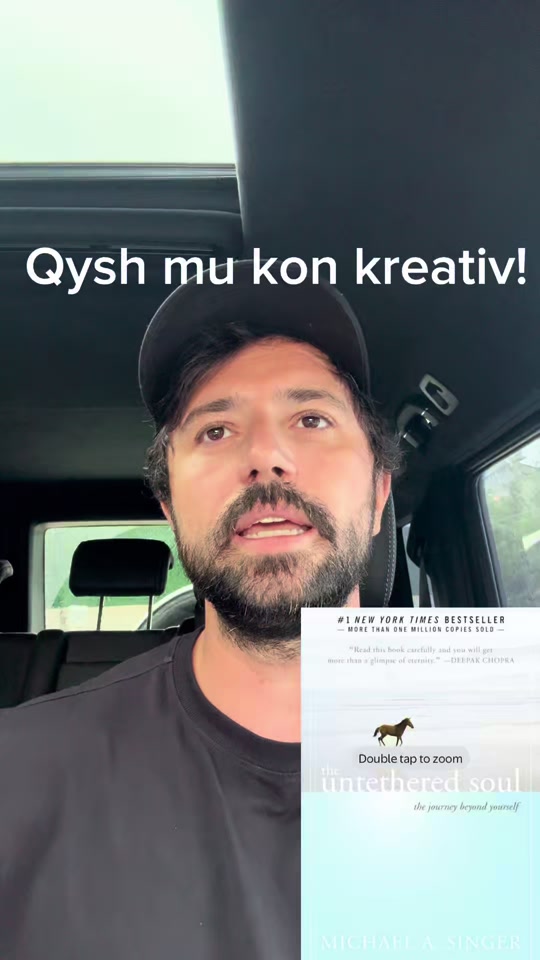
In the video, I bring up a book: The Untethered Soul, by Michael A. Singer. And I ask you to imagine that the voice in your head is another person.
The person comments on everything. Questions everything. Changes the subject before you have finished the first thought. Would you let that person direct every decision you make?
That image is what interests me. We hear our own commentary so often that we can mistake familiarity for authority. An idea appears, and immediately there is a verdict: stupid, already done, people will laugh.
The idea has barely arrived. We have already shown it the door.
What I took from the book
Singer’s book explores our relationship with thoughts and emotions through a spiritual framework. The author’s own description connects that inquiry with meditation, mindfulness and inner freedom. It is a spiritual book, not a laboratory demonstration of where creativity comes from.
In the clip I use the language of God, the universe and creative energy. That is my interpretation of the experience. It does not establish that a quiet mind connects to a scientifically measurable source of ideas.
The practical question survives without that agreement: can I notice a thought without immediately obeying it?
“This will be embarrassing” is a prediction. It is not a review from somebody who has seen the finished work. “I have nothing to say” might be how this moment feels. It is not an inventory of everything I have lived.

Give the problem a different room
In the video I mention several ways people step away from the noise: prayer, meditation, running, the gym, music and writing. I am not giving everybody the same routine. Nor does creativity require you to eliminate every thought. Turning silence into another exam would miss the point.
Here is a small experiment you can adapt. Write the problem in one sentence. Step away in an ordinary way that suits you: a walk, quiet time, a few lines in a notebook. Come back and write one alternative before deciding whether it is good.
Suppose your problem is an article opening. Instead of “I must write something brilliant,” try “What happened that made me want to speak?” A concrete moment gives you something to work with. You can judge the paragraph after it exists.
This is an editorial exercise, not a measured method with a promised success rate. Sometimes nothing useful comes. You may need more information, another person’s perspective, or simply rest.
And stepping away cannot be the whole process. At some point you return and make the thing. That is the other half of my video about creating every day.
The inner voice can come along. It does not need to hold the pen.
Sources and calculation notes
-
Michael A. Singer, The Untethered Soul, official book description; first published 2007. The imagined companion is my paraphrase in the video, not a verbatim quotation from the book. Spiritual interpretations and the practical exercise are distinguished from scientific findings.
-
Original video and thumbnail: Eduard Luta on TikTok. Published 2026-05-23. Research checked 26 September 2026.