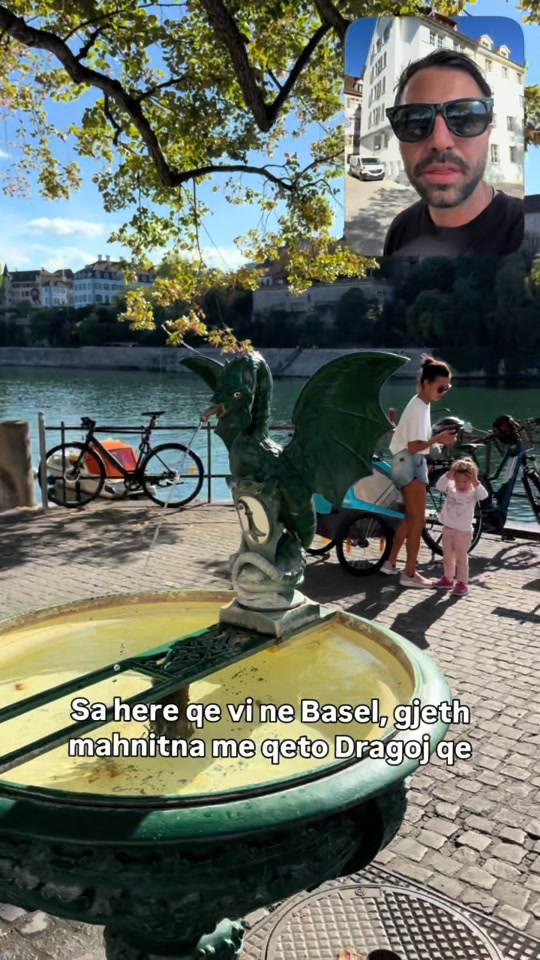
Walking through Basel, a creature caught my attention and made an ordinary fountain hard to ignore: wings, a beak, a curled tail. In the video, it sends my thoughts towards dragons, Albanian stories and the things people believe have disappeared from history.
Then I repeat a theory I had heard about pandas being genetically invented in China. That claim is false. Giant pandas are naturally evolved bears with wild populations and an ancestral fossil record. Their appearance, or the fact that they are associated with China, does not establish an artificial origin.[2][3]
The video remains here so the question and the correction can be seen together. The curiosity is worth keeping. The claim needs replacing with evidence.
Basel’s creature has a name: the basilisk
Basel Tourism identifies the basilisk as a mythical figure combining a cockerel and a serpent, familiar in the city’s history since the Middle Ages. It appears in the city’s public art, including fountains.[1]
The sculpture is real. The cultural history attached to it is also real. Neither fact demonstrates that a biological animal matching the legend once lived in Basel.
That distinction matters when I connect the fountain to the dragoi and kulshedra mentioned in the clip. Recognising a resemblance can begin a conversation about stories. It does not establish that every tradition describes the same creature, or that an extinct species lies behind them all.
The video’s suggestion that dragons existed until a particular century is not established by the evidence presented here. A date stated in conversation needs its own support; a city symbol cannot supply it.

Why a panda’s appearance is a poor test of its origin
The Smithsonian describes wild giant pandas in the mountain forests of central China, eating almost entirely bamboo. It also notes that adult pandas are strong, potentially dangerous bears; keepers do not share their enclosures.[2]
A short, amusing clip of an animal is a narrow view of its life. Looking soft or awkward to us does not tell us whether it can feed, survive or reproduce in its habitat. Before treating that impression as a biological explanation, we need to ask what evidence would test it.
For this claim, the relevant evidence is unusually concrete: anatomy and fossils.
A wrist bone carries a much older story
A 2022 fossil study describes an enlarged wrist bone in the ancestral panda Ailurarctos, functioning as a bamboo-gripping false thumb. The researchers place this feeding adaptation as far back as 6–7 million years ago.[3]
That is an ancestral lineage, not a claim that today’s species has remained unchanged for that entire period. It is nevertheless evidence directly at odds with the idea of a recently invented animal.
The paper is useful because it identifies specimens and explains what their anatomy supports. It gives us something to inspect and challenge. A rumour about how an animal looks does not offer an equivalent basis.

International panda programmes do not imply invention
The video also links pandas to China’s relationships with other countries. There are real international arrangements: the Smithsonian describes its breeding and research agreement with Chinese partners.[2] That concerns the management and conservation of animals. It is not evidence that the species was engineered into existence.
This is a common weak point in a persuasive story: attach an unsupported conclusion to a true detail, and the conclusion starts to feel documented too. We have to examine the connection, not only recognise the detail.
I had a similar moment of attention around a dragon statue in Cologne. Public art can make us look more closely at a place. That is already a good reason to stop; it does not need an invented natural history.
Let the question survive the correction
There is still plenty to be curious about: why a city keeps a mythical creature as a symbol, what different communities see in it, and how a real animal adapts to a demanding habitat.
Thinking for yourself includes being able to say that something you repeated does not hold up. The stronger question is what the evidence allows us to understand next.
Basel’s basilisk belongs to the city’s cultural life. The giant panda belongs to the natural world. We can be interested in both without confusing the kinds of evidence they require.
Sources and notes
-
[1] Basel Tourism: Public art, basilisk entry. Its dated bridge sculpture is not used to date the small fountain shown in this video.
-
[2] Smithsonian National Zoo: Giant Panda FAQs, wild habitat, feeding, keeper safety and research arrangements.
-
[3] Xiaoming Wang and colleagues, Earliest giant panda false thumb suggests conflicting demands for locomotion and feeding, Scientific Reports 12,10538 (2022), DOI:10.1038/s41598-022-13402-y.
-
Checked on 16 October 2026. The original clip contains the unsupported panda-origin theory; this article explicitly corrects it. No current population estimate is inferred. Source and visual notes.
-
Original video and thumbnail: Eduard Luta on TikTok. Published 9 October 2026. Sources checked 16 October 2026.