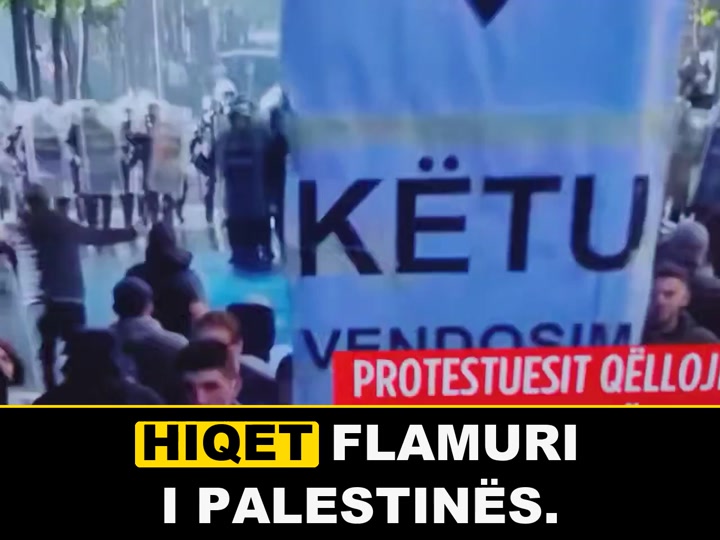
The frame is crowded: people, flags, a large blue banner, police further along the street. My words appear across the bottom, pulling the focus towards one demand: accountability in Albania.[1]
The opening text describes a Palestinian flag being removed. The caption then explains the position I wanted to express: this protest should stay centred on corruption and the control of Albanian institutions. That is my political argument, not a finding about everyone standing in the crowd.
A symbol can become the whole story
A short clip makes a symbol easy to argue about. It is harder to keep asking the slower questions: which public decision is wrong, who made it, and what needs to change?
I did not share a survey of protesters. The footage cannot establish what each person believes, who represents whom or why every movement in the crowd happened. The underlying sound is news reporting; the added captions carry my message. I was not presenting myself as an eyewitness to the scene.
When I wrote about taking the state back into citizens’ hands, I meant political accountability. The accusation of state capture is my assessment. This video does not prove a particular corrupt transaction or identify a criminal network.

A clear focus makes a demand easier to understand. It gives someone who is watching a way to ask a useful next question, rather than choosing a side in a dispute over an image alone.
Choosing a focus and restricting expression are separate questions
There is also a distinction that matters beyond this particular post. Arguing for an Albanian campaign’s focus does not, by itself, establish a legal basis to restrict someone else’s symbol.
The UN Human Rights Committee regards flags and banners as generally legitimate assembly expression. Exceptions may apply to symbols chiefly and directly tied to inciting discrimination, hostility or violence. Restrictions should normally be neutral about the message.[2] This guidance does not decide the unidentified conduct in this recording.
The clip does not give me enough evidence to decide who had authority over a flag or whether a particular intervention was lawful. I would not turn a few crowded seconds into that conclusion.
Return to what the protest is asking for
My point was to keep attention on the institutions making decisions in Albania and the people affected by them. The test is whether the discussion reaches those decisions and produces an answer that can be examined.

That is why I keep coming back to documents and responsibility. In the Ahmetaj–Report excerpt, allegations needed records and replies. In police pay and conscience, an announcement needed to be distinguished from what had actually happened.
A protest can carry anger, solidarity and disagreement at the same time. My demand in this post is that the question of Albanian public accountability does not disappear inside the argument about its symbols.
Keep the people responsible for the decision inside the frame.
Sources and notes
-
[1] Original post, shared 20 October 2026. Exact uploaded MP4, full audio and eight-frame timeline reviewed. Original event date, participants’ identities and the flag-removal circumstances remain unverified. The news recording and Eduard’s added commentary are distinguished.
-
[2] UN Human Rights Committee, General Comment 37, paragraphs 48 and 51; no ruling on this scene. Checked 21 October 2026. Visuals are editorial.