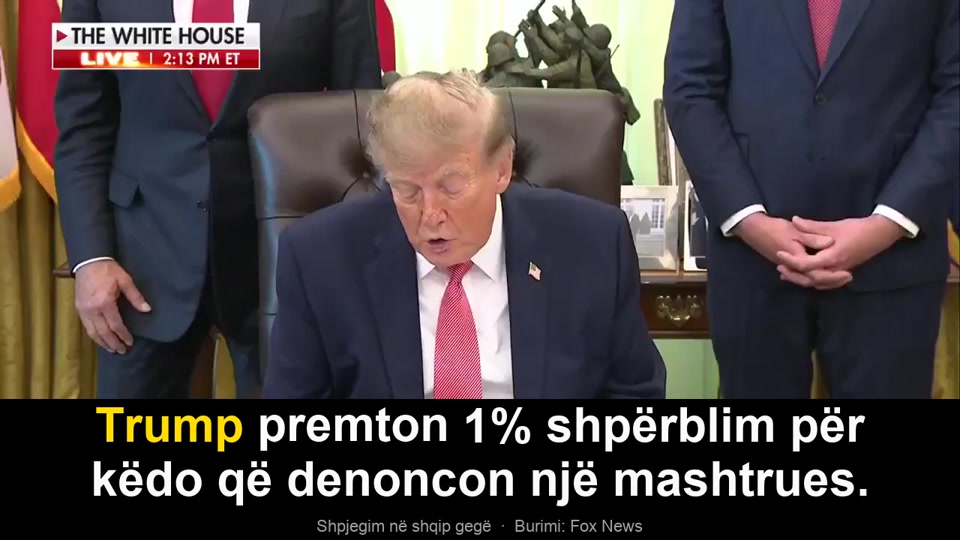
One number in this clip makes the idea easy to picture: 1%.
Donald Trump is seated at a desk, describing a commission for a person whose report helps uncover fraud. He uses a billion-dollar example and says the percentage would also apply to much larger amounts. My caption did the calculation and asked for this idea to become law in Kosovo and Albania.[1]
That was the attraction: let the person who helps expose wrongdoing share in the incentive to uncover it. Reward the honest voice instead of leaving all the advantage with the person hiding the money.
But a percentage in a speech and a payment under a written programme are different things. I checked both.
Yes, 1% of a billion dollars is $10 million
One percent means one hundredth. For the example in my caption:
$1,000,000,000 × 0.01 = $10,000,000.
The arithmetic is right. It describes the result of applying the percentage Trump states in the excerpt. It does not establish that anyone has earned, received or become legally entitled to that payment.

There is another question behind the number. An amount of fraud uncovered is not necessarily the amount of money recovered. A workable reward system has to say what its percentage is calculated on. A headline cannot settle that choice.
The written DOJ rules describe a different early-stage award
The Justice Department’s announcement of 20 October 2026 describes the Fraud Whistleblower Incentive Program, or WHIP: $10,000–$30,000 awards for information leading to criminal charges in specified areas. Awards are discretionary. That is not the uncapped 1% formula heard in the clip.[2]
The published terms require voluntary, truthful, original information and cooperation. They also limit the covered offences. They allow possible later awards through other government programmes; that does not convert this early-stage award into a universal 1% entitlement.[3]

So I would not tell someone: report a billion-dollar fraud and you will receive $10 million. My calculation illustrates the speech. A real application depends on the applicable written rules.
The distinction is worth keeping even if you strongly support the idea. Enthusiasm should make us ask for a system that works, not skip the document that determines what happens.
What I would want for Kosovo and Albania
My caption was a policy proposal. It was not an announcement of a new reward law in either country.
Both already have whistleblower-protection frameworks: Kosovo’s Law 06/L-085 and Albania’s Law 60/2016, amended by Law 150/2020.[4][5] Protecting a person who reports wrongdoing and deciding whether to pay a reward are separate design questions. Citing those laws does not establish a local 1% payment.
If we debate a reward scheme, I would want clear answers: who independently verifies the information, what event triggers payment, how the amount is calculated and how the person reporting is protected from retaliation. These are the questions I would put into the proposal, not claims that the short video has already answered them.
An accusation must still be examined. A reward should encourage useful evidence; it should not turn the loudest public allegation into a winning ticket.
This is close to the question in public contracts and the need for evidence: can we follow the decision, the people and the money, rather than stopping at the outrage?
The idea still interests me. Paying for useful truth deserves rules that are as clear as the percentage.
Sources and notes
-
[1] Shared video, posted 20 October 2026. Full 33.4-second English source and added Albanian captions reviewed. The clip states a 1% commission; examples are hypothetical arithmetic, not verified payouts.
-
[2] DOJ announcement, 20 October 2026. Written early-stage award range and discretion.
-
[3] DOJ published programme terms. Eligibility and payment conditions; other programmes remain separate.
-
[4] Kosovo Law 06/L-085, especially Articles 7–9 on rights and protection.
-
[5] Albanian Ministry of Defence: whistleblowing framework, identifying Law 60/2016 as amended. Sources checked 21 October 2026. No claim of an enacted Kosovo/Albania 1% reward. Visuals are arithmetic and a source comparison, not payment evidence.