Nothing happened.
No visuals. No entities. No cosmic theatre.
After several nights at an ayahuasca retreat in Norway, this calm almost felt strange. You enter a ceremony prepared for the medicine to take you somewhere, to show you something, to pull a demon out of a corner you forgot existed.
But that night was silent.
Then, near the end, one message arrived with such clean precision that I wrote it down the next morning:
The tooth you repaired at the beginning of the year is making you sick. Remove it.
That was it. No explanation. No dental scan floating through another dimension. No instructions about what kind of dentist to find.
Just the tooth.

The Tooth Everyone Said Was Fine
The strange part was that I already knew something was wrong.
Since the root canal, my oral health had declined. I had bad breath that never seemed to disappear, blood in my saliva from time to time, and a feeling that my mouth was never truly clean. More than that, I did not feel well in my body. I could not prove that the tooth was responsible, but I could feel that something had changed.
When I went back to the dentist, the answer was simple: the tooth was fine. The work was good. I was probably not cleaning properly, worrying too much, or overreacting.
It is a deeply confusing experience when a professional tells you everything is okay while your body keeps saying:
No. Something here is not okay.
I do not think the dentist was lying. I think he trusted his work, his training, and what he could see. I trusted a sensation he could not measure.
We were speaking two different languages.
The Documentary That Opened the Rabbit Hole
The morning after the ceremony, I found the documentary Root Cause. Its argument is controversial: that infections and material left around root-canal-treated teeth may affect health far beyond the mouth.
I sent it to the dentist who had performed my treatment and told him exactly what had happened. I told him I had received this message during ayahuasca, that I had not felt right since the procedure, and that I wanted him to look again.
He watched it and came back with certainty:
Many dentists perform bad root canals. That is why the documentary exists. But I did yours very well. Your tooth has no problem.
According to him, I was connecting things that were not connected.
At the time, his certainty became another confirmation for me.
Not confirmation that every root canal is toxic. Confirmation that professions can develop blind spots. When you spend years learning how to do something, questioning the thing itself can feel like questioning your identity.
But certainty is dangerous on both sides.
If I had removed a healthy tooth only because of a ceremony and a documentary, that would not have been spiritual courage. It would have been reckless.
A download can open an investigation. It cannot replace one.
What I Mean by Biological Dentistry
I had already been looking into what people call biological dentistry for a few months. To me, the useful part is not the label. It is the question underneath it:
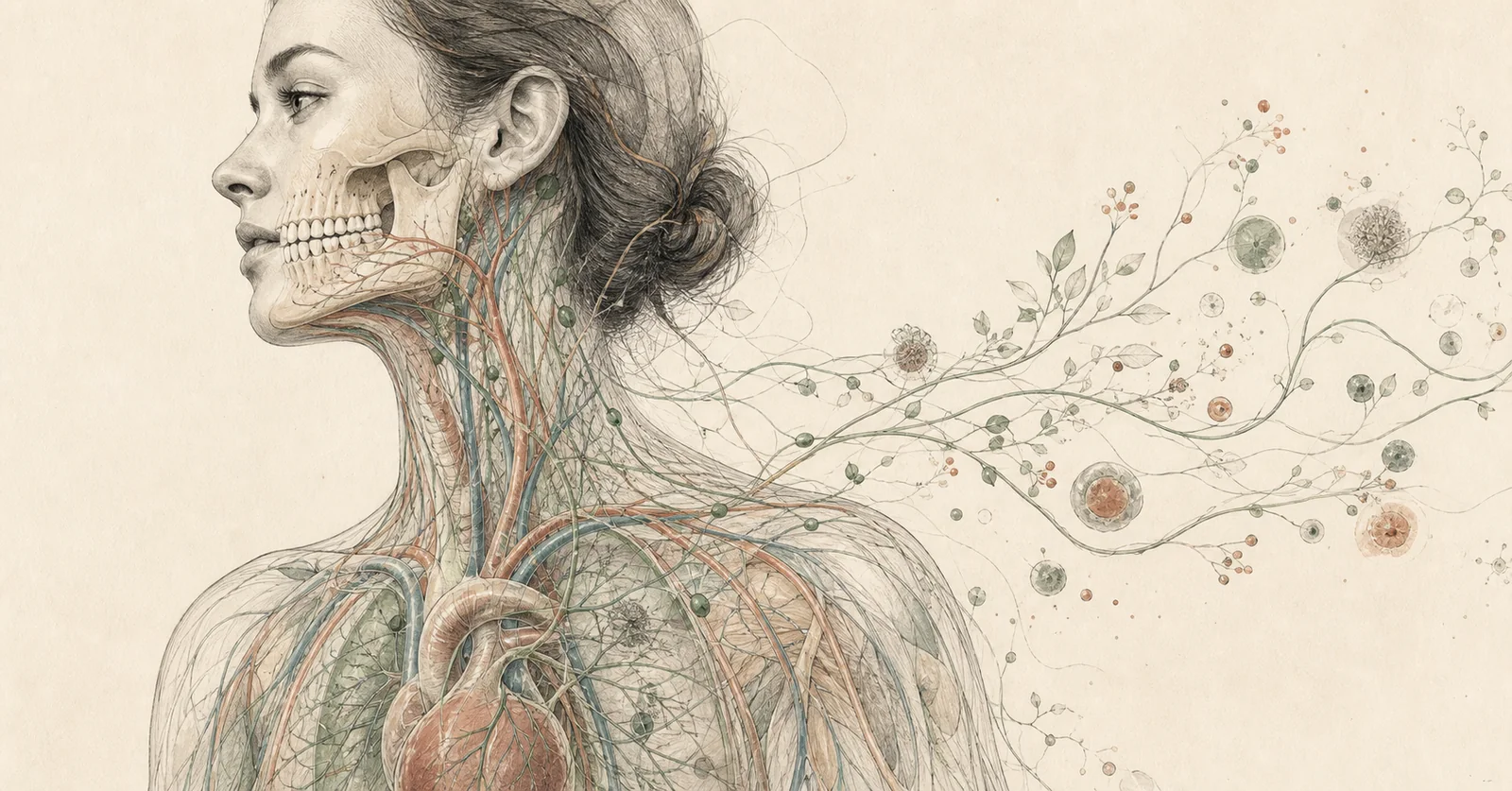
Why do we act as if the mouth is outside the body?
Teeth share blood supply, nerves, bone, immune activity, bacteria, and inflammation with the rest of us. The American Dental Association’s overview of oral-systemic health makes the careful version of this point: oral disease is associated with conditions elsewhere in the body, although proving direct causality is much harder.
Where My Two Teeth Sit on the Meridian Map
There is another map that appears again and again once you enter the world of biological dentistry: the tooth-organ meridian chart.
It combines the meridian theory of Traditional Chinese Medicine with a later system called Electroacupuncture According to Voll, or EAV. Different versions disagree on some details, but the broad tooth groups are usually similar. An evidence-aware biological-dentistry overview describes it honestly as an interpretive lens rather than anatomical wiring.
Now that I know exactly where my teeth were, I can place them on that map.
They were on the upper-left side, the second and third teeth after the eye tooth. Counting backward from the canine toward the molars, that most likely means:
- FDI 25 / Universal 13 — the upper-left second premolar.
- FDI 26 / Universal 14 — the upper-left first molar.
The American Dental Association’s numbering table confirms those conventional tooth names and numbers.

In the common version of the map, tooth 25 belongs to the lung–large-intestine meridian group, often accompanied by the sinuses. Some expanded charts add the thymus.
Tooth 26 belongs to the stomach–spleen/pancreas group, often accompanied by the maxillary sinus. Expanded versions, including the Riordan Clinic’s published tooth-organ chart, also place the thyroid and mammary gland beside this upper-molar region.
So the two teeth were physically side by side, but the map places them at the border of two different systems:
Breath and elimination on one side. Digestion and metabolism on the other.
And then there is the mammary-gland reference beside the first molar. Of course, that immediately made me think about my mother.
But this is where curiosity must remain honest.
Meridian tooth charts have not been scientifically validated, and the charts themselves vary. They cannot tell me that an infected tooth damaged one of those organs—or that removing it healed one. The verified correlation in my case is dental: both teeth had received root canals, both were compromised when removed, and one showed infection on the 3D scan.
The map did not diagnose my teeth.
It gave me another symbolic language for looking at what the scan and extraction had already made physical.
My Mother’s Right Side
This was not the first time the connection between teeth and the rest of the body entered my family.
After my mother developed breast cancer, serious infections were found in the teeth on one side of her mouth. She eventually had to remove all the teeth on that side.
Her breast cancer was on the right side. The infected teeth that had to go were also on the right side.
Right breast. Right jaw.
Seeing the mammary gland appear beside the upper-molar region on some versions of the chart made this memory feel even stranger. But I do not know the exact numbers of my mother’s infected teeth, so I cannot honestly claim a tooth-by-tooth match. My own extracted teeth were on the left; hers were on the right.
The documentary makes much bigger claims around these same-side patterns. Seeing the pattern in my own mother made it impossible for me to dismiss emotionally. But I also cannot tell you that those teeth caused her cancer. One family story cannot prove that, and I found no reliable evidence that the side of a breast tumor can be mapped directly to infected teeth on the same side of the mouth.
What I did find was already important enough.
A prospective study following 65,869 postmenopausal women found that a history of periodontal disease was associated with a 13% higher incidence of breast cancer. A newer 2026 meta-analysis of cohort studies reported a smaller but still positive association of about 11%. These studies concern periodontal disease, not root-canal-treated teeth. Association is not causation, but it means the wider oral-health question is not imaginary.
Then the biology became even more interesting. In January 2026, researchers at the Johns Hopkins Kimmel Cancer Center reported in a published study that Fusobacterium nucleatum — an oral bacterium associated with periodontal disease — could travel through the bloodstream, enter breast tissue, trigger inflammation and DNA damage, and accelerate tumor growth and spread in laboratory and animal models. That gives the connection a possible mechanism. It still does not prove that a root canal caused my mother’s cancer.
And the arrow can point the other way. Cancer and cancer treatment can weaken oral defenses and allow existing dental infections to become more serious. The US National Cancer Institute recommends dealing with dental and periodontal infection around cancer treatment for exactly this reason.
So what happened to my mother?
Did the infections add to the inflammatory terrain in which cancer developed? Did the cancer and its treatment allow silent dental infections to explode? Or were both consequences of a body already under pressure?
I do not know.
But I know the mouth was part of the story. It was never separate.
Then I saw Daymond John describe his own biological-dentistry experience. He wrote about hidden problems found in his jaw and an unexpected change in pain he had carried for years. He was careful to call it his experience alone.
That distinction matters.
His story was not proof of mine. The documentary was not proof of mine. The ayahuasca message was not proof of mine.
But together they made the crack wide enough for me to keep looking.
The 3D Scan Found One
A friend of mine had recently become a dentist. I sent him the documentary, but instead of immediately defending or attacking it, he agreed to sit with me, look at my mouth, and investigate.
This changed everything.
We did a cone-beam computed tomography scan — a CBCT, the three-dimensional scan used in dentistry to see teeth, roots, and surrounding bone from multiple angles.
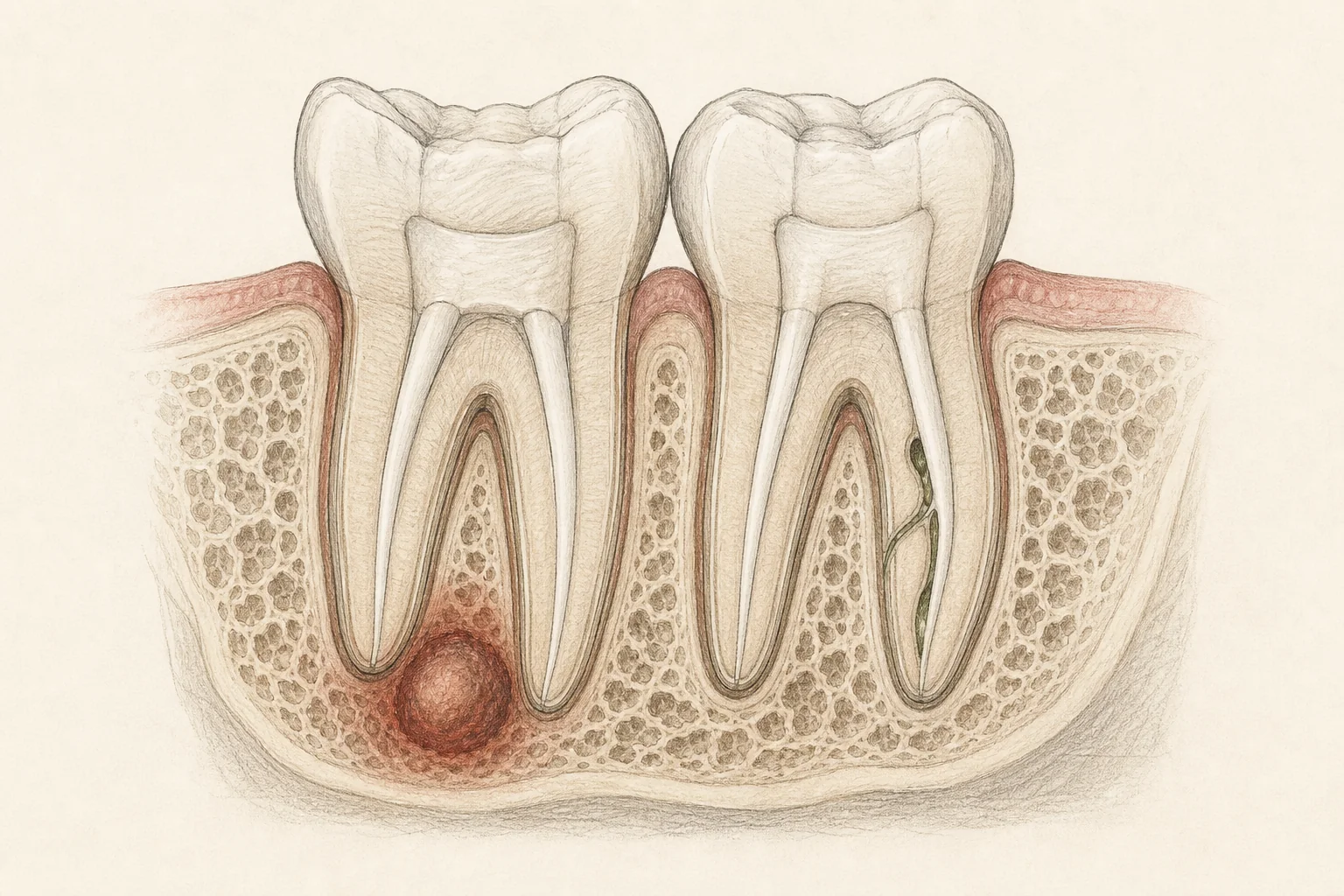
The newer root-canal-treated tooth showed a suspicious area consistent with infection around it.
There it was.
The message from Norway had crossed into matter. Something that began as a download now existed as a shape on a screen.
Beside it was an older tooth that had also received a root canal years earlier. On the scan, that one appeared much better. The new tooth looked like the problem. The old tooth did not.
So we made the decision to remove the newer one.
The Extraction Revealed Two
During the procedure, while my dentist was working to remove the first tooth, the older root-canal-treated tooth beside it fractured.
Suddenly, the plan changed. One tooth became two.
He had to remove both of them. And when they were finally outside my body, the surprise was not that one looked diseased.
Both did.
The photograph below is graphic. It is also the most honest image in this article.
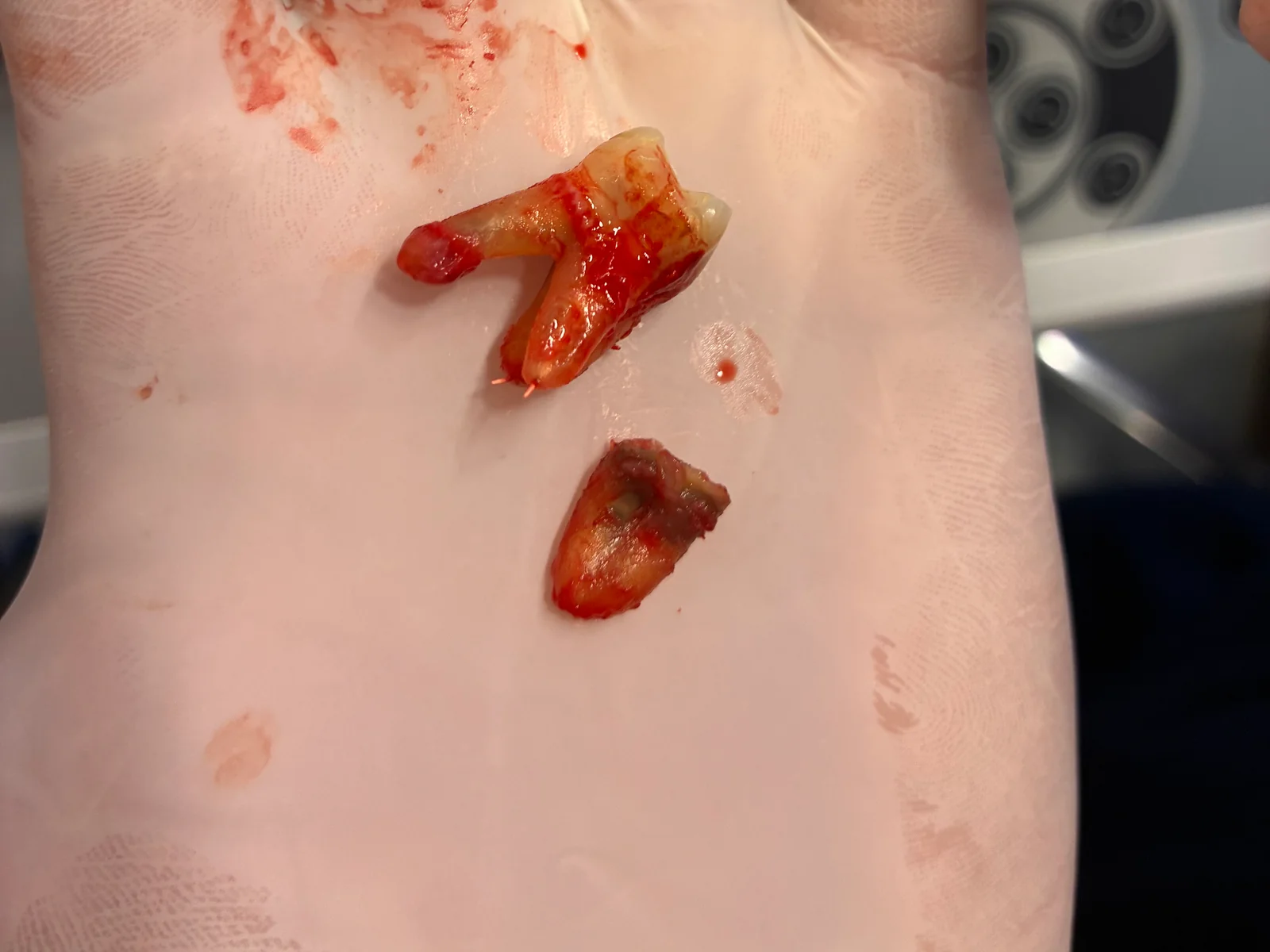
My dentist’s assessment after the extraction was that both teeth were infected and compromised. The newer root canal appeared poorly completed, matching what the scan had suggested. But the older tooth — the one that looked acceptable on the 3D image — also appeared badly affected once it was out.
The 3D scan found one. The extraction revealed two.
This was the moment that shook me most.
I had entered the ceremony knowing nothing about dental imaging, persistent apical infection, or what we would later find. I received one instruction: remove the tooth. I followed it with research, a second opinion, a scan, and a clinical decision.
And at the end, reality went further than the message.
I thought I was being sent to remove one sick tooth.
I was being sent toward two.
What the Evidence Actually Says
This is where I need to be precise.
The scientific consensus does not say that every root canal is toxic or that root-canal treatment causes chronic disease. The American Association of Endodontists describes root canal treatment as a safe, established way to remove infection and preserve a natural tooth.
That does not mean every treatment succeeds.
Bacteria can persist. Anatomy can be missed. A seal can fail. A tooth can fracture. Infection around the root can remain or return — a condition called post-treatment apical periodontitis. The AAE describes monitoring, retreatment, endodontic surgery, and extraction as possible responses depending on the tooth, while the European Society of Endodontology’s clinical guideline emphasizes diagnosis, aseptic technique, re-evaluation, and preserving teeth when possible.
The scan also deserves humility. CBCT is far more revealing than an ordinary two-dimensional dental image, but it is not the eye of God. A 2024 meta-analysis estimated its sensitivity for apical periodontitis at about 94.6% and specificity at 91.2%. Excellent is not omniscient — and diagnostic accuracy can be more difficult in teeth already filled with root-canal material.
So my experience does not prove that scans are useless.
It proves that a scan is a tool, not reality itself.
The Release
After both teeth were removed, I felt an immediate release.
Part of it was physical. Something that had bothered me for months was finally gone. Part of it was emotional: I had spent so long being told that nothing was wrong that seeing the teeth outside my body ended the argument inside my mind.
And part of it was spiritual.
My body had been trying to get my attention. Ayahuasca did not invent the signal. It made the signal loud enough for me to stop negotiating with it.
I do not yet know what this will change in my long-term health. Healing needs time. Bad breath, bleeding, fatigue, and feeling unwell can have many causes, and relief after a procedure does not prove a theory about every other person.
But the release was real.
For the first time in a long time, my mouth felt like it had space to heal.
A Sign Is Not a Diagnosis
I keep returning to one question:
Did my higher self diagnose an infection before the dentist did?
Maybe.
Or maybe the quiet of the ceremony allowed me to hear information my body had already been sending through discomfort, smell, blood, tension, and the strange feeling that something was wrong.
Maybe the spiritual world did not give me new information. Maybe it removed the noise around the information that was already there.
I cannot prove which explanation is correct.
I have written before about synchronicity and the invisible thread connecting inner experience with outer events. This felt like the same language, only stripped of symbols. No moth. No number. No dream.
Just a tooth.
But I know this: the message did not tell me to reject medicine. It sent me deeper into investigation. It led me to a documentary, a difficult conversation, another dentist, a 3D scan, a decision, and finally the physical evidence of two compromised teeth lying outside my body.
That is the bridge I see now:
Intuition points. Evidence tests. Action reveals.
The spiritual and the physical were not enemies in this story. They were two ends of the same thread.
The Mouth Is Not Outside the Body
The biggest lesson was not “remove every root canal.”
It was much simpler:
Take your mouth seriously.
Do not normalize bleeding. Do not normalize a persistent bad smell. Do not normalize pain, pressure, swelling, or the feeling that something changed after a procedure. Do not let a documentary diagnose you — but do not let one confident opinion end your investigation either.
Ask for the images. Ask what they show and what they cannot show. Get an evaluation from an endodontist or another qualified dentist when symptoms persist. Understand the options: observation, retreatment, surgery, or extraction. Then make the decision for your tooth, your body, and your evidence.
This is my personal experience, not a protocol or medical advice. I am not saying root canals cause systemic disease or that people should remove treated teeth. A tooth should be extracted only after qualified clinical evaluation and a case-specific discussion of the alternatives.
For months, I believed I was looking for a problem in my body.
The problem was waiting in my mouth.
And in a silent night in Norway — without visions, without fireworks, without proof — something in me already knew where to look.
Sometimes the higher self does not send a prophecy.
Sometimes it points to one dead tooth and waits for you to listen.
— — — — —
Prishtinë, 26.07.2026