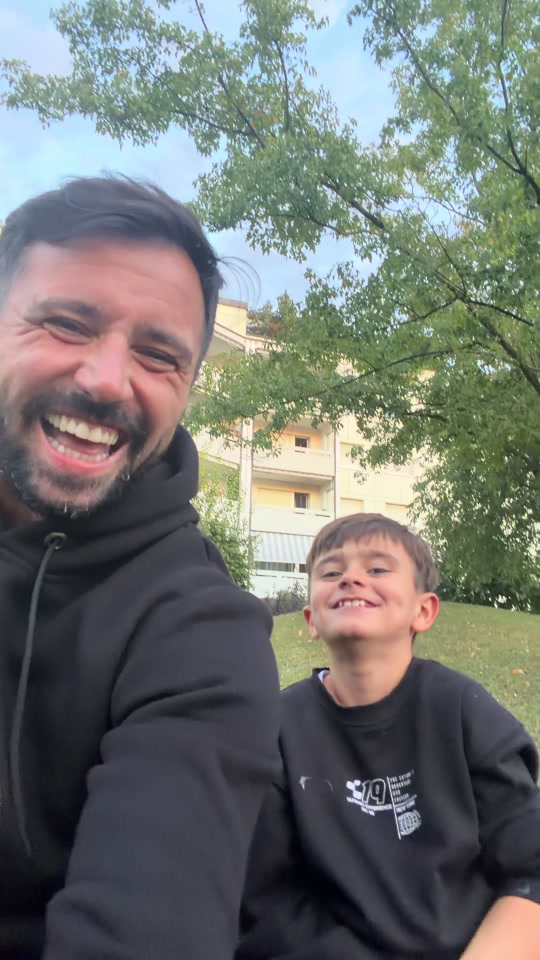
The caption on this video calls responsibility one of Marin’s first lessons: nobody else can take it for you. The exchange itself is playful. We are outside, talking and laughing.
There is a big idea inside that small moment. At some point, each of us has to act. Someone can explain, encourage and help, but they cannot practise every part of life on our behalf.
With a child, that idea needs care. “You can learn to do this” is useful. “You are on your own” is a very different message.
Give the child a part they can actually carry
For me, teaching responsibility means connecting an action with something real. Put the thing back where it belongs. Take part in getting ready. Say when you need help. If something goes wrong, help repair it.
The size of the task has to fit the child and the situation. Adult responsibilities—safety, basic care, major family decisions—remain with adults. A lesson in independence is not permission to move those burdens onto a child.

That distinction also matters when we ask a child where they would like to live. Their preference belongs in the conversation. The final family decision is not theirs to carry.
Responsibility grows through practice
Harvard’s Center on the Developing Child explains that executive function and self-regulation skills develop through interaction and practice. Its activity guide offers suggestions by age, rather than expecting the same performance from every child. Executive function activities guide.
I take a practical implication from that: a reminder, a demonstration or a smaller step can be part of learning. Needing support does not make the child’s effort meaningless.
Suppose we are practising packing a bag. An adult can show what belongs inside, let the child choose and place one manageable set of items, then check together. The next time, the child may do more. This is a hypothetical example, not an event described by the clip.

The point is not to remove every mistake. It is to make the task understandable and the consequence proportionate. Forgetting an item can lead to checking the routine, without turning it into a statement that the child is lazy or incapable.
Asking for help is also an action
There is a version of “take responsibility” that sounds like “never need anyone”. I do not find that useful for adults, let alone children.
Recognising that something is beyond your current ability and saying so is part of dealing with reality. The next question can be: which part can you do, and where do you need help?
That leaves room for effort without demanding a performance of total independence. It also makes the adult’s role clearer: support the attempt, explain the boundary, and take over when safety requires it.
Keep the laughter in the lesson
The clip is not a parenting lecture. It is a light exchange with my son. I want the article to keep that quality even while taking the caption seriously.
There is room for playfulness and responsibility together. A child can learn something while laughing. A parent can be clear without making every moment heavy.
Nobody can practise your part of life for you. That does not mean you have to learn it alone.
Sources and calculation notes
-
Research: Harvard Center on the Developing Child, Enhancing and Practicing Executive Function Skills with Children from Infancy to Adolescence, 2014. General developmental context, not an assessment of Marin or a fixed age milestone for a particular task.
-
The article develops the video’s explicit responsibility theme. Suggested tasks and diagrams are illustrative, not a reconstruction of uncertain dialogue. Adapt activities to the individual child and keep safety with the adult.
-
Original video and thumbnail: Eduard Luta on TikTok. Published 2026-09-18. Research checked 23 September 2026.