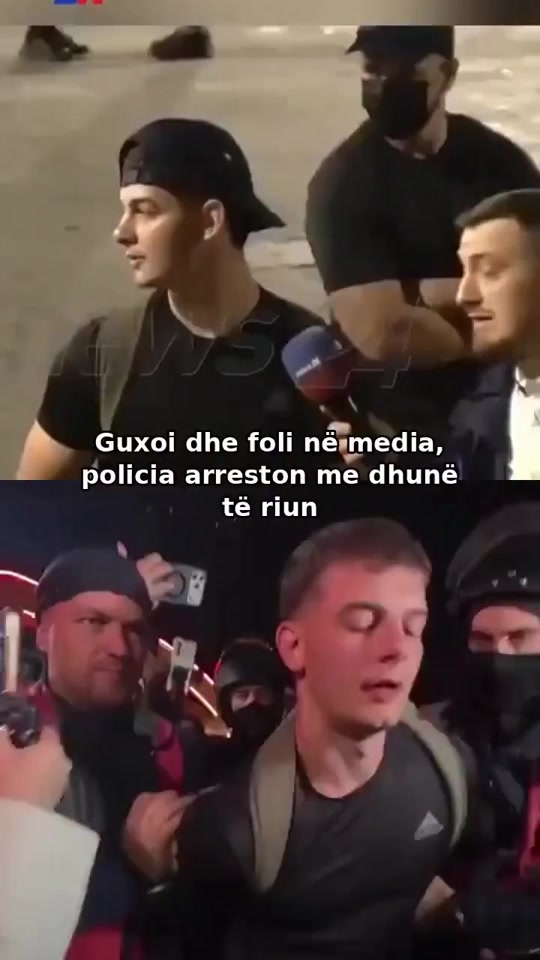
A microphone is held towards a young man wearing a backwards cap. In the other half of the frame, officers surround a young man and hold him as the scene becomes crowded.[1]
The edit links those images. Its Albanian overlay alleges that a young person spoke to the media and was then arrested violently. My caption repeats that as an allegation accompanying the video, rather than something I witnessed or independently established.
What made me share it was the possibility of someone being punished for speaking openly. My position is clear: criticism should not become a reason to intimidate a person into silence. But a strong position does not remove the need to establish what happened in a particular case.
What the interview adds
In the audible interview, the young speaker questions the timing of a call for dialogue and refers to students’ demands. That is a political criticism. I do not need to agree with every part of an interview to care whether someone can give it freely.
The police footage adds a different kind of information: physical intervention is visible. The recording does not provide the full lead-up, a verified identity match between the two views, an arrest record or the official grounds for the action. The later audio is too unclear for a reliable quotation.

Putting two recordings beside each other can make a claim immediate. It does not independently establish the sequence or the cause. The claim that speaking to journalists triggered the intervention remains an allegation here.
Rights are a reason to ask for the record
Albania’s Constitution protects expression. It also requires lawful grounds and procedures for deprivation of liberty and provides safeguards including notification of reasons and access to a lawyer.[2]
Those references explain why the question matters. They do not tell us whether an unidentified intervention met the relevant requirements.
Article 32 of the State Police Law limits force to necessity and requires a proportionate, graduated level.[3] Assessing that needs the circumstances, not simply a label attached to the person being held.

An official explanation should be able to identify the conduct relied upon and the record supporting it. A person challenging that account should have a way to put forward the full recording and other evidence. These are the questions I want the public conversation to reach.
Do not lose the person inside the argument
In my caption, I used the language of political outrage and predicted a political fall. That is my opinion, not a verified description of a future outcome or a legal classification of the state.
The useful demand beneath that anger is an answer that can be checked. If the allegation is wrong, the record matters. If it is right, the record matters just as much.
I wrote about seeing the person behind a protest because it is easy to stop seeing people once they become symbols. The same habit belongs here: look at the person, examine the evidence and ask a precise question.
A microphone should open a conversation. The next frame should not close the inquiry.
Sources and notes
-
[1] Original post, shared 20 October 2026. Exact 30.023401-second source and full timeline reviewed. The edit alleges causation; identity, original event date, legal status, grounds and the full sequence remain unverified. Unclear police-scene speech is not quoted.
-
[2] Constitution of Albania, Articles 22, 27–28. General safeguards, not a ruling on this recording.
-
[3] State Police Law 82/2024, Article 32. Sources checked 21 October 2026. The diagrams are qualitative editorial guides.