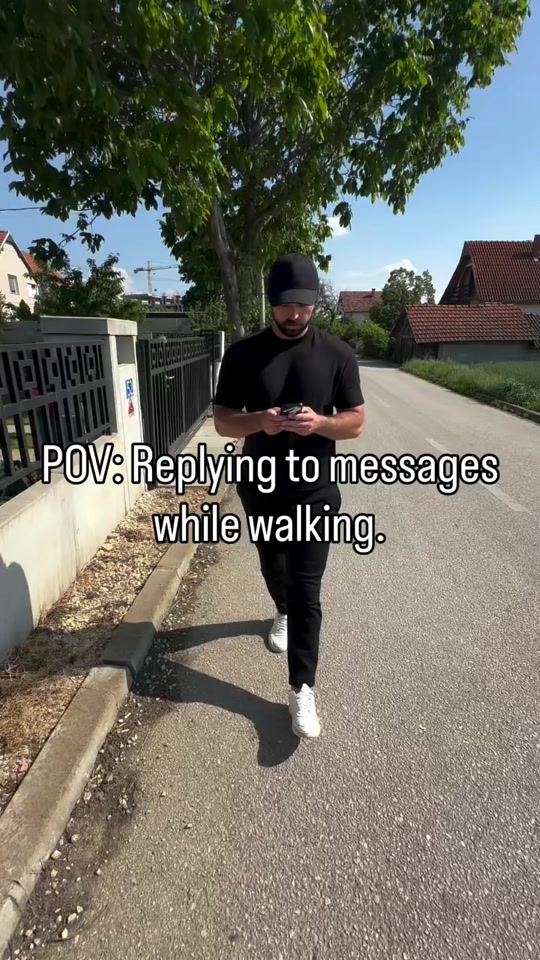
I’m walking down the road, phone in both hands, eyes on the screen. The camera comes closer. My thumbs keep working. The caption says: “POV: replying to messages while walking.”[1]
That is the whole joke. No dramatic ending is needed. If you recognize the habit, you already know why the scene feels familiar.
The body is on a walk. The attention is in a conversation somewhere else.
I like that the clip stays small. It catches an everyday contradiction without needing a speech about it. We want to get somewhere, stay available and finish one more reply, all in the same moment.
What changes when the phone joins the walk?
In a 2014 experiment, 26 healthy adults walked roughly 8.5 metres under three conditions: without a phone, reading or typing. Both phone conditions slowed walking and increased deviation from a straight path.[2]
That controlled study cannot measure this clip or predict an individual accident. It shows that a familiar task can change when a phone is added.
My clip is a joke about the habit, not an experiment measuring it.
Give each thing its moment
A small response is enough. If a reply needs your attention, find a clear place to stop, finish it, then put the phone away and look around before moving again. This is a practical suggestion, not a routine demonstrated in the clip.

I have also written about walking as time to reflect. This little video shows the other version: the walk continues, while the screen takes centre stage.
Sometimes the message can wait. Sometimes you can stop for it.
Let the walk be a walk.
Sources and notes
- [1] Original TikTok video, published 20 October 2026. The reviewed original is 5.268 seconds long; the caption and action provide the joke’s context.
- [2] Schabrun et al., PLOS ONE (2014). Correction, February 2014: distorted Figure 1. Checked 20 October 2026; visual steps are editorial. Source notes.