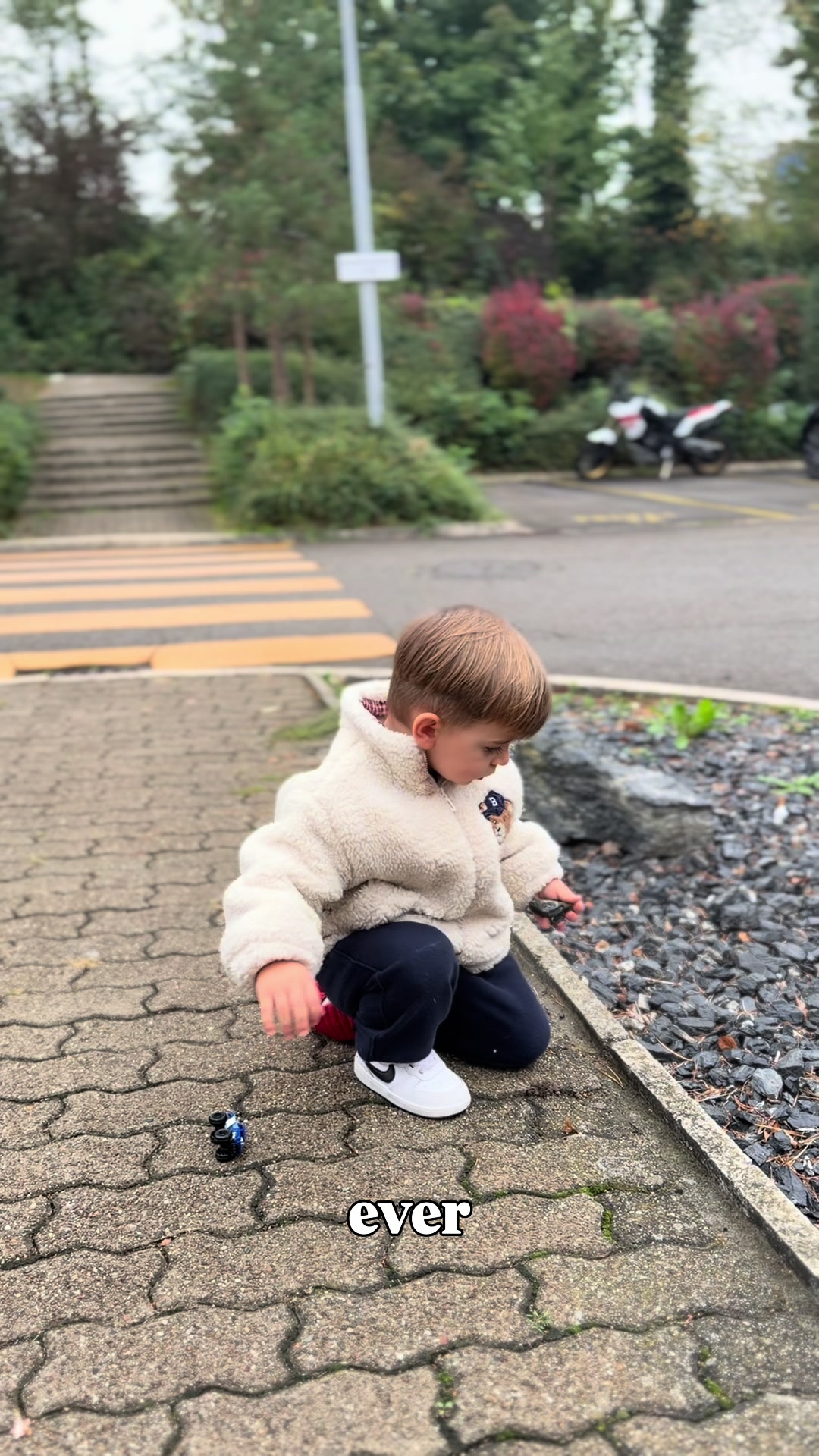
A small blue toy sits on the pavement. Beside it, a toddler crouches at the edge of a patch of stones, looks up and returns to the little world in front of him.
The commentary turns that scene into a Pokémon encounter. A wild toddler. Unlimited energy. A very questionable obedience score.
The numbers in the caption are a joke, of course. There is no parenting dashboard here. What I wanted to share with this post was the pleasure of entering a child’s world for a moment instead of immediately asking that world to hurry up.
The game was already there
I like the contrast. In a game, we go looking for something worth discovering. Here, a child has already found it on an ordinary stretch of pavement.
The clip is only about fourteen seconds. It cannot tell us how the rest of the day went, and it does not need to. It holds one small scene: a toy, some movement, a bit of playful narration. Happiness does not always announce itself as a major event.
That is close to what I meant in making room for your child. Being together can mean allowing something small to matter because it matters to the person beside you.
Playful attention, without a performance
There is a useful idea behind this kind of attention. UNICEF describes “serve and return” as an exchange in which an adult responds to a young child’s sounds, gestures or interests. It can happen during ordinary routines; toddlers can also lead a playful moment that the adult follows. [1]
Harvard’s Center on the Developing Child likewise emphasises responsive, attentive back-and-forth interaction. [2] That is broader guidance about relationships, not a diagnosis of the child in this clip or proof of a developmental outcome from one recording.
For me, the practical invitation is simple. Notice what has caught their attention. Respond to that. Leave room for their next move. A safe setting and age-appropriate objects matter; the point is the exchange, not copying every object or location shown in a video.

You do not need to turn each minute into a lesson or produce a funny video every time. Sometimes you join in. Sometimes you watch quietly. And when the child moves on, the game can end.
Let the joke stay a joke
“Obedience: 0%” belongs to the Pokémon gag. It is not a judgment of a child’s character. Neither is this clip a reason to measure whether another parent is sufficiently present or another family is having enough fun.
I keep returning to playfulness without losing responsibility. The responsibilities remain. So does the possibility of finding something funny inside the day you already have.
I shared it as a real-life Pokémon encounter. What I wanted to keep was the moment.
Sources and notes
-
[1] UNICEF, Playtime, anytime!, 16 June 2020: responsive exchanges, everyday routines and following a toddler’s interest. The visual is an editorial example, not a measured intervention or a transcript.
-
[2] Harvard Center on the Developing Child, 5 Steps for Brain-Building Serve and Return, published 19 June 2017: attentive back-and-forth relationships. No developmental score, guaranteed benefit or prescribed time target is claimed here.
-
Original source: Eduard’s TikTok post of 17 October 2026, its caption and matching video/audio. The playful opening comparison is clear; uncertain wording near the end is not quoted. Caption “levels” and percentages are humorous, not measurements. Sources checked 18 October 2026.
-
Original video and thumbnail: Eduard Luta on TikTok. Published 17 October 2026. Sources checked 18 October 2026.