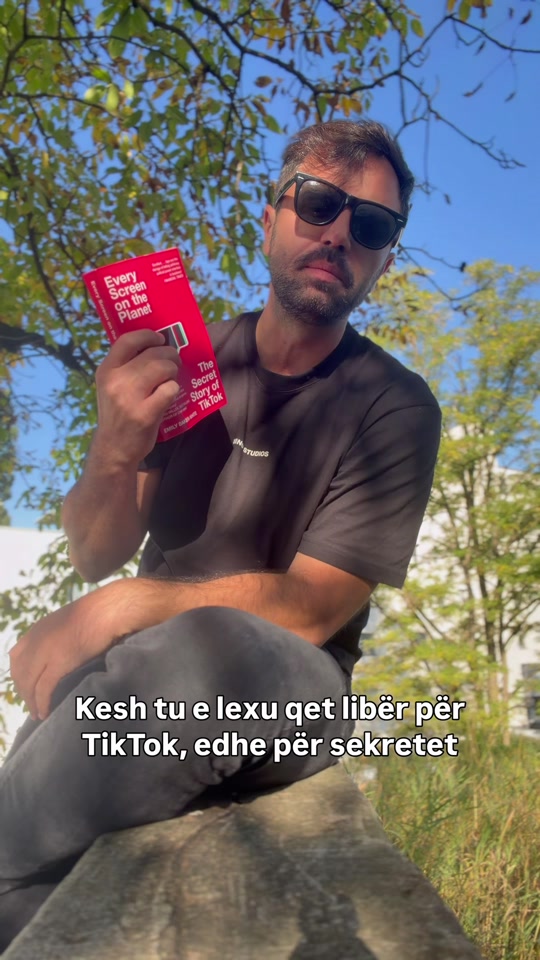
I am outside under a tree, holding a red book: Every Screen on the Planet: The Secret Story of TikTok, by Emily Baker-White. Reading about founders and how companies begin always gives me something to think about. In the caption, I say it does two things for me: I learn, and I get inspired.
The idea that stays with me in this video is a reversal: instead of the person finding information, the information finds the person. It is an appealing product idea. It also leaves us with questions about who chooses what reaches us.
The book behind the video
Macmillan identifies Baker-White’s book as an account of TikTok’s rise and the controversies around its power. The publisher lists its hardback edition as published on 2 October 2025.[1] This article develops my reaction to the book; it is not a chapter-by-chapter review or a claim that every detail I retell in the clip has been independently established.
In the spoken video I recount parts of Zhang Yiming’s story. A founder’s biography can make a complicated company feel like one person’s journey. The useful question for me is what product problem the company learned to solve. The chronology helps keep the stages separate.
TikTok did not begin as one finished idea
ByteDance dates its founding to 2012, Douyin’s launch to September 2016 and TikTok’s international launch to May 2017.[2] The musical.ly combination followed in August 2018.[3]

There are different products, markets and decisions in that sequence. The timeline does not prove which decision caused success. It makes it harder to compress the whole story into a moment of genius.
That is why I like reading these histories while building things myself. An outcome can look inevitable after we know it. While the work is happening, people still have to decide what to make, learn what users do and change course. I want to learn from those decisions without assuming I can reproduce the result by copying a founder’s habits.
What it means for information to find you
In the video, I use dogs and cats to explain the idea: what you linger on can influence what you see next. TikTok’s 2020 explanation includes viewing completion among its interest signals.[4] Its later transparency explanation describes ranking based on activity such as watching, sharing, commenting, searching and following.[5]
A simple way to picture that relationship is: an interaction provides a signal; the system estimates relevance; another selection reaches the viewer. This is a conceptual sketch, not TikTok’s source code or a formula with published weights.

In the clip, I say the algorithm can know you better than you know yourself. That is a vivid way to describe how personal a feed can feel. Predicting what might hold my attention is not the same as knowing who I am. A video can hold me because I am curious, confused, amused or disagreeing with it. Those are different experiences even if I remain on the same screen.
It also matters what the recommendation cannot settle. A feed cannot decide whether a claim is well supported just by showing it to me. I still need to look at the source, its evidence and what may be missing.
Keep a choice in the loop
TikTok’s June 2025 announcement describes Manage Topics as a way to influence how frequently broad subjects appear, rather than eliminate them completely.[6] These controls are useful to understand, but I do not want my whole information diet to depend on adjusting a feed.
An exercise I can use alongside it is to choose one question before opening the app. After watching, I can ask: did I find an answer, or did the next recommendation choose a different question for me? If something matters, I can seek the original document, a longer interview or a book. This is a reflection prompt, not a measured technique for improving attention.
The same distinction matters when I create content and practise communicating: being worth watching and being accurate are separate responsibilities.
Inspiration without a perfect-founder story
The video also touches on China, power and national ambition. Those subjects deserve their own evidence; the clip does not establish a legal conclusion or prove that one company changed an entire country’s image. What I can say clearly is what motivates me: people can build something that reaches beyond the place they started.
In the caption I connect that hope to us as Albanians. It is an aspiration, not a forecast. I would rather carry it into the next useful thing we build than turn it into a claim that success is owed to us.
The more I learn, the more I notice what I still need to understand. A good company story leaves me with better questions, not a shortcut around doing the work.
Sources and notes
-
[2] ByteDance: company history. Company-reported chronology; not independent evidence of market leadership.
-
[3] TikTok and musical.ly combination announcement, August 2018.
-
[4] TikTok’s recommendation explainer, 18 June 2020; [5] its explanation of recommendation reasons, 20 December 2022. These describe the platform’s own account of its system, not a complete current algorithm specification.
-
[6] TikTok: Manage Topics and feed controls, 3 June 2025. Interface and availability can vary.
-
The timeline contains sourced dates. The recommendation diagram is qualitative; no numerical effects or hidden ranking weights are claimed. Source and visual notes.
-
Original video and thumbnail: Eduard Luta on TikTok. Published 5 October 2026. Sources checked 10 October 2026.