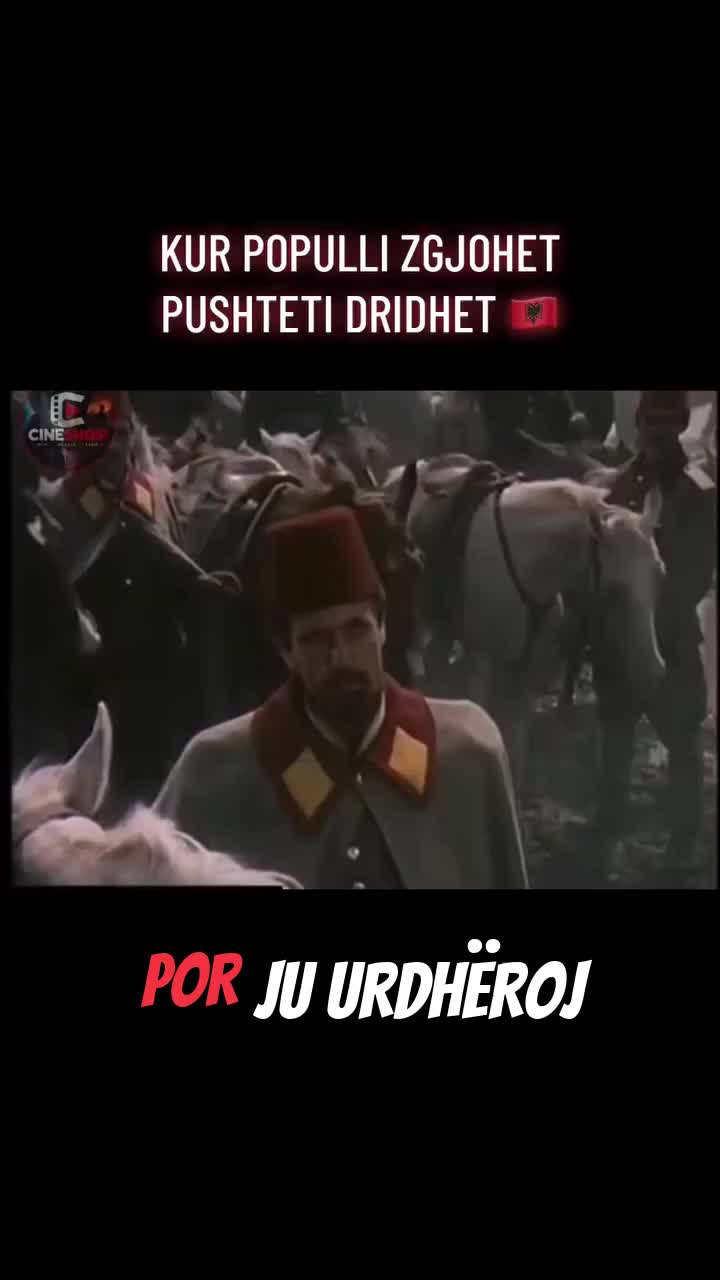
An officer on horseback insists that Ismail Qemali come with him. He has an order behind him. The men in front of him have to decide what their word is worth.
I shared this scene because of that choice. My caption was about besa, dignity and the courage to face fear. Loving your country should reach as far as your conscience. Otherwise the flag becomes much easier to carry than the responsibility.
The film behind the clip
The scene comes from Nëntori i dytë (The Second November), Viktor Gjika’s 1982 historical drama. Albania’s national film archive describes its story as the journey towards the declaration of independence in Vlora on 28 November 1912. [1, 4]
The confrontation is acted. It is a dramatic portrayal of the past, and the dialogue should be read as film dialogue. The clip I posted on 18 October 2026 is not footage of a contemporary protest or a recording of the historical conversation.
In the excerpt, an appeal to shared identity interrupts obedience. A soldier offers to stand with Ismail Qemali. The officer invokes punishment. By the end, the idea of independence has become larger than whether one man can be arrested.

There is another layer to the film’s survival. The Albanian Cinema Project and Colorlab restored it from original film materials, with a restoration premiere in Tirana on 3 November 2012. [2] That does not establish which print this social-media excerpt came from. It does remind us that a scene reaches another generation because somebody preserved the work behind it.
What I mean by besa
The line I selected for the caption is about refusing to betray another Albanian. What matters to me is the obligation inside it: somebody must be able to rely on your word when keeping it becomes uncomfortable.
There are documented examples beyond cinema. Yad Vashem’s exhibition about Muslim Albanians who rescued Jews during the Holocaust explains besa through keeping a promise and being trusted with another person’s safety. [3] Those accounts concern different people and a different historical period from the film.
That also widens the question. Dignity cannot depend only on whether the person asking for protection belongs to our own group. The responsibility becomes meaningful when another person is vulnerable and our decision has a cost.

The order and the person carrying it out
A uniform, a title or a powerful voice can make an instruction feel final. The scene holds that moment open. The person receiving the order is still there, with a judgment to make.
I return to a similar question when writing about public decisions and accountability: who takes responsibility for what happens to the people affected?
The film cannot answer today’s political disputes for us. What it can do is leave us with an uncomfortable question about our own conduct. When pressure arrives, how much of what we say we believe is still standing?
That is why I shared it.
Sources and notes
-
[1] AQSHF, Nëntori i dytë: official film catalogue, director, production year and historical setting.
-
[2] The Albanian Cinema Project, restoration record: first-party account of the 2012 restoration and premiere. The version used in the shared excerpt is not established.
-
[3] Yad Vashem, Besa: A Code of Honor: documented rescue accounts and an explanation of besa. These are separate from the film’s events.
-
[4] InfoShqip, scene identification, 20 April 2019: the matching confrontation and dialogue are attributed to this film; used to identify the excerpt, not to verify the historical conversation.
-
Original source: Eduard’s TikTok post of 18 October 2026, its caption and the matching film excerpt. The scene is paraphrased; uncertain transcript wording is not reproduced. Timeline dates distinguish historical setting, production and restoration. The second visual contains editorial questions, not a historical test. Sources checked 19 October 2026.
-
Original video and thumbnail: Eduard Luta on TikTok. Published 18 October 2026. Sources checked 19 October 2026.