Moin, moin, Hamburg.
In the video, I greet the city in German: your expression is gloomy, but your heart is big. Then I turn to our people. Where are the Albanians in Hamburg? Where should we go to meet?
The clip lasts only 22 seconds. The invitation is simple. I am walking through the city and looking for people to talk to. If you know a place, tell me.
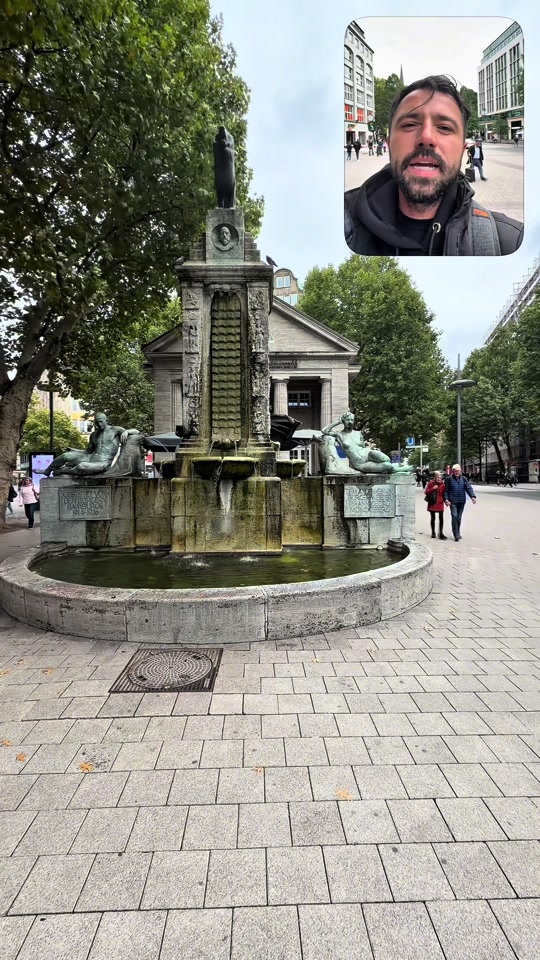
The fountain in the video has its own story
The original thumbnail shows Mönckebergbrunnen, with the former public reading hall behind it. The ensemble stands where Mönckebergstraße and Spitalerstraße meet. The Fritz Schumacher Society documents the site and its design.¹
According to Denkmalverein Hamburg, Schumacher designed the ensemble in 1914, but war delayed completion until 1926. Its bronze figures are by Georg Wrba. The restored fountain was rededicated on 24 November 2009.²

The arithmetic gives the scene another layer: 1926 − 1914 = 12 years from design to completion, and 2026 − 1926 = 100 years since completion. Those are calendar-year differences, not the age of every individual component.
A place you pass with a phone in your hand can hold a century of people stopping, looking and continuing with their day. This is the background to my greeting. It deserves a name.
We are part of the city
When I speak about Albanians being an integral part of Hamburg, I am talking about belonging. The life people build here. The relationships that make a city feel familiar.
There is useful context in the statistics. Statistik Nord reports a 41.9% migration-background share at the end of 2025, up 0.7 percentage points from 2024. That gives 41.2% for the earlier year.³

This broader category includes people with German citizenship. It is not a count of ethnic Albanians. A percentage cannot tell me who speaks our language, who feels at home here, or who wants to meet for a conversation.
The calculation is 41.9 − 41.2 = 0.7 percentage points. Calling that a 0.7% relative increase would mix two different measurements. I have explored the citizenship-versus-identity distinction further in Albanians in Germany.
Turn “we should meet” into something usable
In the narration, I ask for ideas about where to go and where to arrange a meeting. The video does not announce a confirmed venue or time.
A useful suggestion needs three things: the name of a public place, a time that works, and a clear way to find each other. “Somewhere in the centre” still leaves the hardest part undecided.
For anyone coming along, a place near public transport makes the first hello easier. I worked through the ticket comparisons in the Hamburg camper article. This video is the next step: being in the city and asking who is here.
I would like to hear what Hamburg looks like through your eyes. Which place would you show someone first? Where do you feel part of the city? What brought you here, and what made you stay?
A city’s heart becomes visible when somebody answers.
Sources and calculation notes
-
1. Location: Fritz Schumacher Society, work 162.
-
2. Fountain: Denkmalverein Hamburg, restoration account. Year arithmetic uses design, completion and publication years; it does not date each sculpture.
-
3. Population: Statistik Nord, release 75/2026, 7 May 2026; population register at 31 December 2025. Earlier share calculated as 41.9 − 0.7 = 41.2. Both bars start at zero.
-
Download the dates, percentages and calculations. No Albanian headcount or confirmed meetup is asserted.
-
Original video and thumbnail: Eduard Luta on TikTok. Published 2026-09-24. Research checked 24 September 2026.