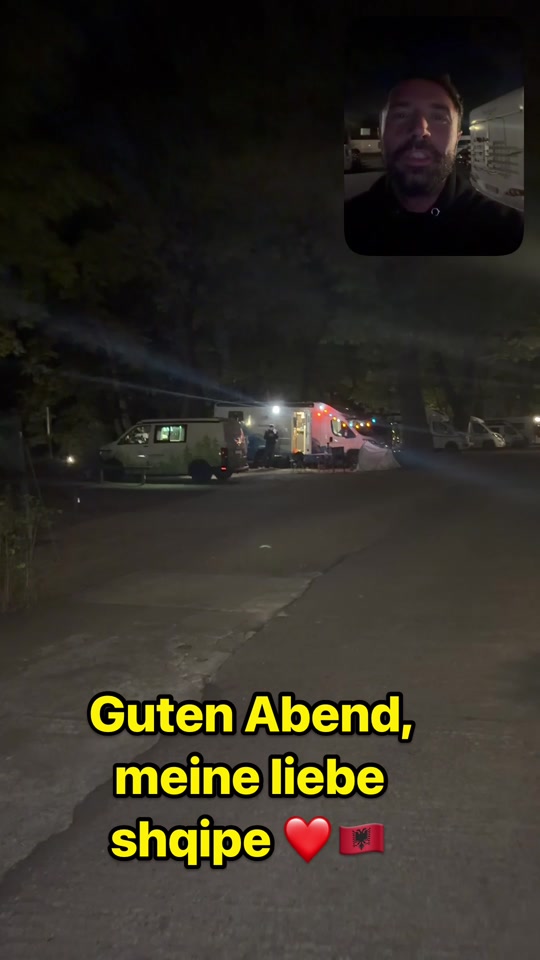
I had just arrived in Berlin when I recorded this video. Hamburg was next. I wanted to meet people who use dua, hear their stories, and listen to criticism as well as the good parts.
Germany matters to me personally. I grew up there. And almost every conversation about our diaspora seems to lead to someone who has family there.
In the video, I mention broad estimates of the Albanian community. An article gives me room to slow down and ask what we can actually count. A large number becomes useful only when we know who is inside it.
The official number we can verify
Germany’s Federal Statistical Office records 323,260 Kosovo citizens in its foreign-population register at the end of 2025, compared with 218,150 in 2018. The table was updated on 2 April 2026. It classifies people by citizenship; it is not a count of Albanian ethnicity. Destatis, foreign population by citizenship and year.

The increase is 105,110 people, or 48.2%, from 2018 to 2025. The last annual change is smaller: 323,260 minus 313,615 equals 9,645, or 3.1% from 2024.
These are changes in a registered population, not counts of new arrivals. Births, deaths, migration, citizenship changes and registration can all affect the total. Calling the increase “105,110 immigrants” would turn a stock comparison into something it does not measure.
Why this is not the number of Albanians in Germany
Citizenship, ancestry and identity overlap, but they do not describe the same thing. Someone can be Albanian and a German citizen. Someone with Kosovo citizenship can belong to another ethnic community. Albanian families also have roots in Albania, North Macedonia, Montenegro and elsewhere.

The video’s wider estimates are not verified by this table. I am therefore not presenting them here as an established total. 323,260 is a precise answer to a narrower question. It should not become an inaccurate answer to a bigger one.
This is also why adding a few nationality columns is not enough. It would still leave out naturalised German citizens and their German-born children, while including people whose identity differs from the label we are trying to count.
The part no headcount can tell me
I want to know how people live inside that community. Who still feels connected to home? Who found a partner who understands both parts of their life? Who has been here for years and still finds it difficult to meet someone?
For dua, those conversations can reveal where the product helps and where it gets in the way. A useful story is specific: how two people started talking, what made them trust the interaction, and what happened afterwards. An introduction in an app and a lasting relationship are different outcomes. I am not inventing a couples total to fill that gap.
There is a practical side to listening, too. If someone says a feature is confusing, ask where they got stuck. If someone found a relationship, ask which part of the experience mattered. The same principle appears in my piece on criticism and useful feedback.
A community is something you participate in
The trip is a chance to turn an audience into conversations. A greeting, a walk, an honest complaint, a story that would never fit into a comment box.
I have put the practical Hamburg ticket comparisons in the camper arrival article. They make meeting easier. They do not measure what a meeting means.
The number tells me there are many people to meet. It cannot replace meeting them.
Sources and calculation notes
-
Data: Destatis citizenship table, AZR, year-end 2018–2025; updated 2 April 2026. German citizens, including German dual citizens, are outside this foreign-population category.
-
Calculations:
323260 − 218150 = 105110;105110 / 218150 × 100 = 48.2%;(323260 − 313615) / 313615 × 100 = 3.1%. These describe population-stock changes, not migration flows. -
The identity diagram explains definitions; its boxes are not proportional population estimates. No verified total of ethnic Albanians or dua relationships is asserted.
-
Original video and thumbnail: Eduard Luta on TikTok. Published 2026-09-22. Research checked 23 September 2026.