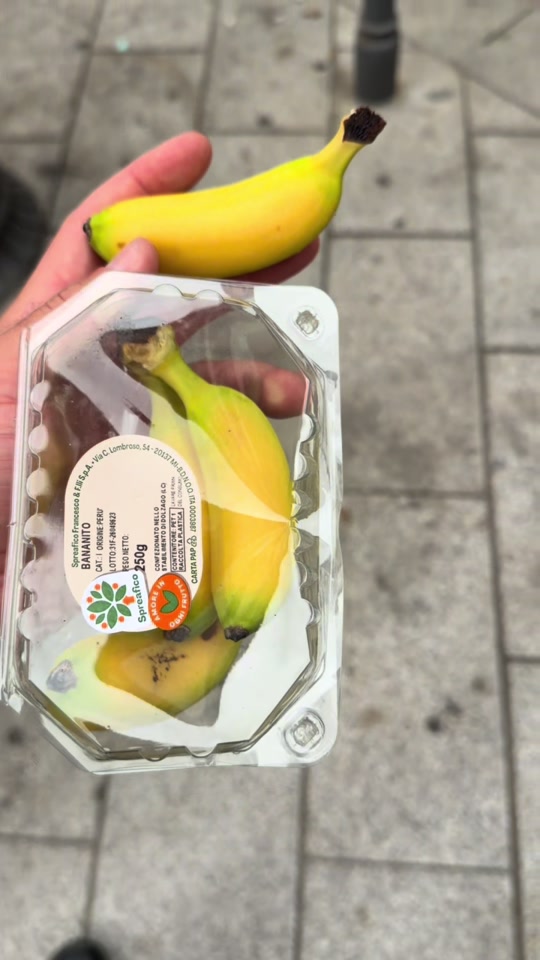
Mini bananas. Five euros fifty. Milan.
That is almost the whole video: a small banana in my hand, the pack underneath it, and my surprise at the price. The useful detail for understanding the number is on the label: BANANITO, 250 g.
If the €5.50 mentioned in the clip is the price of that 250 g pack, it works out to €22 per kilogram. The video does not show a receipt or shelf-price label, so that link between price and pack is an assumption, not an independently verified purchase record.
From €5.50 per pack to a price per kilo
The conversion is straightforward:
- 250 g ÷ 1,000 = 0.25 kg.
- €5.50 ÷ 0.25 kg = €22/kg.
- At the same rate, 100 g would correspond to €2.20 and 500 g to €11.
Those last quantities are arithmetic equivalents. They are not additional packs I bought, and they are not offers found in a shop. The calculation uses the labelled pack weight, not a measured weight of peeled fruit.

Compare the same amount before comparing the price
A package price tells us what that package costs. A price per kilogram lets us compare different pack sizes on the same scale. The EU’s consumer guidance explains unit pricing for precisely this purpose: helping people compare brands and quantities.[1]
For another product, the calculation is the same: price in euros ÷ weight in kilograms. If the label uses grams, divide the weight by 1,000 first. Compare €/kg with €/kg; a number marked €/100 g uses a different quantity.
The unit price does not decide whether the taste, size or convenience is worth it to you. It makes the amount of food behind the price clearer.
What this small purchase cannot tell us
This clip does not establish the average price of bananas in Milan. It also gives us no verified ordinary-banana price from the same shop, so there is no sound basis here for claiming a particular markup. The product name on the pack is not enough to identify a botanical cultivar, either.
The same care with the comparison matters in my Kosovo–Germany grocery-price article: the quantities behind the prices have to be clear before the result means much.
The small banana made the video. The 250 g on the label makes the calculation possible.
Sources and notes
-
[1] Your Europe: price per unit, EU consumer guidance, checked 17 October 2026. Used to explain comparison by quantity, not to assess a retailer’s legal compliance.
-
The original clip, published 8 October 2026, supplies the spoken €5.50 and Milan context; the original poster shows BANANITO 250 g. No purchase date, receipt, shelf price, competing offer or peeled weight is verified.
-
Calculation assumption: €5.50 buys the displayed 250 g pack. €5.50 ÷ (250 ÷ 1,000) = €22/kg; €22 × 0.1 = €2.20 per 100 g; €22 × 0.5 = €11 per 500 g. Inputs and source notes.
-
Original video and thumbnail: Eduard Luta on TikTok. Published 8 October 2026. Sources checked 17 October 2026.