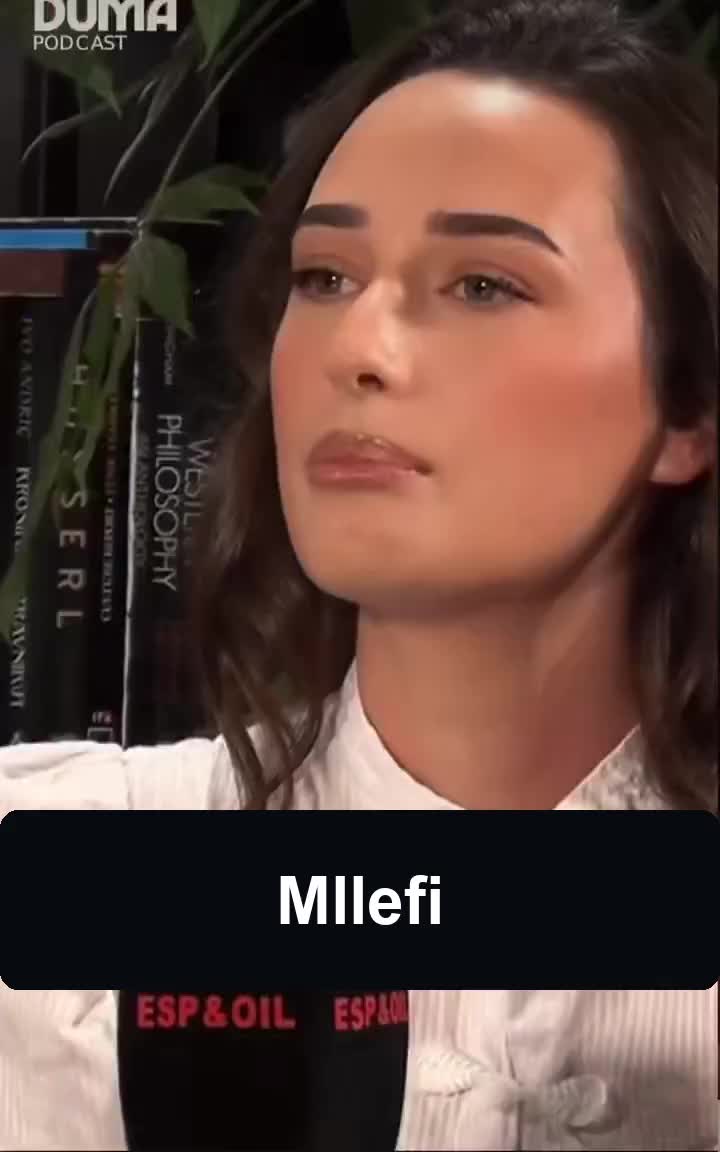
“Askush nuk do të ikë.” Nobody wants to leave.
The young woman in this clip says it twice. Then she describes a conversation with her brother: he had told her that she had made him want to book a ticket and come to protect her. A discussion about emigration suddenly becomes a conversation between siblings.
I shared the video with a question: what needs to change so young people have reasons to stay? That question matters more to me than deciding whether someone who leaves has made the right or wrong choice.
The recording carries the DUMA Podcast mark. These are the guest’s words and family experience, not mine. Her name and the original recording date have not been established here; 17 October 2026 is the date I shared the clip.[1]
An appeal for a future at home
She says she is 22. She is not presenting herself as someone with political training or a ready-made government. She asks for support and solutions, and explicitly resists turning the appeal into a search for another personality.
Her examples are concrete: universities, hospitals and violence. She argues that the problems are visible. The clip establishes what she is asking people to notice; it does not, by itself, verify the condition of every institution or explain a particular incident.
I hear the line about nobody wanting to leave as an appeal about belonging. It is not a survey of every Albanian’s plans. Some people genuinely want to study, work or build a life abroad. Others may love home and still see leaving as their best available option. Respecting both experiences makes the question about staying more honest.
Albania’s population decline: what the census shows
INSTAT’s published census comparison records 2,821,977 residents in 2011 and 2,402,113 in 2023.[2] The difference is 419,864 fewer residents, or 14.9% of the 2011 total, rounded to one decimal place.
| Census | Resident population |
|---|---|
| 2011 | 2,821,977 |
| 2023 | 2,402,113 |
| Change | −419,864 (−14.9%) |

This is a historical comparison between two censuses, not a current 2026 population estimate. It also does not mean that exactly 419,864 people emigrated.
Population change combines births, deaths, immigration and emigration. INSTAT identifies lower fertility and emigration as major drivers of Albania’s long decline.[3] A difference between two population totals cannot isolate the number who left, their motives or how many later returned. It is not a diaspora headcount either.
That distinction is the same reason I separate citizenship from identity when looking at Albanians in Germany. A number can be correct and still answer a different question from the one we think we are asking.
What would make staying a real choice?
The clip does not offer a complete policy programme. It does offer a useful place to begin: take the conditions she names seriously enough to ask what improvement would look like.
For a university, that might mean reliable teaching and a credible route from study to work. For a hospital, it might mean timely care and a clear explanation of where to go. For safety, it might mean being able to report harm and receive an accountable response. These are editorial examples of questions to ask, not findings that those services are uniformly absent or promises that one reform would stop emigration.

A useful public commitment should name the problem, the institution responsible, what will change and how people can check the result. Without those details, telling a young person to have patience asks them to carry all the uncertainty.
And the responsibility cannot be pushed entirely onto the family. A brother’s concern matters. So do the ordinary acts of care I describe in Albanian family values. But affection cannot replace functioning public services.
Leaving should not erase belonging
My caption speaks about distance from family, prejudice and the work of starting again. Those are the costs I wanted readers to consider, not a claim that everyone abroad has the same experience.
The answer is not to shame people into staying, or to insist that leaving solves everything. It is to take seriously the life someone wants to build and the choices actually available to them.
The image I return to is the brother and the ticket. Behind a debate about population, there is someone worried about his sister. That is a reason to listen before reaching for a slogan.
Staying should be a possibility people can trust.
Sources and notes
- [1] Video shared by Eduard Luta, 17 October 2026. The guest’s statements are attributed testimony. The DUMA Podcast mark is visible; her identity, the original recording date and wider interview context remain unverified.
- [2] INSTAT, Population and Housing Census 2023: Main Results, printed pp. 16 and 114, section 2.1.1. Calculation: 2,821,977 − 2,402,113 = 419,864; 419,864 ÷ 2,821,977 × 100 = 14.8784%, rounded to 14.9%. Published census totals; no adjustment for estimated census coverage is made here.
- [3] INSTAT, The population of Albania: population change, fertility and migration. Sources checked 18 October 2026. The second visual contains editorial questions, not survey results. Source data and calculations.