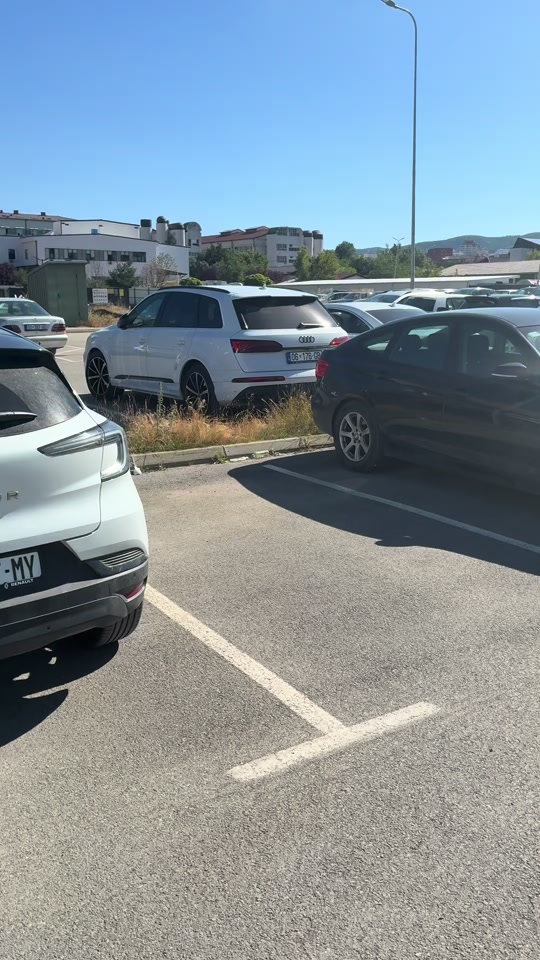
I am standing in the hospital parking area in Prishtina, pointing the camera at what is in front of me. There are available spaces. Then there are cars occupying the pavement, where somebody who is already unwell needs to walk.
That is the scene behind this video. It is an observation from that visit, not a count of every space on the grounds or a claim about the situation today.
What bothers me is how quickly a practical problem can become an argument about whose party is responsible. Meanwhile, the person trying to get through still has to get through.
Help the driver without forgetting the patient
In the clip I suggest having people guide drivers towards available parking. Politely. Somebody arriving at a hospital may be worried, confused or accompanying a person who needs help. Starting with clear guidance makes more sense to me than assuming everybody is acting out of contempt.
But understanding the driver’s situation does not make a blocked route usable. The person on foot must remain part of the decision. So must someone using a wheelchair, walking aid or assistance from another person.
The World Health Organization identifies inaccessible facilities as one of the barriers people with disabilities face in health care. Its guidance also stresses including disabled people in decisions and monitoring whether they benefit. That supports asking patients about the route, rather than judging success only by whether cars have been moved.[1]

What would a small trial require?
Here is a worked staffing example, not a proposed hospital budget. Suppose two guidance positions need to be covered simultaneously for eight hours. That is 2 × 8 = 16 staff-hours per day. Covering the same positions for twelve hours requires 24 staff-hours, an increase of eight hours, or 50%.
These are coverage hours, not a claim that two employees are enough for a complete rota. Breaks, leave, training, shift patterns and other duties would have to be added. No local wage rate or staffing cost has been verified for this example.

The people managing the site would need to choose lawful locations and responsibilities. Guidance should complement a clear pedestrian route, understandable signs, a suitable drop-off arrangement and appropriate enforcement. A friendly person cannot compensate for a layout that leaves nowhere sensible to go.
Measure the journey, not the argument
A useful trial could record blocked-route observations, requests for directions and feedback from patients before and during the change. Compare similar times of day and note unusual demand. Those would be new measurements; the video does not supply them.
Then ask a simple question: can someone get from arrival to the entrance without an avoidable obstacle? Include people who find that journey difficult, not only those who can step around a car.
I also say something positive about the hospital environment in the clip. Recognising a problem does not require pretending everything around it is a failure. My note on approaching institutions honestly comes from the same instinct: make the problem specific enough that somebody can help solve it.
The pavement is part of the hospital journey. Keep it available to the people who need it.
Sources and calculation notes
-
[1] WHO, Disability fact sheet, 7 March 2023: inaccessible health facilities, participation and monitoring. This is general context, not a local audit of the hospital.
-
Illustrative coverage: 2 positions × 8 hours = 16 staff-hours/day; 2 × 12 = 24; (24 − 16) ÷ 16 × 100 = 50%. Inputs and calculation. Positions, coverage periods and trial measures are editorial proposals, not adopted plans.
-
Original video and thumbnail: Eduard Luta on TikTok. Published 2026-06-16. Research checked 27 September 2026.