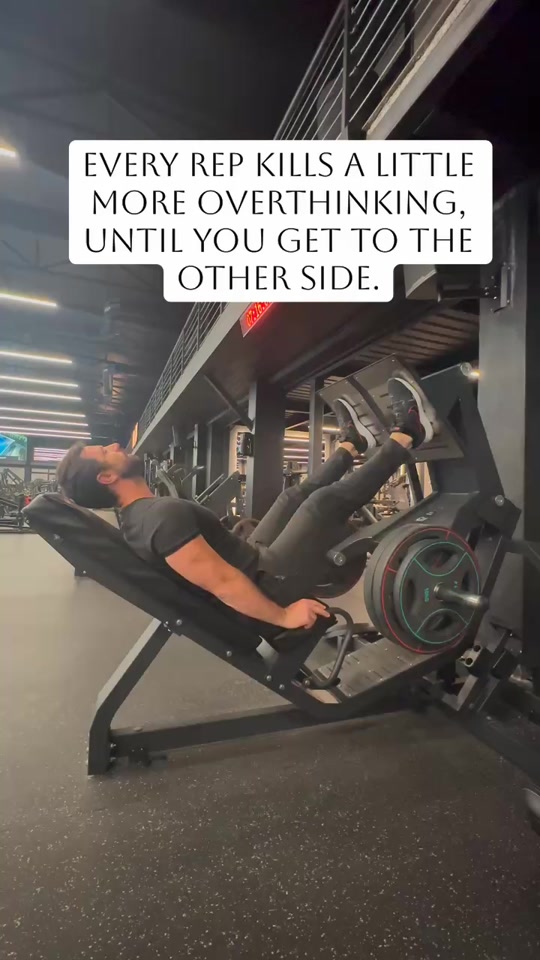
I am on the leg-press machine. Above the clip is a sentence about each repetition cutting through a little more overthinking. The caption asks you to imagine never reaching your potential because you kept getting in your own way.
It is a sharp sentence aimed at hesitation. For me, the useful contrast is between the perfect plan I can keep imagining and the next concrete action I can take. A repetition has a beginning and an end. For that moment, the task is clear.
Let the caption be motivation
“Every rep” is a metaphor, not a measured dose of relief. Fourteen seconds of training cannot show a change in anxiety, establish my full routine or prove that effort solves every difficulty. The amount of weight on this machine is not reliably established either.
WHO’s physical-activity guidance supports the broader value of movement, including mental-health benefits.[1] That gives exercise a place in a life; it does not turn this clip into treatment or make somebody who struggles less deserving of support.
The question I want to keep from the caption is: what action fits my circumstances today? Sometimes it is training. Sometimes it is a smaller, more manageable start. Rest and asking for help can belong in a responsible routine too.
Make the week visible
For adults aged 18–64, WHO recommends 150–300 minutes of moderate aerobic activity weekly, or 75–150 vigorous minutes, or an equivalent mix. It also recommends work for all major muscle groups on at least two days.[2]
Here are three arithmetic ways to total 150 moderate aerobic minutes:
| Number of periods | Minutes each | Weekly total |
|---|---|---|
| 5 | 30 | 150 |
| 3 | 50 | 150 |
| 10 | 15 | 150 |

The multiplication is 5 × 30 = 3 × 50 = 10 × 15 = 150. That does not prescribe any of these schedules to you, demonstrate identical effects or count a strength exercise as the whole aerobic recommendation. It simply turns a weekly number into something you can picture.
Potential needs somewhere to land
I do not know my potential as a final number waiting at the end of a graph. I can notice whether I keep making promises that never enter my calendar. I can also notice whether the plan is so demanding that I abandon it immediately.
A week I can return to is more useful than a dramatic day I cannot repeat. My HYROX training reflection carries the same connection between movement and feeling present, with a different kind of workout.
I do not have to finish thinking about my whole life before I begin one useful action.
Sources and calculation notes
-
[1] WHO: physical activity, 26 June 2024. Population-level health guidance, not a measured outcome from my clip.
-
[2] WHO Europe: physical activity recommendations, adult guidance. The table illustrates multiplication only. Reproducible calculations.
-
No load, repetition count, diagnosis or personal medical programme is inferred from the footage.
-
Original video and thumbnail: Eduard Luta on TikTok. Published 2026-05-18. Research checked 27 September 2026.