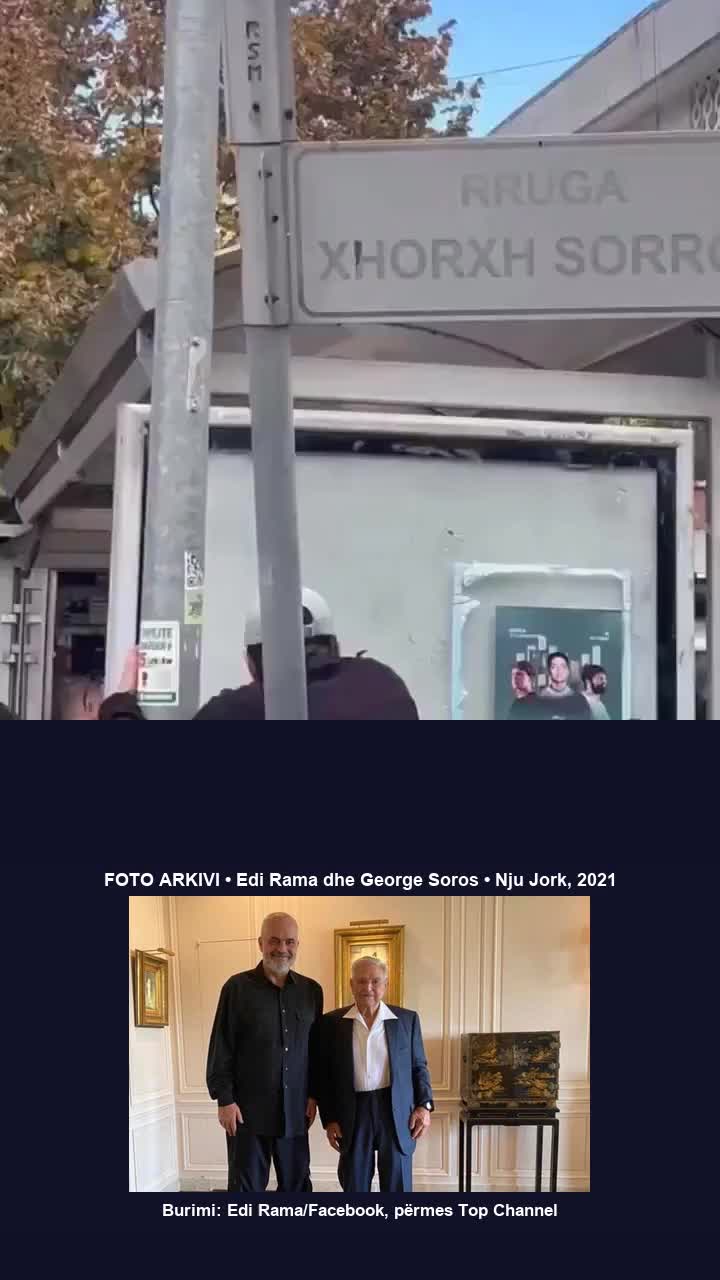
In the clip I shared, people reach up to a street sign reading “Rruga Xhorxh Sorros”. Hands grip the post and the sign. A name that usually sits above everyday traffic becomes the centre of an argument.
My caption asked whether this was simply about a sign or a bigger message. That is the question I want to keep open. Public space belongs in public debate, and the relationships around political power deserve scrutiny.
But the article also needs a distinction that the short caption did not make: the footage shows people trying to remove the sign. It does not establish an official street-name change. I published this edit on 17 October 2026; that is not a verified date for the underlying incident.[1]
What the George Soros street-sign video actually shows
The visible sign spells the name “Xhorxh Sorros”, referring to George Soros. The edit identifies the location as Tirana and places archival photographs of Edi Rama with George or Alexander Soros below the street footage. Those are separate images, labelled as archival material, rather than photographs of the street incident.
The narration goes further. It presents George and Alexander Soros as key supporters of Rama’s rise to power. That is a political claim in the video. The photographs alone do not establish the extent of anyone’s influence, how an election was won or whether a particular decision involved wrongdoing.
The available edit also does not identify the people handling the sign, establish their individual motives or show what happened after the recording. One action cannot stand in for the opinion of an entire country.

I can question power without filling those gaps with certainty. The question becomes stronger when the evidence is clear enough for someone who disagrees with me to inspect it.
A sign and an official name are different things
Albania’s Law No. 139/2015 assigns street naming to the municipal council in Article 54(ll). Article 19 provides for citizens’ requests, complaints and observations to local-government bodies.[2]
That distinction matters here. A physical sign can be pulled, damaged or removed while the administrative name remains unchanged. To establish a formal renaming, I would want the council’s decision, its date and the street it covers. The sources checked for this article do not establish such a decision for this incident.
There is also a deeper question: what should a place choose to honour? People can disagree about that without being excluded from the conversation. A name on a public street should be open to public explanation, including the reasoning behind the original choice and any proposed change.
Relationships deserve questions; claims still need evidence
There is a documented institutional history to examine. In its fact sheet dated 25 March 2021, Open Society Foundations says its Albanian foundation began work in 1992, initially supporting areas including health, education and scholarships.[3] This is the organisation’s account of its own activity, not an independent judgment of every project or political relationship.
That history neither settles the debate about influence nor proves the narration’s claim about Rama gaining power. For a specific allegation, the useful evidence would be specific too: a dated grant, a named recipient, a meeting record, a decision, a declared interest or a documented benefit. A photograph can show people together. It cannot, by itself, supply the terms of a relationship.
This is the same concern I explored in the article about Sazan, investment and public trust. Access is a reason to ask questions. The decisions and their consequences are where those questions become testable.

The three sets of records above are a way to organise an inquiry. They are not claims that a hidden agreement exists or that documents have already been obtained. If a public answer is incomplete, that incompleteness can be stated precisely and followed up.
What I mean by freedom here
The video closes with a line about Albanians gaining freedom, explicitly labelled “inspired by the thoughts of Sami Frashëri.” It should be read as a modern formulation used in this edit, not as an authenticated quotation from a named work of his.[1]
For this article, the point is the freedom to question, examine records and challenge decisions peacefully. A demand for accountability does not need intimidation or damage to make it legitimate. It needs an answer that the public can examine.
A street sign is a powerful image. What matters afterwards is whether the people who make public decisions are prepared to explain them.
Sources and notes
- [1] Original TikTok, published 17 October 2026; reviewed against the original captioned export and subtitles. The original incident’s date, participants, complete outcome and any official renaming remain unverified. Tirana is the location stated in the edit. The endcard says “inspired by,” not that the line is a documented Sami Frashëri quotation.
- [2] Law No. 139/2015 on local self-government, official regional-government copy: Article 54(ll), p. 19, and Article 19, p. 7. Used for the distinction between a physical sign and a council decision; this article does not establish the current administrative status of this particular street.
- [3] Open Society Foundations: Albania fact sheet, 25 March 2021. Institutional self-description, not independent verification of influence or the video’s causal claim. Sources checked 18 October 2026. The diagrams are qualitative editorial guides; no opinion poll, attendance count or measured political influence is implied. Source record and limits.