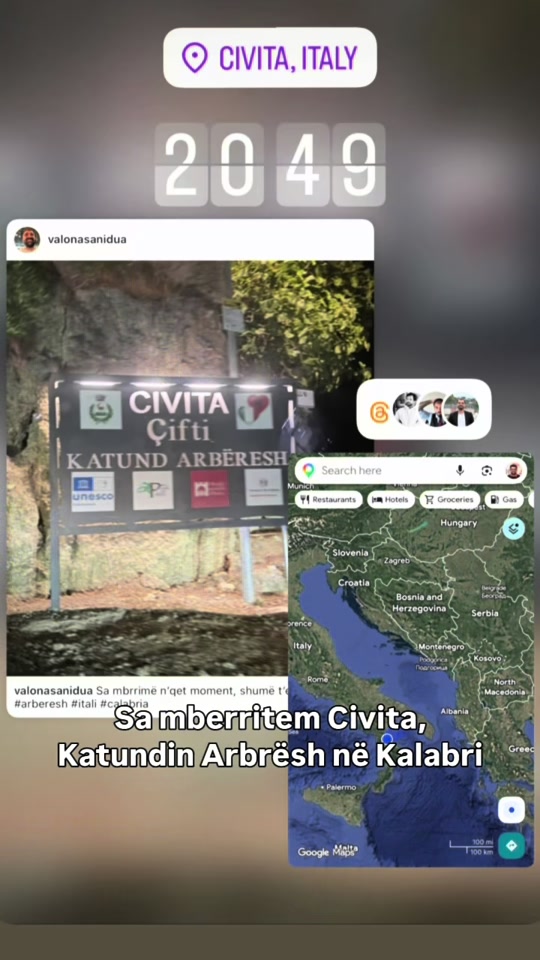
We arrive in Civita after dark, without knowing that the village is celebrating. Before we have even settled into the hotel, there is a surprise waiting for us: the Festa della Madonna del Rosario.
The journey into the village has not felt effortless. In the video, I comment on the narrow roads. I also describe trying to understand one another through a mixture of Albanian and Italian. Then the mood shifts towards the energy of the celebration and the feeling of encountering familiar roots in Calabria.
The sign in the opening image gives the village two names: Civita and Çifti. Beneath them are the words identifying it as an Arbëresh village. That is the beginning of the story I wanted to share.
An unexpected festival, with a date we can check
I name the celebration in the video as the Festa della Madonna del Rosario. There is independent evidence for the event: Civita’s municipal Ordinance 24, dated 9 October 2026, concerns traffic arrangements for festivities honouring Maria Santissima del Rosario on 10 and 11 October 2026.[1]
The video was published on 11 October. Its upload date is not, by itself, proof of exactly when every scene was recorded. But the municipal record corroborates the named celebration and its 2026 dates.
For a future visit, use the programme announced for that year. The clip describes the celebration as falling on the second Sunday in October; the verified notice gives us the dates of this edition, rather than a permanent timetable.
What I remember in the video is the unexpected encounter: the difficult arrival, the conversation and then the energy of a place celebrating together.
What “more than 550 years” means here
The caption reflects on a culture carried across more than 550 years. Italy’s official tourism portal places Albanian settlement in Civita around 1471; Calabria’s regional tourism site also gives 1471 in its account of the village.[2]
The arithmetic is simple: 2026 − 1471 = 555 calendar years. Because the settlement date is approximate in the national account, this is a way to understand the historical timespan. It is not an exact anniversary for every family, custom or word spoken in Civita.
Civita is in the province of Cosenza, in Calabria’s Pollino area. Knowing that location helps us place the encounter: an Arbëresh community with a long history in Italy and a continuing connection with the Albanian-speaking world.

Understanding each other does not require identical speech
One of the details I enjoy in the clip is the attempt to communicate. I describe us speaking Albanian and receiving Italian in reply, while still managing to understand one another.
That moment should not become a claim that everyone in Civita speaks the same language, or that all visitors will have the same experience. It is an encounter in the video.
The municipality’s explanation of Arbëresh helps give it context. The language varieties retain older features while also having developed locally, including through contact with neighbouring Romance speech.[3] A long history of transmission includes change.
So the interest is in listening closely: the words we recognise, the words we need help with and the ways people make themselves understood. This brings the feeling of roots into an ordinary conversation.
The work behind continuity
A festival makes culture visible for an evening. Other forms of work continue around it.
Italy’s Ministry of Culture dates Civita’s Museo Etnico Arbëresh to 1989. Its collection description includes local rural life, traditional clothing, photographs, material on Byzantine rites and a library of Albanian texts.[4] This is background for understanding the village, not a claim that I visited the museum in this clip.
The municipal language desk describes work with the administration, schools and cultural associations, with particular attention to younger people carrying the language forward.[5] Continuity involves people organising, teaching, documenting and using what they have inherited.

Familiar roots, a place with its own life
In the caption, I mention Mother Teresa, Skanderbeg and the double-headed eagle as signs of a history that feels close. They belong to my account of what caught my attention. Civita also deserves the time to be understood on its own terms: its local speech, neighbourhoods and celebrations.
That is what makes these journeys valuable to me. As in my walk through Vienna thinking about Albanian identity, recognition opens the door to learning more. And as in the everyday actions that carry family culture, the connection becomes tangible through what people do.
We came to reach a village. We found a celebration, a conversation and another reason to keep learning about the people who have carried this heritage forward.
Sources and notes
-
[1] Comune di Civita, Ordinance 24 of 9 October 2026, register 605/2026. Official record specifies the Rosario festivities on 10–11 October 2026; it does not establish the exact recording time or every future edition.
-
[2] Italia.it: Civita gives settlement around 1471; Calabria’s official tourism guide also uses 1471. Calculation: 2026 − 1471 = 555, a calendar-year difference using a historical reference date.
-
[3] Comune di Civita: La lingua arbëreshe, on retention, change and language contact.
-
[4] Italian Ministry of Culture: Museo Etnico Arbëresh, founding and collection description. Its older opening-hours fields are not treated as current visiting information.
-
[5] Comune di Civita: language-desk activities. Sources checked 15–16 October 2026. Source and calculation notes.
-
Original video and thumbnail: Eduard Luta on TikTok. Published 11 October 2026. Sources checked 16 October 2026.