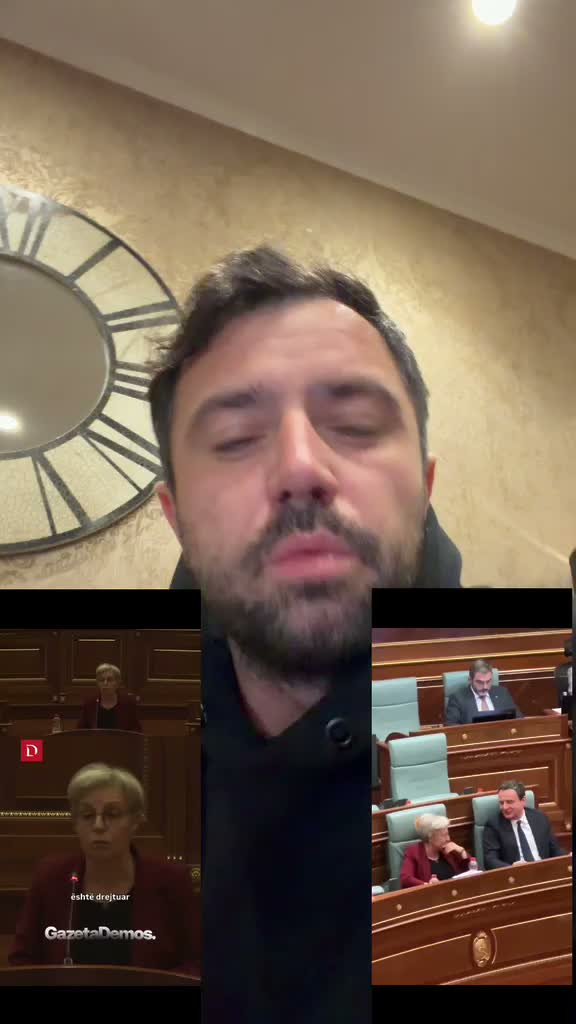
She asked for protection. Why are we discussing which door she knocked on?
In the parliamentary excerpt inside my video, Donika Gërvalla says: “Unfortunately, Arlinda did not approach the Government.” My reaction is to that sentence and the distinction it makes.[1]
A woman asking to stay alive should not need a personal route to political power.
The video is angry because the subject deserves seriousness. Arlinda is not an argument to win against another party. A request for protection is a responsibility to act on.
Keep the words and the evidence together
The clip includes Gërvalla saying that Arlinda approached the justice system and did not receive the protection she sought. She then suggests that approaching the Government might have brought engagement, while respecting the constitutional order. That conditional point should stay with the sentence I criticise.
Kosovo’s Assembly identifies Donika Gërvalla as justice minister in its account of the extraordinary session of 26 October 2026.[3] The Prime Minister’s published speech that day names Arlinda Sylaj Zekaj, says she was killed the previous day and had approached the Prosecution three days before her death. It calls for an investigation into possible institutional negligence or inaction.[2]
That is official context for the case. It is not a completed finding against a particular official. Determining who received which warning, what they knew and what they did requires the records and a proper investigation.

Another inset shows people in the chamber appearing to smile. I find the contrast with this subject upsetting. The short edit does not establish what they were reacting to or what they intended. I should not turn my reaction to an expression into a factual accusation about their motive.
The stronger criticism does not need that guess: the public discussion should return to the woman who asked for protection.
Institutional boundaries cannot become a maze for the victim
There is a real difference between demanding an answer from a minister and asking a minister to control an individual court decision. I want accountability without political interference in justice.
But respecting different responsibilities cannot mean sending the victim from one institution to another until nobody owns the risk. My question is not who can take credit after a tragedy. It is how protection reaches a person before it is too late.
The government’s Regulation 01/2025 calls for victim-centred, non-discriminatory local coordination and direct cooperation in specific emergencies.[4]

This framework does not prove how Arlinda’s case was handled. It gives the public a concrete standard to ask about: who coordinated, what protective action followed the warning and where the response broke down, if it did.
I do not want a woman’s safety to depend on knowing a minister, belonging to a party or finding the politically convenient door. Protection must be organised around the person in danger.
The call in my post has a date
My 27 October post announced a protest for Wednesday, 28 October 2026, at 16:00 in Zahir Pajaziti Square, Prishtina.[1] That is the announcement carried by the source video and caption. This article does not report that the protest has already taken place or establish its attendance.
The point goes beyond one afternoon. Ask for the investigation. Ask for the records. Ask what changes for the next woman who reports danger. The same insistence on a real answer to a public question has to survive the party argument.
I do not need the next victim to be someone from my own family before her life matters.
She asked for protection. The answer should have been protection.
Sources and notes
-
[1] Original post, shared 27 October 2026; full 115.933333-second source and original thumbnail reviewed on 28 October. Albanian commentary and parliamentary insets; automatic transcription is an aid, not a published verbatim transcript. The protest date/time is the creator’s announcement, not confirmation of occurrence or attendance.
-
[2] Prime Minister’s published speech, 26 October 2026, opening paragraphs. Official case account and call for investigation; no final finding of individual negligence or criminal guilt is inferred.
-
[3] Assembly’s extraordinary-session account, 26 October 2026. Session and minister’s role; the disputed sentence is attributed to the excerpt in the original video, not presented as an official full transcript.
-
[4] Government Regulation 01/2025, Articles 3–5 and 7.1.6. General framework; no case finding. Checked 28 October 2026.