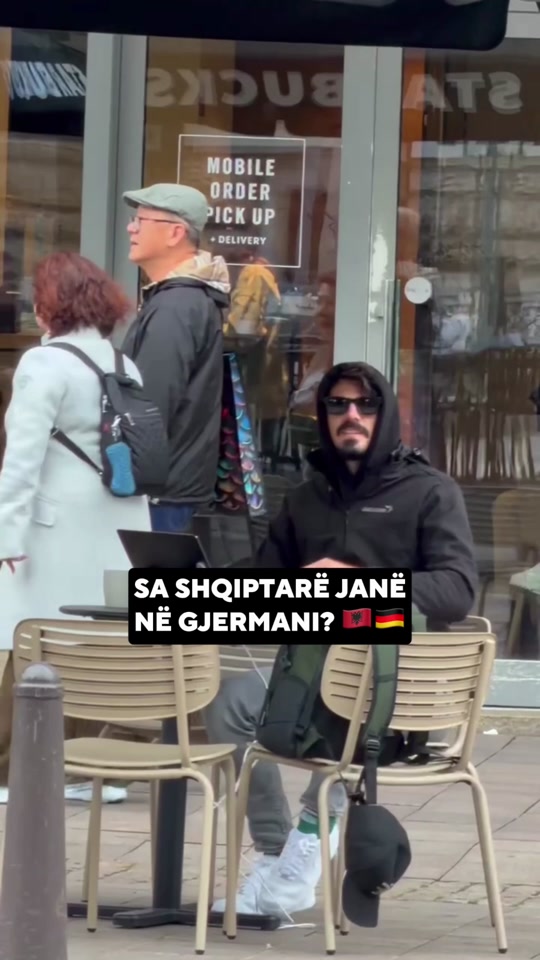
I start this video outside a café, with a laptop on the table and a question: how many Albanians live in Germany? A few cuts later, I am talking about likes, matches and families.
That is the journey I wanted to show. A large community can still contain people who have not found each other. An introduction can change that.
This is a promotional video for dua.com. I want people to try it. I also want the longer article to make room for something a short clip cannot do well: explain what the numbers actually measure.
108,000 registrations do not mean 108,000 people online
In the video I use roughly 1–1.2 million for the Albanian community in Germany and 108,000 for people registered on dua. The caption rounds the community estimate to 1.2 million and says more than 108,000 registrations. Those are claims made in the video, not a new population survey or an independently audited platform report.
There is a dated public reference for the registration figure. dua’s Germany article reports 107,715 registered members in Germany who identified as Albanian in July 2026. That is first-party company data. It provides context for the rounded number in this September video; it does not verify an exact increase between the two dates.
Registration also tells us nothing by itself about how many people logged in today, are currently single, or are looking for the same kind of relationship. And the broader diaspora estimate is not a suitable denominator for an app adoption rate. I explored the population-counting problem separately in Albanians in Germany: More Than a Headcount.

What 35,000 likes a day would add up to
The clip and caption report more than 35,000 likes daily. To make that scale understandable, take 35,000 as a fixed illustrative baseline. At that level, seven days would produce 245,000 like events; thirty days would produce 1,050,000.
That million is arithmetic, not a newly discovered monthly statistic. It requires the same level every day. The same person can send several likes, so a million like events does not mean a million different people.

The daily activity figures are described as activity among Albanians. The post does not supply a reporting period, a database extract, or a clear Germany-only filter for those events. I therefore do not divide them by the German registration count or label the chart “activity in Germany”.
A match is an opening, not an outcome
dua’s own matching instructions make the distinction clear: both people must like each other for a match, which opens a chat. A like expresses one person’s interest; a match records mutual interest. Neither tells us whether a conversation continued.
There is also a small wording conflict in the source. The video’s on-screen text says up to 1,000 matches per day; the caption says over 1,000. Those are different claims. For the calculation below, 1,000 is simply an assumed daily level, not a verified average or a lower bound.

It would be tempting to divide 1,000 by 35,000 and call the result a success rate. That would mix rounded figures, potentially different populations and actions that need not occur on the same day. It would tell a more precise story than the evidence supports.
The part that matters has names
At the end of the clip, I point to couples’ stories. One of the cards names Gentiana and Xhemajl. Their published account on dua connects Berlin and Hamburg: they describe meeting through the app, becoming engaged in October 2024 and marrying in Prishtina in July 2025.
That is a company-published personal story, not a representative sample. It gives a human example of what I mean; it cannot establish the clip’s broader claim about hundreds of families or your probability of finding a partner.
For someone thinking about Albanian dating in Germany, this is the useful question: can you meet a person whose language, intentions and everyday life make sense alongside yours? A shared background can start the conversation. It still takes two people to build the relationship.
If that is what you are looking for, explore dua.com. Be clear about what you want, and read the person behind the profile.
The number that changes your life may be one.
Sources and calculation notes
-
Source claims: original video, caption and visible overlays reviewed. “Up to” and “over” 1,000 conflict; no precise average is inferred. Activity geography, reporting window and an audited family total are not supplied.
-
Dated platform context: dua’s Germany page, July 2026 member snapshot. Company-reported registrations; not active-user or official population data.
-
Definitions and example: dua Help: matching; Gentiana and Xhemajl. First-party sources, with the relationship account treated as a testimonial.
-
Calculations: 35,000 × 7 = 245,000; × 30 = 1,050,000. Separately, 1,000 × 7 = 7,000; × 30 = 30,000. Constant-rate scenarios, not forecasts or measured monthly results. Download inputs and assumptions.
-
Original video and thumbnail: Eduard Luta on TikTok. Published 2026-09-28. Research checked 28 September 2026.