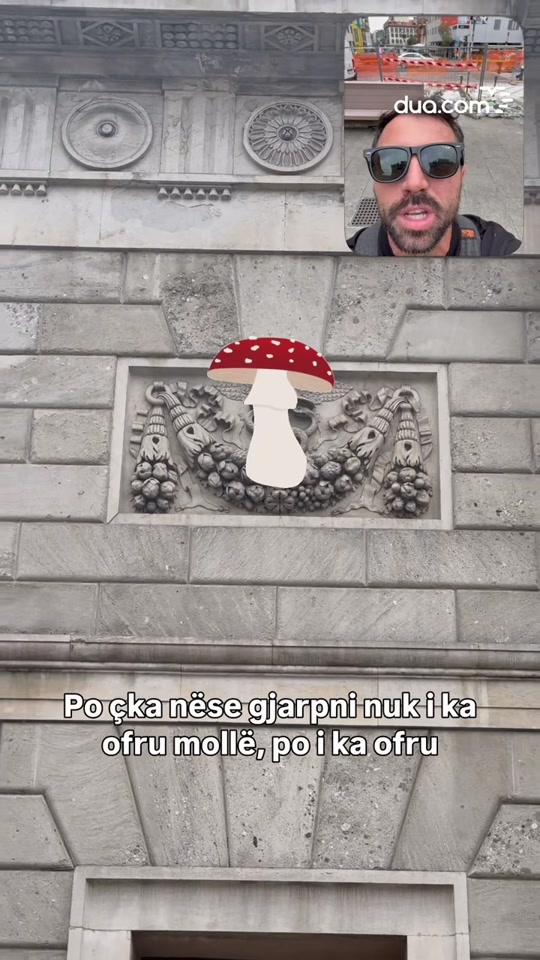
In the video, I ask what happens when we question the stories we grew up hearing. Adam, Eve, a serpent, a forbidden fruit: familiar images can become so familiar that we stop asking where the details come from.
I then suggest a different story involving a mushroom, spiritual awakening and an escape from captivity. That is speculation. The texts examined here do not establish it as an ancient account or a historical event. Putting a question mark after an idea does not supply the evidence it would need.
The useful part of the question is where it sends us next: back to the sources.
Does Genesis actually say apple?
Genesis 3 names fruit from a tree, without identifying it as an apple or a mushroom. The woman takes and eats it, then gives some to her husband. The chapter describes opened eyes and, later, departure imposed by God; it does not describe a successful escape organised by Eve.[1]
This is a small reading exercise with a large consequence. Removing a detail that the passage never supplied does not prove whichever alternative we prefer. If apple is not specified, mushroom has not therefore been confirmed.
There are three different questions here: what the passage says, how someone interprets it, and what someone imagines beyond it. We can explore all three, provided we keep their labels attached.

What changes in a Gnostic reading?
Gnosticism is an umbrella term for diverse ancient religious ideas and groups, not one institution with a single agreed version of every story. Yale scholar Dale B. Martin makes that distinction in his lecture on early Christianity.[3]
One relevant text is The Hypostasis of the Archons, also called The Reality of the Rulers. It portrays ignorant rulers and a female spiritual principle teaching through the serpent. Yet Adam and his wife are still expelled from the garden. Its garden passage names no mushroom.[2]
That gives us something more interesting than a blanket claim that the Gnostics believed my version. A particular work rearranges authority and knowledge in a familiar narrative. We can study that rearrangement without treating every detail in a modern retelling as if it came from the manuscript.
The video’s language about the world as an illusion is likewise a spiritual interpretation, not an established description of reality. Reading a tradition carefully means allowing it to be more specific than a short caption.
Where the mushroom idea belongs
In this clip, the mushroom is a thought experiment. The mushroom graphic placed over the stone façade is part of the video’s presentation; it is not archaeological evidence for the claim.
To argue for a historical connection, I would need an identifiable source that actually supports it. Resemblance, a striking image and a story that feels meaningful cannot do that work by themselves. The same standard should apply to a familiar explanation and to an exciting alternative.
This is why reading the beliefs we build our lives on matters. Reading lets us notice when we have combined a text, a remembered explanation and our own imagination into one apparently seamless story.

Keep the curiosity, improve the question
A better question is precise: where does this claim appear, and what does that passage actually allow us to say? Compare the surrounding sentences. Name the work. Notice when the argument moves from interpretation to a claim about events.
It is possible to find an interpretation moving without claiming it happened. It is possible to learn from a religious text without accepting every belief expressed in it. Neither requires dismissing people who read differently.
That is the kind of independent thinking that can still respect expertise I want to practise: curiosity that remains willing to correct its own favourite idea.
The invitation in the video is to question. This article adds the responsibility to check the answer.
Sources and notes
-
[1] Genesis 3, NRSVUE, especially verses 2–7 and 22–24.
-
[2] The Hypostasis of the Archons, translated by Bentley Layton, The Nag Hammadi Library in English (1988), printed pp.164–165. This page paraphrases the garden passage; it does not reproduce the translation.
-
[3] Dale B. Martin, Open Yale Courses, lecture 26, on the diversity covered by the category Gnosticism.
-
Read on 16 October 2026. The mushroom scenario is the video’s speculation, not a conclusion supported by these texts. Source and visual notes.
-
Original video and thumbnail: Eduard Luta on TikTok. Published 9 October 2026. Sources checked 16 October 2026.