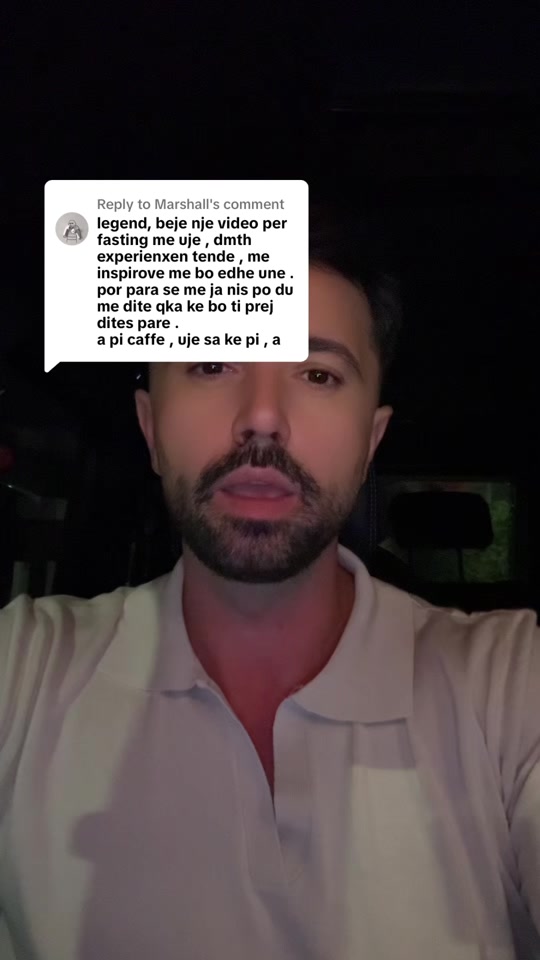
A viewer asked what I actually do when fasting: what I drink, how I begin and what the experience feels like. My 4 June reply runs for almost ten minutes. It mixes practical anecdotes, reflections about focus and spirituality, and medical assertions that need a separate standard of evidence.
The personal part is clear. I describe more time away from meals, a difficult period of hunger, then a feeling of calm and space to reflect. I talk about memories, emotions and a sense of connection while meditating. Those are reports of my experience. They do not establish what another person will feel, or prove a treatment works.
Research note, 28 September 2026: the original video includes unsupported claims about curing cancer and eliminating parasites. The evidence checks below are added context. Do not use the recording as a treatment plan or stop prescribed care because of it.
First, be clear about what the video describes
Although I use the term “water fasting”, I mention coffee and tea as well as water. That is not a strict water-only account. My drinks, exercise routine and way of returning to food are personal anecdotes, not validated instructions for a reader to copy.
There is also a clock correction. The example of eating from noon to 18:00 leaves six hours for eating and 18 hours until noon the following day. It is not a 14-hour interval. That calculation clarifies the words in the video; it is not a recommended schedule or a safety claim.

What autophagy does—and what this account cannot show
The Nobel Assembly describes autophagy as a cellular process that breaks down and recycles components. Its role in responding to nutrient deprivation does not establish a universal hour when a person has been “cleaned”, nor demonstrate that memories or emotions are released by that mechanism. The video contains no biological measurements that could establish such a connection. Nobel background.
Feeling clearer is a valid description of a feeling. It is not a laboratory result. The meaningful personal observation can stand without attaching a medical explanation that has not been demonstrated.
Cancer and parasites require clinical evidence
The National Cancer Institute says there is no proof that popular diets, foods, supplements or herbs can cure cancer, slow it or prevent its return. This video does not establish fasting as an effective cancer treatment. Anyone receiving cancer care should discuss dietary changes with their oncology team. NCI’s explanation.
The claim that everybody has parasites, and that fasting or garlic clears them, is not established by the recording either. CDC describes diagnosis based on the suspected infection, symptoms, exposure and appropriate tests. A feeling of improvement does not identify an organism or demonstrate eradication. CDC diagnostic guidance.
A prolonged fast has risks beyond willpower
NIDDK identifies low blood glucose as a major fasting risk for people with diabetes, alongside concerns including dehydration and dangerous high glucose when medication is changed inappropriately. Do not change prescribed medication to imitate a social-media routine; discuss fasting with the clinician managing it.
Returning to food can also need clinical oversight. NICE treats little or no intake for more than five days as a reason for particular caution when nutrition is reintroduced, with additional criteria for high refeeding risk. That is not a declaration that shorter fasts are safe. A watermelon-and-soup anecdote is not a clinical refeeding protocol.
Before considering a prolonged fast, seek qualified medical advice about your circumstances. Feeling unwell is not a test of discipline to push through.
The part of the video worth preserving as a personal account is the experience of slowing down and reflecting. Someone interested in that can make room for a walk, a quiet break or journaling without using prolonged food restriction as the route. Meaningful reflection does not require an unproven medical claim.
Sources and calculation notes
-
Nobel Assembly: autophagy; NCI: popular diets, supplements and cancer; CDC: diagnosis of parasitic diseases.
-
NIDDK: fasting safely with diabetes; NICE CG32, recommendations 1.3.2 and 1.4.5–1.4.8. No medication, fluid, electrolyte or refeeding doses are prescribed here.
-
Clock arithmetic: 18−12 = 6 hours; 24−6 = 18 hours. It describes the example in the video, not an endorsed regimen. Inputs.
-
Original video and thumbnail: Eduard Luta on TikTok. Published 2026-06-04. Research checked 28 September 2026.