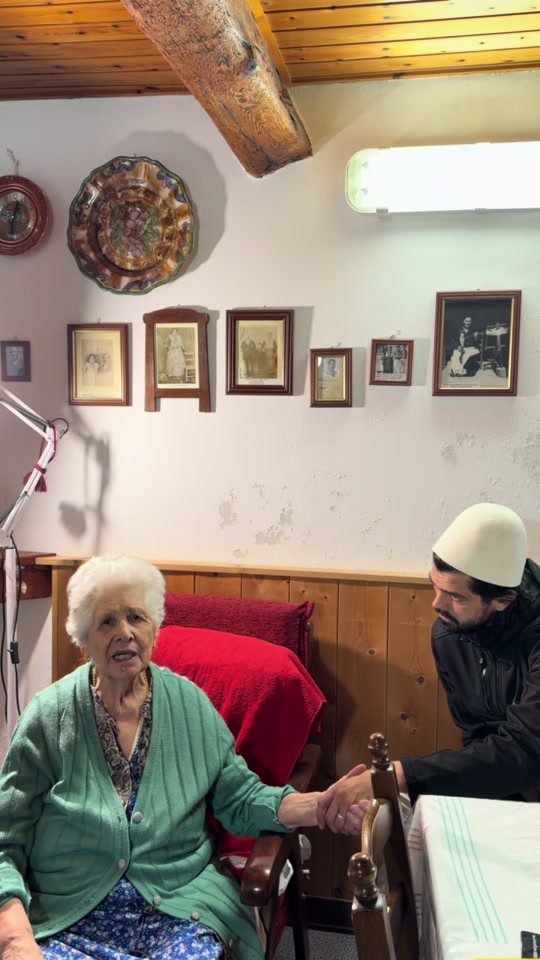
Rina Bellusci is singing, and we are holding hands.
That is the moment I wanted to share from our journey through the Arbëreshë villages of Calabria. In the introduction, I speak about visiting Civita and Frasnitë, and about how learning more of our history and traditions deepens my attachment to being Albanian. Meeting Rina became one of the most meaningful parts of that journey.
I describe the song as bringing tears to our eyes. The video then gives her voice time. There is no need to rush past the performance to explain the emotion. Listen to her.
Rina Bellusci, and the knowledge carried by a voice
In the video, I introduce Rina as the sister of the late Father Antonio Bellusci. Her contribution also has a written record. Researcher Ornela Radovicka describes gathering Caterina, known as Rina, Bellusci’s stories, songs and place names for a book, preserving the local Arbëresh speech of Frasnitë, or Frascineto. Radovicka explains that this involved repeated listening and work with recordings in the Bellusci library.[1]
That detail matters. Rina is someone with a repertoire, memories and a way of speaking that deserve careful attention in their own right.
A written text can record words. Hearing a person adds pronunciation, pacing, melody and the way they give a phrase its weight. The hand held in the video adds something else: this is a meeting between people, with the song at its centre.

Arbëresh is a living language with its own history
Civita’s municipality describes Arbëresh as the Albanian language varieties spoken in Italy by descendants of earlier migrants. It notes both retained features and changes developed over time, including contact with surrounding Romance varieties.[2]
That is a useful way to listen. We can recognise a connection without expecting every word to sound like the Albanian we speak today. Difference is part of the history of these communities.
Calling the language preserved should not make it sound frozen. People kept speaking it while living their lives in Italy. They developed local forms, passed on songs and made choices about what to transmit. A conversation today belongs to that ongoing life.
This is close to what I explore in Albanian family values in everyday actions: culture is carried by things people actually do. In this room, one of those things is singing.
Connected roots, distinct names
The caption brings together Albanians, Arbëreshë, Arvanites and Arnauts as an expression of connection. These names still need their own context.
Arbëreshë refers to historic Albanian communities in Italy. Arvanites belongs to a different history in Greece; linguist Lukas Tsitsipis studies Arvanitika as an Albanian variety in contact with Greek.[3] A language connection does not determine how an individual describes their national identity.
Arnaut is a historical Turkish name for Albanians, rather than the name of another village community in Calabria. Anthropologist Stephanie Schwandner-Sievers discusses that term and how historical labels can carry the assumptions of the people using them.[4]
For me, the feeling of shared roots should lead to more curiosity about people’s particular stories. It should make us more willing to hear the names they use for themselves.

What remains after the emotion
The University of Calabria’s account of its Albanological collections offers a concrete example of preservation work. The Giuseppe Gangale collection donated in 1979 included books, manuscripts and audio recordings concerning Italo-Albanian communities. The university later catalogued and transferred its field recordings to another audio format.[5]
A recording survives because someone keeps it, describes it and makes it possible to find again. The voice needs a name. The place and language variety matter. So does being clear about what is known and what has not been established.
That is why this page names Rina and connects the performance with the work documenting her knowledge. I have not assigned the song an unverified title or date of composition, and I am not presenting an uncertain transcription as its lyrics. The original video lets you hear the performance itself.
My reflections on belonging between countries come back to the people who make a place feel close. This meeting adds a voice to that feeling.
I wanted to share what it was like to be there. Rina’s song is the part to stay with.
Sources and notes
-
[1] Ornela Radovicka, “Antroposofia arbëreshe, rrëfime nga Caterina Bellusci”, Dielli, 22 May 2024. The researcher’s first-person account of collecting Rina’s oral material; no current age is inferred.
-
[2] Comune di Civita: La lingua arbëreshe, for retained features, local development and language contact.
-
[3] Lukas D. Tsitsipis, A Linguistic Anthropology of Praxis and Language Shift, Oxford University Press, 1998; public abstract on Arvanitika and Greek.
-
[4] Stephanie Schwandner-Sievers, Albanians, Albanianism and the strategic subversion of stereotypes, Anthropological Notebooks 14(2), 2008, p. 56, on the historical term Arnaut.
-
[5] University of Calabria: Albanological collections, Giuseppe Gangale collection. Sources checked 15–16 October 2026.
-
Song lyrics are not reproduced. The cards provide listening prompts and terminology, not population estimates or claims about everyone’s identity. Source and visual notes.
-
Original video and thumbnail: Eduard Luta on TikTok. Published 13 October 2026. Sources checked 16 October 2026.