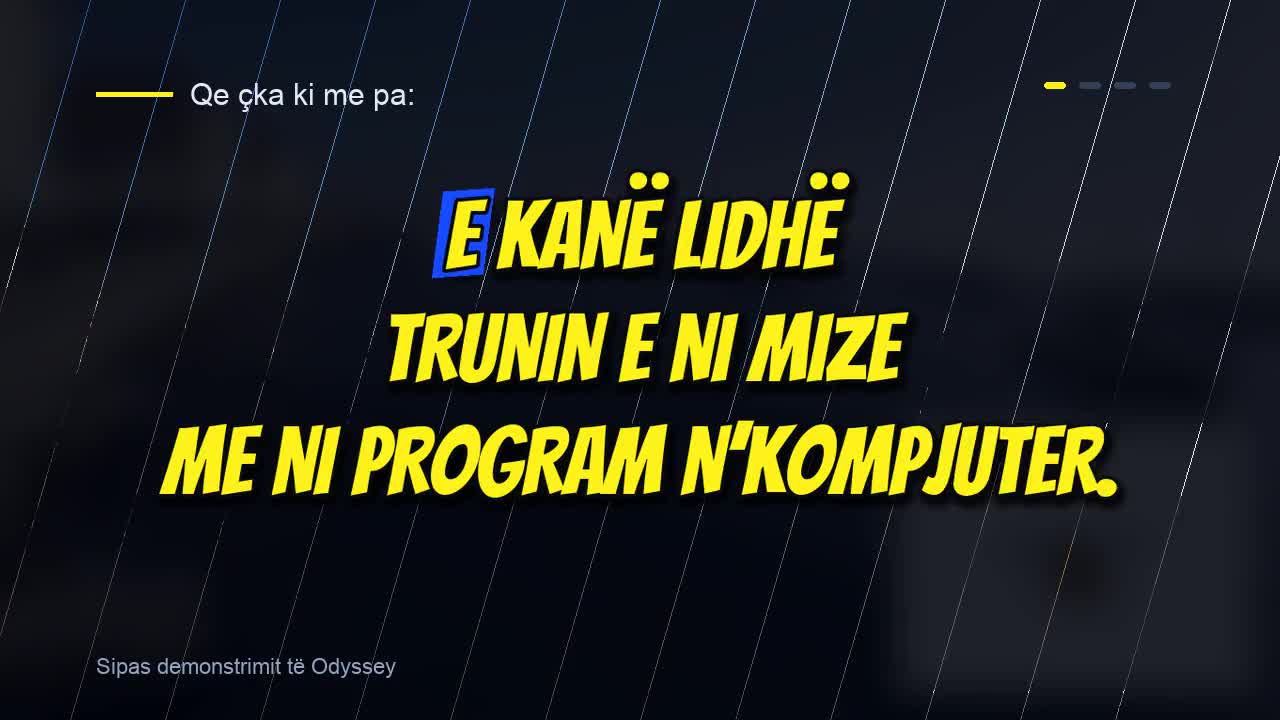
A small fly appears in the corner of the screen. Behind it, the view moves past water, boats and buildings. The scene has the texture of a place you could visit, but the video presents it as a generated world.
I shared it with the question: if we lived in a virtual world, could we tell? The Matrix ending makes that question playful. It does not turn the clip into evidence that our universe is a simulation.[1]
What makes the demonstration worth discussing is closer to the screen: an environment can look convincing while leaving important questions about how it works unanswered.
What Odyssey says about the fly
In its original post on 17 October 2026, Odyssey says it put a fruit-fly brain inside Odyssey-3 and shows a fly moving through generated environments.[2] That is the company’s description of its demonstration.
The short post does not identify the brain implementation or provide a method for validating its biological fidelity. It does not establish that a living brain was physically connected to a computer, that an entire animal was uploaded, or that the virtual fly is conscious. Those would be additional claims requiring additional evidence.
The introductory wording in my edit is simplified. In the article, I want the distinction to remain visible: we have a company’s demonstration and an attributed description, not a complete neuroscience paper.
What a world model contributes
Odyssey describes Odyssey-3 as a model that generates environments and predicts how they change in response to actions and events. Its October 2026 release explains that previous observations and new inputs help determine what appears next.[3]
A useful way to read the scene is to separate three things: the environment on screen, whatever controls movement, and the resulting change in view. The social clip does not disclose every connection between those components.

That separation helps us ask better questions. Is the movement chosen independently? What information does the controller receive? Can the same initial situation be repeated? What happens when the scene presents something unexpected?
Those are questions for a fuller demonstration. A smooth journey through a harbour cannot answer all of them by itself.
Looking real is only one test
Odyssey’s own CaliBench research makes a useful distinction: a plausible individual video and a simulator that reproduces the right range of outcomes are different achievements.[4]
Take a fair six-sided die. The theoretical probability of any particular face is 1 ÷ 6 = 16.67%, rounded to two decimal places. Across 600 independent rolls, the expected count for each face is 600 × 1/6 = 100. That is an expectation, not a promise that every face appears exactly 100 times.
| Question | What would help answer it? |
|---|---|
| Does one roll look convincing? | Inspect the movement and final face. |
| Does the simulator represent a fair die? | Repeat the experiment and compare the outcome frequencies with 1/6. |
A beautifully rendered die that lands on six every time would be visually persuasive and statistically wrong for that example. This is a theoretical illustration, not a result measured from the fly video, and CaliBench is not presented here as validation of the fly’s brain.

The same discipline belongs in ordinary AI use. A good-looking answer can earn attention. It still needs the right test for the job. That is why I prefer learning AI with a real project and an inspectable result to treating a striking demonstration as the final evaluation.
The reality question can stay open without becoming a claim
The fly gives the philosophical question a vivid form. If an agent receives only information from a generated environment, how could it identify what lies outside that environment? It is a thought experiment worth discussing.
But showing that people can generate a scene does not show that our own surroundings were generated. Nor does movement on a screen establish an inner experience. The clip gives us neither a test of our universe nor a measure of the fly’s awareness.
I can be impressed by the demonstration and still want to see its methods. In fact, that is the more interesting response: keep the curiosity, then ask what evidence would change the conclusion.
Enjoy the strange little world. Keep the observation separate from the story we build around it.
Sources and notes
- [1] Video shared by Eduard Luta, 18 October 2026. The reviewed 42.8125-second edit contains Albanian explanatory cards, the harbour demonstration and a humorous Matrix ending.
- [2] Odyssey’s original fly post, 17 October 2026. Its text was verified in the preserved original-post record; a fresh direct X fetch was unavailable. The brain connection is attributed to Odyssey, not independently validated here.
- [3] Odyssey, Meet Odyssey-3, 8 October 2026. General model description; it does not document the fly experiment’s full implementation.
- [4] Odyssey, Introducing CaliBench, 10 August 2026. The fair-die calculation is illustrative: 1/6 × 100 = 16.666…%; 600 × 1/6 = 100 expected occurrences per face. No fly-performance data is inferred. Sources checked 19 October 2026. Source notes and calculation.