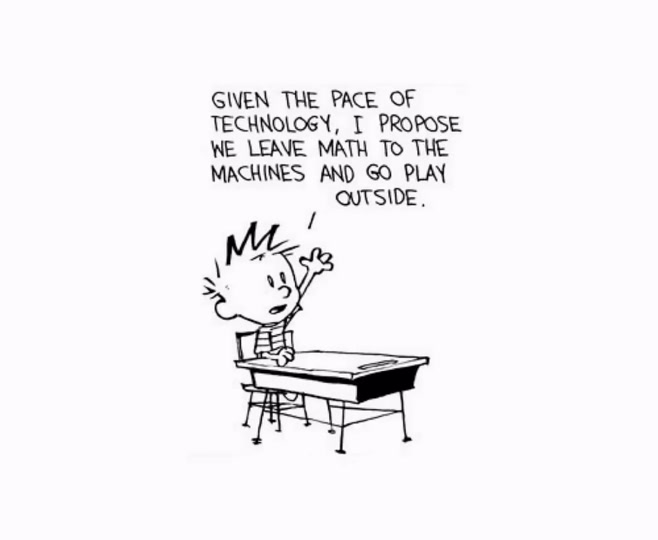
Calvin is sitting at a school desk, hand raised, making a proposal that is suspiciously convenient for Calvin: let the machines handle the maths, then go outside.[1]
I shared the panel because the joke feels fresh in a world where AI can produce an answer before we have finished reading the question. There is something attractive in it. If a tool takes a task off my hands, why would I insist on doing everything the old way?
But I keep coming back to a smaller question: am I trying to finish this task, or learn how to do it?
The answer on the screen is only one result
For a finished task, a useful tool can save work. For learning, I also want something to remain with the person after the tool is gone.
In a 2023 Turkish-school trial, GPT Base raised practice scores but lowered later unaided scores; guarded GPT Tutor showed no significant unaided difference.[2]

These are setting-specific point estimates.
That distinction is enough to make me pause before treating a completed worksheet as proof that I understand the topic.
Use the tool and keep a test for yourself
My practical response would be simple: try the problem, ask for help with the part that blocks me, then close the answer and attempt another problem myself. This is my suggested check, not a routine shown in the cartoon or a tested intervention of my own.
I would want to explain why the answer makes sense, not only repeat the number. If I cannot do that yet, I know where the next piece of work is.
This connects with learning AI through a real project: make something concrete, inspect what happened, and stay involved in the thinking.
Calvin’s proposal still makes me smile. Tools should give us room to live. I just want to keep enough understanding to know what I am handing over.
Let the machine help. Keep the part that lets you question it.
Sources and notes
-
[1] Original TikTok post, 20 October 2026. Bill Watterson’s Calvin and Hobbes panel is retained in the original thumbnail/video; no additional comic panels reproduced. The caption dates it to 1992; the cropped source does not independently establish its publication date. The MP4 has no audio stream.
-
[2] Bastani et al. 2025, Table 1; author manuscript, p. 10. Calculation: 100×(0.321−0.054)=26.7%;0.054÷0.321×100=16.82%. Checked 21 October 2026.