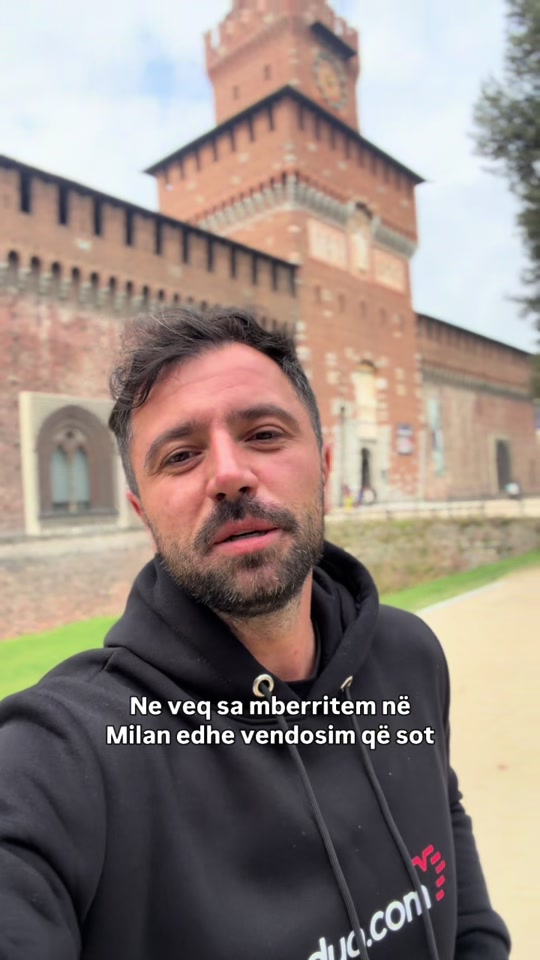
We had just arrived in Milan. Behind me were the brick walls and tower of Castello Sforzesco. In front of the camera, I had a much simpler plan for the evening: meet some of our people.
The video invited Albanians living nearby, including members of dua.com, to come for coffee, food and a conversation. I wanted to put faces to a community I knew was there.
This is the invitation from 8 October 2026, kept here as part of the journey. It is not an announcement of an upcoming event.
The invitation: a place and a time
The card in the original video named Chunk Milano, Ripa di Porta Ticinese 55, with a meeting window of 18:30–20:00 on 8 October.[1] That is an hour and a half set aside for getting to know one another.
There was no complicated pitch in the invitation. If you were nearby and had time, come, have a coffee and say hello. The recording captures that invitation; it does not tell us how many people attended or what happened afterwards.

What do we mean by “Albanians in Milan”?
In the clip, I mention estimates for the Albanian community and for dua.com users. Those figures are not independently verified here. A community can feel large while its exact size still depends on what we are counting.
Start with the place. The municipality of Milan and the Metropolitan City of Milan are different geographic units. The latter includes 133 municipalities.[2] A number for the wider territory cannot simply be labelled a number for the city itself.
Then ask what “Albanian” means in the data. Milan publishes resident statistics by citizenship.[3] Citizenship is a legal category; it does not describe every person’s family roots or cultural identity. Istat’s census methodology also distinguishes citizenship from migration background, using information such as parents’ places of birth.[4]
Finally, app users are a different group again. Without a dated definition of location and activity, a platform count cannot tell us how many people live in a city or would attend a gathering.

Those distinctions matter when publishing a statistic. They were not a condition for being welcome at the table. The invitation was simply to meet.
The castle in the background
The setting has its own history. The castle’s official account describes its rebuilding under Francesco Sforza and the court of later Sforza rulers, during the period when Leonardo da Vinci worked in Milan.[5]
I also mention Skanderbeg in the recording. The specific military-support link I describe has not been established by the sources checked for this article, so I leave it as an unverified statement in the original video.
What stays with me about this arrival is the urge to connect. I wanted to see the city, but I also wanted to meet the people who call it home. That same curiosity appears in the Milan street-art moment from this trip: a place becomes more interesting when you pay attention to what is already happening around you.
Sources and notes
- [1] Original video and invitation card, published 8 October 2026. Date, venue and time are the announced details, not evidence of attendance. Calculation: 20:00 − 18:30 = 90 minutes.
- [2] Città Metropolitana di Milano: Territorio e Comuni: 133 municipalities; page updated 24 March 2026.
- [3] Comune di Milano: residents by citizenship and other characteristics, dataset coverage 2012–2025. Used to identify the statistical category, not to calculate an Albanian population total.
- [4] Istat: 15th population census methodology, fascicle 3, printed p. 34: citizenship and migration background are distinct dimensions.
- [5] Castello Sforzesco: official history. Research checked 17 October 2026. Sources, calculation and limits.